
What This Calculator Does
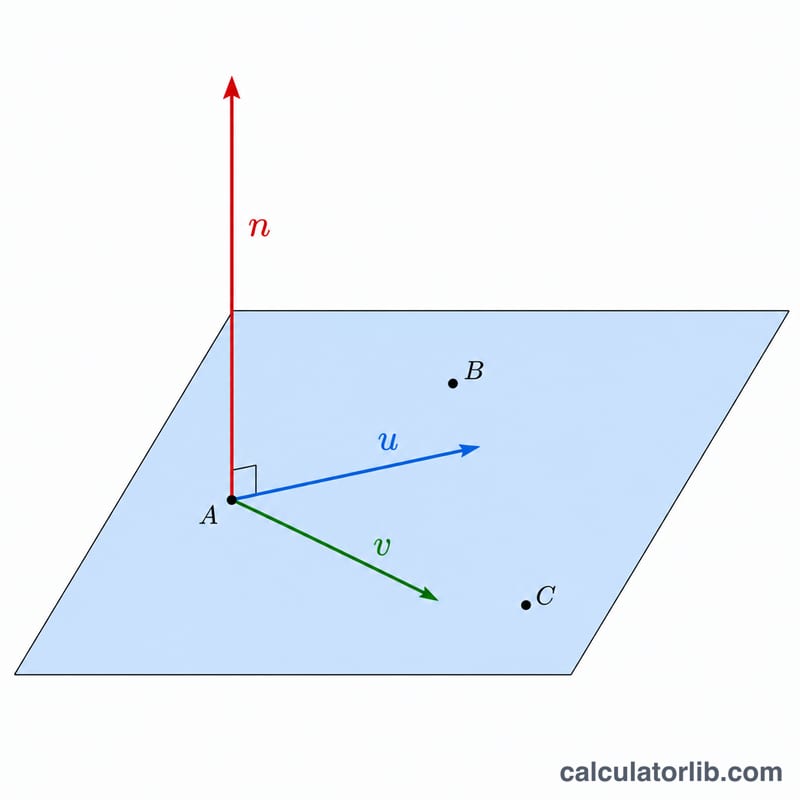
This tool finds the equation of a plane in three-dimensional space that passes through three given points A, B and C. The result is expressed in the standard general form \(ax + by + cz + d = 0\), where (a, b, c) is a vector perpendicular (normal) to the plane and d locates the plane in space. Three non-collinear points uniquely determine a single plane, which is exactly what this calculator returns.
How To Use It
Enter the x, y and z coordinates of each of the three points. The values are plain real numbers (positive, negative or zero) — there are no units to convert. Press calculate and the tool returns the four coefficients a, b, c, d along with the fully formatted plane equation. If your three points happen to lie on a single line (or two of them coincide), no unique plane exists and the calculator will tell you so.
The Formula Explained
First build two edge vectors of the triangle: \(\vec{u} = B - A\) and \(\vec{v} = C - A\). Their cross product \(\vec{n} = \vec{u} \times \vec{v}\) gives a vector normal to the plane, and its components are the coefficients a, b and c:
$$a = u_y v_z - u_z v_y, \quad b = u_z v_x - u_x v_z, \quad c = u_x v_y - u_y v_x.$$Because point A lies on the plane, we solve for d by substitution: \(d = -(a\cdot x_A + b\cdot y_A + c\cdot z_A)\). Any scalar multiple of the equation describes the same plane, so the raw cross-product coefficients are perfectly valid.
Worked Example
Take \(A = (1, 2, -2)\), \(B = (3, -2, 1)\), \(C = (5, 1, -4)\). Then \(\vec{u} = (2, -4, 3)\) and \(\vec{v} = (4, -1, -2)\). The cross product gives $$a = (-4)(-2) - (3)(-1) = 11, \quad b = (3)(4) - (2)(-2) = 16, \quad c = (2)(-1) - (-4)(4) = 14.$$ Finally $$d = -(11\cdot 1 + 16\cdot 2 + 14\cdot(-2)) = -15.$$ The plane is \(11x + 16y + 14z - 15 = 0\). Checking point B: \(33 - 32 + 14 - 15 = 0\). Correct.
FAQ
What if the points are collinear? Then the cross product is the zero vector \((0, 0, 0)\) and infinitely many planes contain the line — there is no unique answer, so the calculator reports the degenerate case.
Why is my answer different from another tool? Likely just a scale or sign difference. Multiplying every coefficient by the same nonzero number gives the identical plane, so \(11x + 16y + 14z - 15 = 0\) and \(-22x - 32y - 28z + 30 = 0\) are the same.
Can I use decimals? Yes — any real coordinate works, and the coefficients will be computed exactly from your inputs.