
What this calculator does
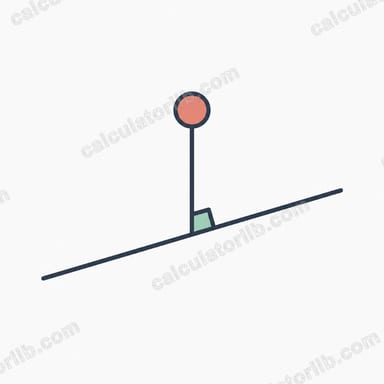
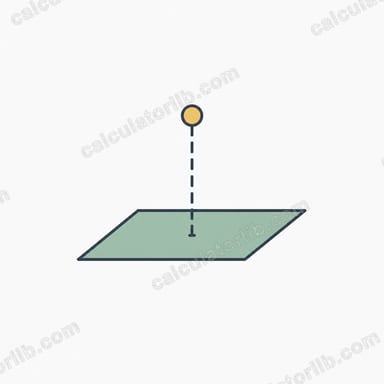
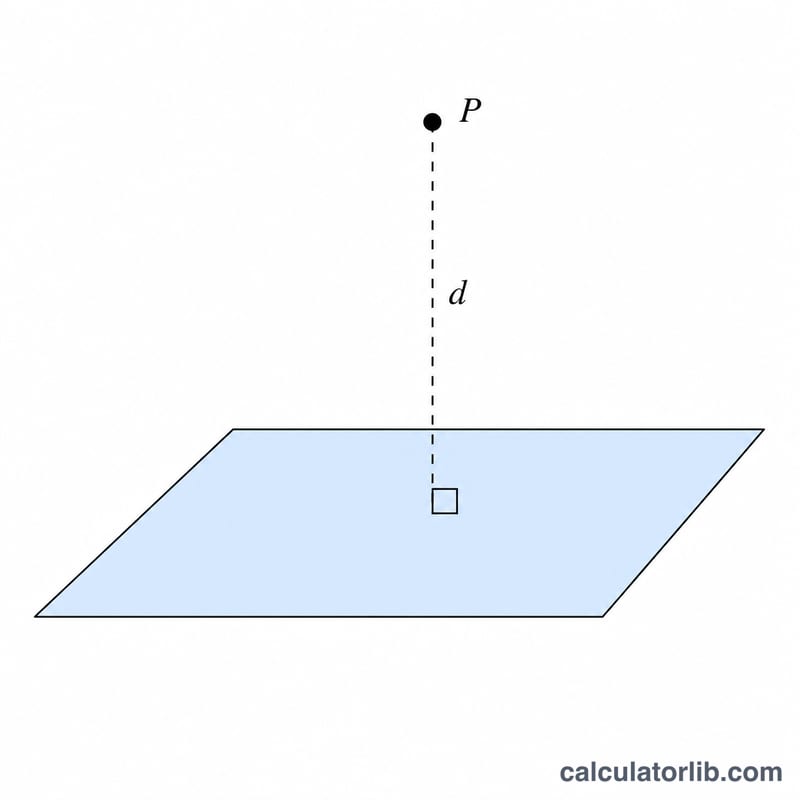
This tool computes the shortest (perpendicular) distance in three-dimensional space between a single point and a flat plane. The point is given by its coordinates (x0, y0, z0), and the plane is described by the general linear equation \(a\cdot x + b\cdot y + c\cdot z + d = 0\), where (a, b, c) is the plane's normal vector. The result is a non-negative number expressed in the same units as your coordinates.
How to use it
Enter the three coordinates of your point, then enter the four constants of the plane equation: the coefficients a, b, c (the components of the normal vector) and the constant term d. Press calculate. The tool returns the distance L along with the numerator and denominator so you can verify each step. All inputs are plain real numbers and may be negative or decimal.
The formula explained
The signed value of the plane equation evaluated at the point, \(a\cdot x_0 + b\cdot y_0 + c\cdot z_0 + d\), measures how far off the plane the point sits, scaled by the length of the normal vector. Dividing by the magnitude of that normal vector, \(\sqrt{a^2 + b^2 + c^2}\), normalizes the measurement into true distance units, and the absolute value guarantees a non-negative answer. A distance of exactly 0 means the point lies on the plane.
$$D = \frac{\left| a\,x_0 + b\,y_0 + c\,z_0 + d \right|}{\sqrt{a^2 + b^2 + c^2}}$$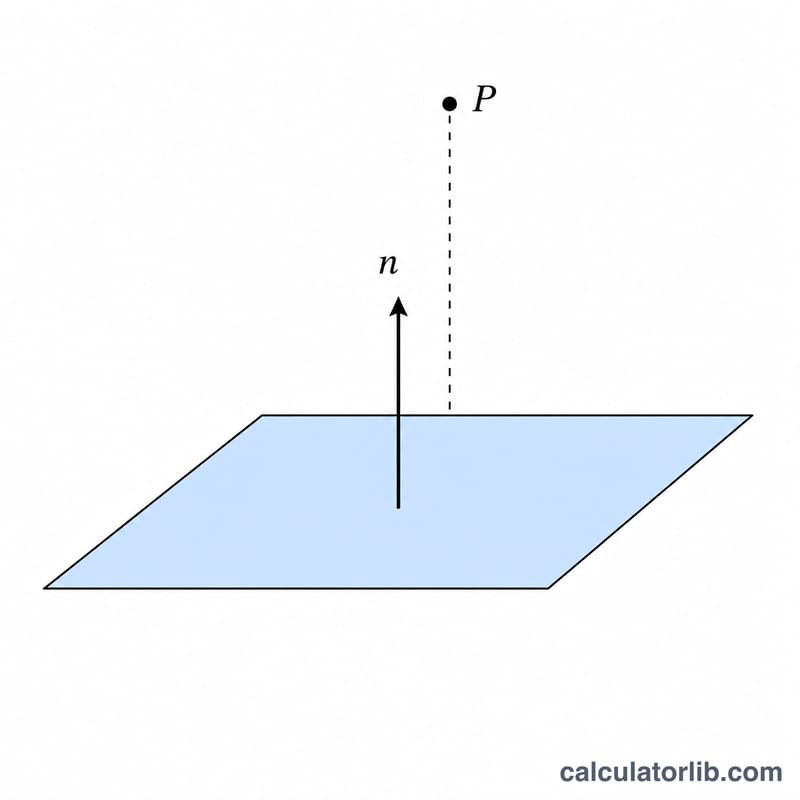
Worked example
Take the point (1, 2, 3) and the plane \(2x + 4y + 3z + 5 = 0\). The numerator is \(|2\cdot 1 + 4\cdot 2 + 3\cdot 3 + 5| = |24| = 24\). The denominator is \(\sqrt{2^2 + 4^2 + 3^2} = \sqrt{29} \approx 5.3851648\). So $$L = \frac{24}{5.3851648} \approx 4.4565820.$$
FAQ
Can the distance be negative? No. The absolute value in the numerator makes the result always zero or positive.
What if a, b and c are all zero? Then there is no valid plane because the normal vector has zero length, and the distance is undefined. The calculator guards against dividing by zero.
Do I need to normalize the plane equation first? No. The division by the magnitude of the normal vector handles normalization automatically, so any scalar multiple of the same plane gives the same distance.