
What this calculator does
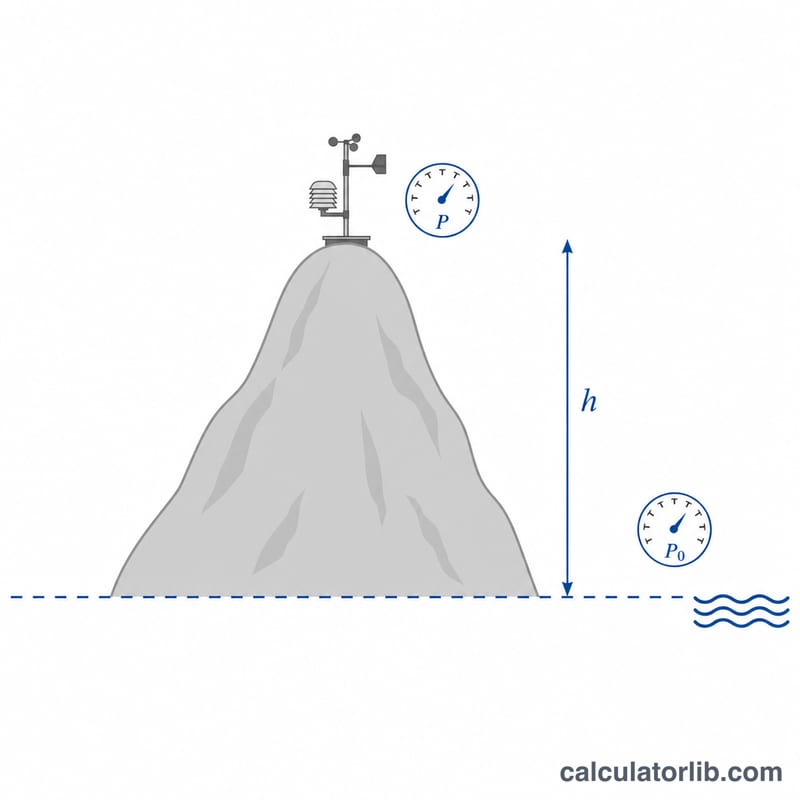
This tool reduces (corrects) a barometric pressure measured at a station's actual altitude to the equivalent pressure that would be read at sea level. Because air pressure naturally falls with height, two weather stations at different elevations cannot be compared directly. By correcting each reading to sea level, meteorologists obtain comparable values used in surface weather maps and altimeter settings (the QNH/QFF family of reductions). This is universal physics based on the barometric formula and is not specific to any country.
How to use it
Enter three values: the station's altitude above sea level in meters, the pressure measured at that station in hectopascals (hPa), and the local air temperature in degrees Celsius. The calculator converts temperature to Kelvin, applies a standard lapse rate, and returns the sea-level pressure (P0) in hPa.
The formula explained
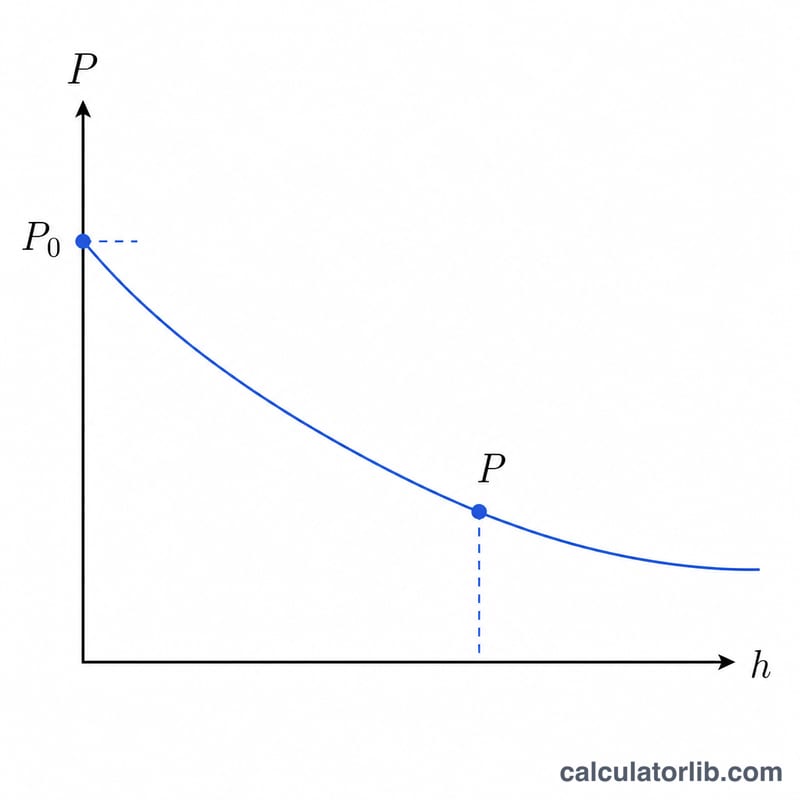
The reduction uses $$P_0 = P \left(1 + \frac{a \cdot h}{T_K}\right)^{\frac{g}{aR}}$$ where \(a = 0.0065\ \text{K/m}\) is the standard temperature lapse rate, \(g = 9.80665\ \text{m/s}^2\) is standard gravity, \(R = 287.05\ \text{J/(kg}\cdot\text{K)}\) is the specific gas constant for dry air, and \(T_K = T_{^{\circ}\text{C}} + 273.15\) is the absolute temperature. The exponent \(\frac{g}{aR}\) evaluates to about \(5.2558\). When altitude is zero the factor becomes 1, so \(P_0\) equals \(P\).
Worked example
For \(h = 1000\ \text{m}\), \(P = 980\ \text{hPa}\), \(T = 15\ ^{\circ}\text{C}\): \(T_K = 288.15\ \text{K}\); \(a \cdot h = 6.5\); inner term \(= 1 + \frac{6.5}{288.15} = 1.022557\); raising to \(5.25579\) gives a factor of \(1.12440\); $$P_0 = 980 \times 1.12440 \approx 1101.9\ \text{hPa}$$
FAQ
How accurate is this? It assumes a standard lapse rate and is accurate to roughly 1 hPa for altitudes up to a few thousand meters under near-standard conditions.
Which units must I use? Altitude in meters, pressure in hPa, temperature in °C. The output is in hPa, the same unit as the input pressure, because the correction is a dimensionless multiplier.
What happens at sea level? With \(h = 0\) the correction factor is exactly 1, so the sea-level pressure equals the entered station pressure.