
What Is the Drake Equation for Love?
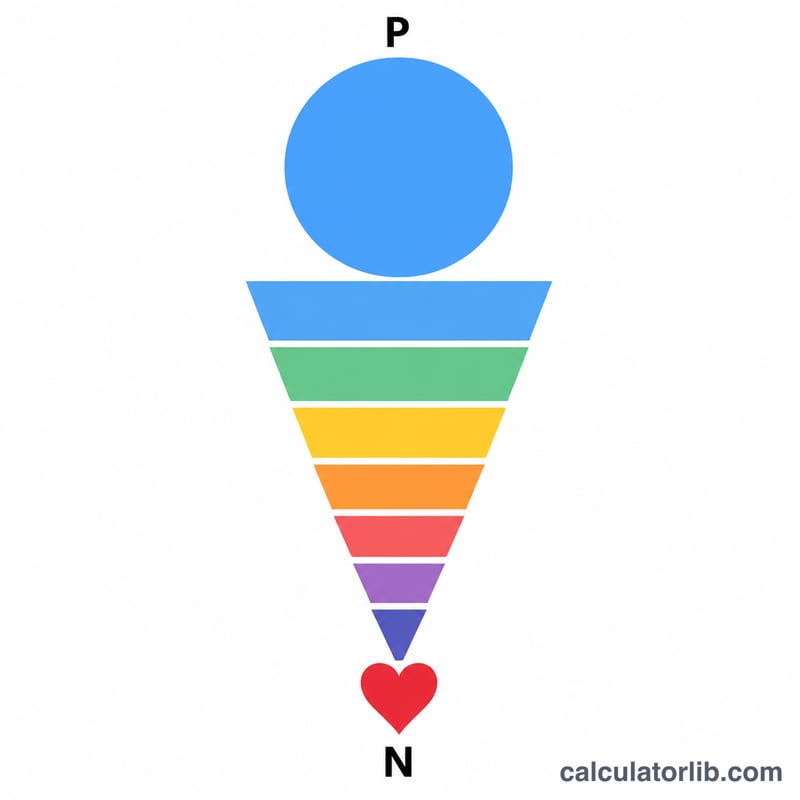
The original Drake Equation estimates the number of communicative alien civilizations in our galaxy. This playful adaptation borrows the same chained-probability idea to estimate how many potential romantic partners could realistically exist around you. Starting from your city's population, it filters down step by step until only the people who could plausibly be "the one" remain.
How to Use It
Enter the population of your city or dating pool, then estimate each percentage: how many are in your preferred age range, live near you, you'd find attractive, are single and available, and would likely be interested in you back. The calculator multiplies them all together and reports the estimated number of partners plus your rough "1 in N" dating odds.
The Formula Explained
$$N = P \times f_{\text{age}} \times f_{\text{loc}} \times f_{\text{att}} \times f_{\text{avail}} \times f_{\text{like}}$$ Each percentage is converted to a fraction (divided by 100) before multiplying. Because the fractions compound, even modest filters shrink the pool dramatically — which is exactly why finding a great match can feel rare.
Worked Example
Suppose your city has 1,000,000 people. 25% are in your age range (0.25), 50% live near you (0.50), 18% you'd find attractive (0.18), 50% are single (0.50), and 5% might like you back (0.05). $$N = 1{,}000{,}000 \times 0.25 \times 0.50 \times 0.18 \times 0.50 \times 0.05 = \textbf{562.5}$$ potential partners — about 1 in 1,778 people.
FAQ
Is this scientifically accurate? No — it's a fun thought experiment inspired by astronomer Frank Drake's equation, not a validated dating model.
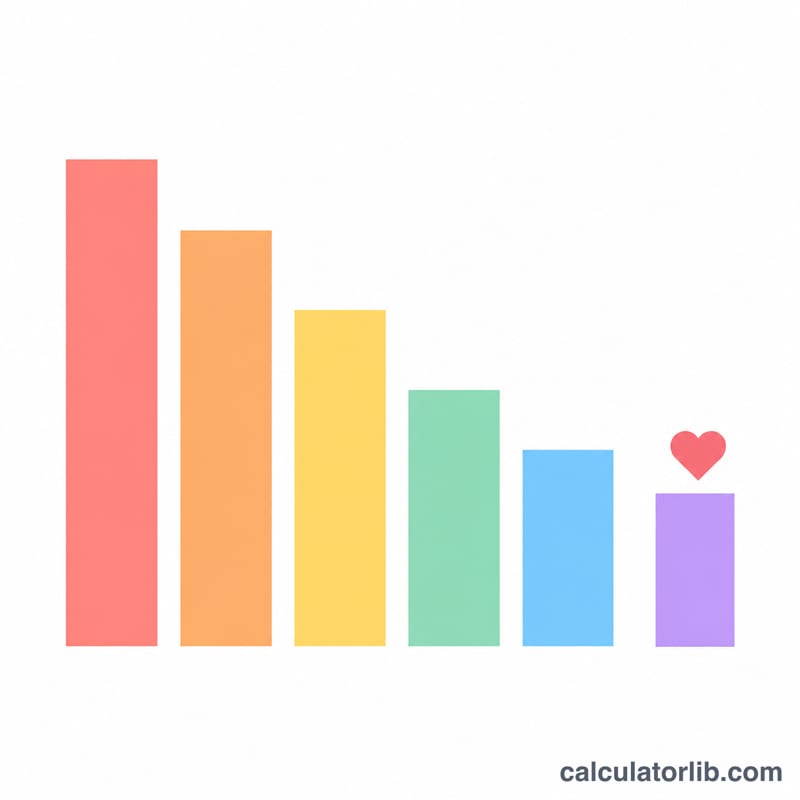
Why does my number get so small? Multiplying several percentages together compounds quickly, so each additional filter sharply reduces the result.
Can the result be a fraction? Yes. A value below 1 simply means the pool is so filtered that, statistically, fewer than one ideal match is expected — try widening your criteria.