
What this calculator does
The 3D Printer Buy vs Outsource Calculator helps makers, engineers, and small manufacturers decide whether to invest in their own 3D printer or send jobs to a print service bureau. It compares the total in-house cost of owning and running a printer against the cost of outsourcing the same number of parts, and it tells you the exact break-even quantity where buying becomes the cheaper option.
How to use it
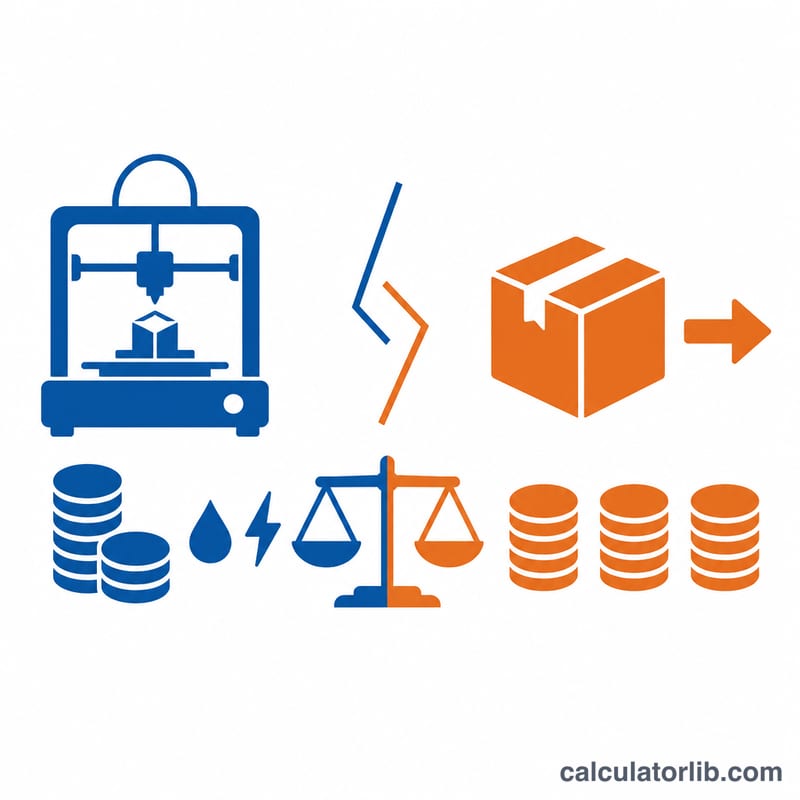
Enter the upfront printer price (you can fold in any tooling or setup you only pay once), your estimated material cost per part, the energy cost per part, the price an outsourcing service charges per part, and the number of parts you plan to produce. The calculator returns your in-house total, the outsource total, the savings of the cheaper option, and the break-even part count.
The formula explained
In-house cost grows from a fixed base plus a small variable cost per part:
$$\text{BuyCost} = \text{PrinterPrice} + (\text{MaterialPerPart} + \text{EnergyPerPart}) \times \text{Parts}$$
Outsourcing is purely variable:
$$\text{OutsourceCost} = \text{PricePerPart} \times \text{Parts}$$
Setting them equal and solving for Parts gives the break-even quantity:
$$\text{Break-even Parts} = \frac{\text{PrinterPrice}}{\text{PricePerPart} - \text{MaterialPerPart} - \text{EnergyPerPart}}$$
If the per-part outsource price is not higher than your per-part running cost, owning a printer never pays back and the calculator flags that there is no break-even.
Worked example
Printer price $1,000, material $2/part, energy $0.50/part, outsource $5/part, 500 parts. In-house = $$1000 + (2 + 0.5) \times 500 = 1000 + 1250 = \$2{,}250.$$ Outsource = $$5 \times 500 = \$2{,}500.$$ Buying saves $250. Break-even = $$\frac{1000}{5 - 2 - 0.5} = \frac{1000}{2.5} = 400 \text{ parts}.$$
Buy vs Outsource Across Different Volumes
The scenarios below hold the equipment and per-part costs fixed and vary only the number of parts produced. The example uses a printer price of $800, material cost of $1.50 per part, energy cost of $0.10 per part, and an outsource price of $4.00 per part. In-house cost is the printer price plus variable cost per part times quantity; outsource cost is simply the per-part price times quantity.
The in-house variable cost is \(1.50 + 0.10 = \$1.60\) per part. Each part outsourced costs $4.00, so every part made in-house instead saves \(4.00 - 1.60 = \$2.40\) toward recovering the $800 printer. Break-even occurs at \(800 \div 2.40 \approx 334\) parts.
| Parts | In-house total | Outsource total | Cheaper option |
|---|---|---|---|
| 100 | $960 | $400 | Outsource |
| 334 | $1,334 | $1,336 | Break-even |
| 400 | $1,440 | $1,600 | Buy |
| 500 | $1,600 | $2,000 | Buy |
| 1000 | $2,400 | $4,000 | Buy |
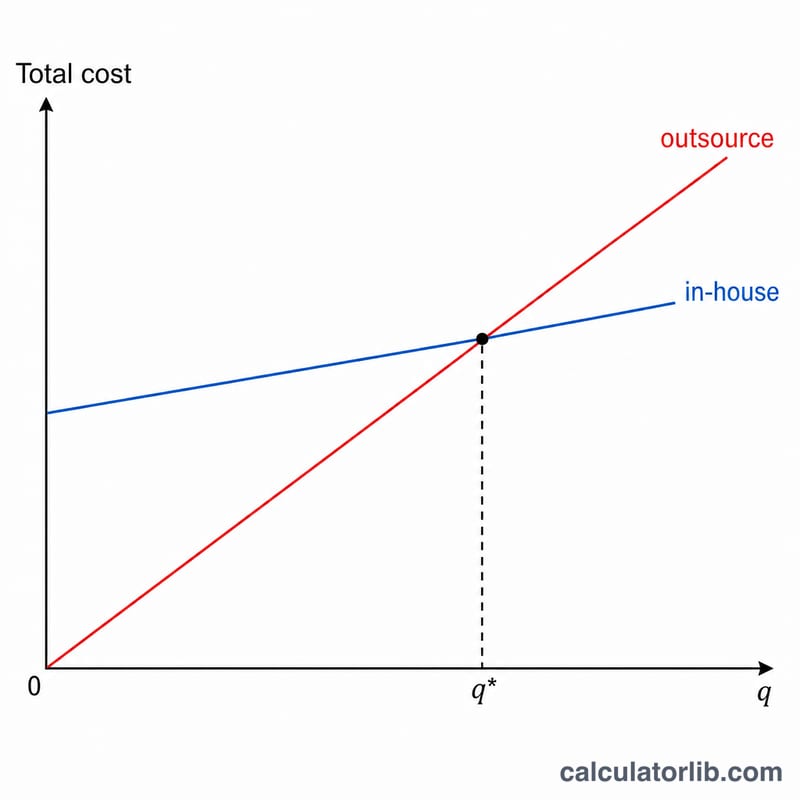
Below the crossover, the fixed printer cost has not yet been spread over enough parts, so outsourcing wins. Above it, the lower in-house per-part cost dominates and buying wins. At 1,000 parts the savings from buying is $1,600.
Typical 3D Printing Cost Reference Values
The figures below are indicative ranges to help you populate the calculator when you do not yet have firm numbers. They are not quotes; actual prices vary by region, machine, material brand, part geometry, and print-bureau pricing structure.
| Item | Typical range | Notes |
|---|---|---|
| Desktop FDM printer | $200 – $1,500 | Hobby to prosumer machines |
| Desktop SLA / resin printer | $250 – $4,000 | Higher detail, smaller build volume |
| FDM filament | $18 – $35 / kg | Standard PLA/PETG; engineering filaments cost more |
| SLA resin | $30 – $90 / L | Standard vs specialty/tough resins |
| Material cost per small part | $0.20 – $5 | Depends on grams/ml used per part |
| Energy cost per print | $0.02 – $0.50 | Roughly 50–250 W over the print duration |
| Print-bureau per-part price | $3 – $50+ | Includes setup, labor, margin, and minimum order fees |
For a more precise material-and-power figure to enter as your in-house per-part cost, estimate it from grams of filament and print time using a dedicated 3D printing cost calculator before running the buy-vs-outsource comparison.
Interpreting Your Break-Even Result
The break-even part count is the volume at which the total cost of buying and running your own printer equals the total cost of outsourcing the same parts. Below that quantity, outsourcing is cheaper because you have not produced enough parts to recover the printer's fixed purchase price. Above it, in-house production is cheaper because each additional part costs only material and energy rather than a full bureau price.
Mechanically, break-even depends on the gap between the outsource price per part and your in-house variable cost per part (material plus energy). That gap is what each part contributes toward paying off the printer. A larger gap means a lower break-even quantity; a smaller gap pushes it higher.
If the calculator reports no break-even, your in-house variable cost per part is at or above the outsource price. In that case buying never pays back, because each part you make in-house costs the same or more than buying it outright — the fixed printer cost can never be recovered no matter how many parts you produce.
The split between fixed cost (the one-time printer price) and variable cost (material and energy per part) is central: high fixed cost with low variable cost favors high volumes, while a cheap printer with thin per-part margins breaks even quickly.
Finally, this comparison is purely about per-part dollar cost. It deliberately ignores non-cost factors such as turnaround time, part quality and consistency, post-processing labor, machine uptime and maintenance, learning curve, and the value of keeping production in-house. Weigh those alongside the numeric result before deciding.
FAQ
Does this include maintenance and failed prints? Not separately — add an allowance into your material-per-part figure to account for waste, failed builds, and consumables.
What if break-even shows no value? It means your per-part running cost is at or above the outsource price, so outsourcing is always cheaper at any volume.
Should labor be included? For a fair comparison, add your per-part labor or machine-time value into either the material or energy field.