
What this calculator does
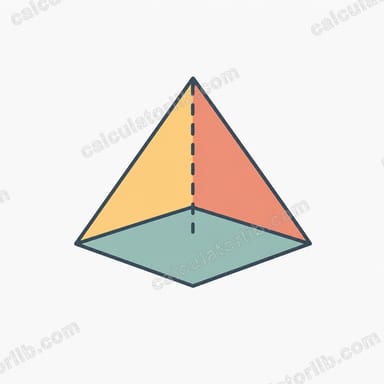
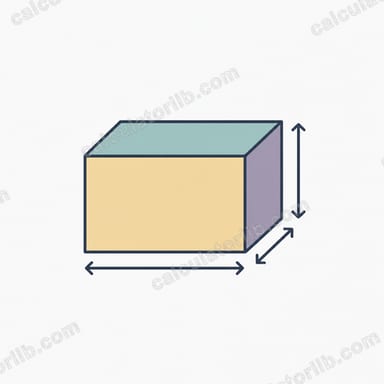
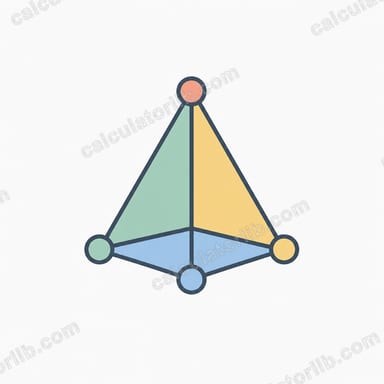
This tool takes four points A, B, C and D in three-dimensional space and returns two volumes: the volume of the parallelepiped spanned by the three edge vectors that start at A, and the volume of the tetrahedron whose vertices are those four points. The coordinates are plain numbers in whatever length unit you are working in, so the resulting volume is in that same unit cubed.
How to use it
Enter the x, y and z coordinates for each of the four points. Press calculate. The order of the points does not affect the size of the answer, only the sign of the intermediate triple product, which we discard by taking the absolute value. If all four points lie in the same plane the tetrahedron is flat and both volumes are zero, which is a valid result rather than an error.
The formula explained
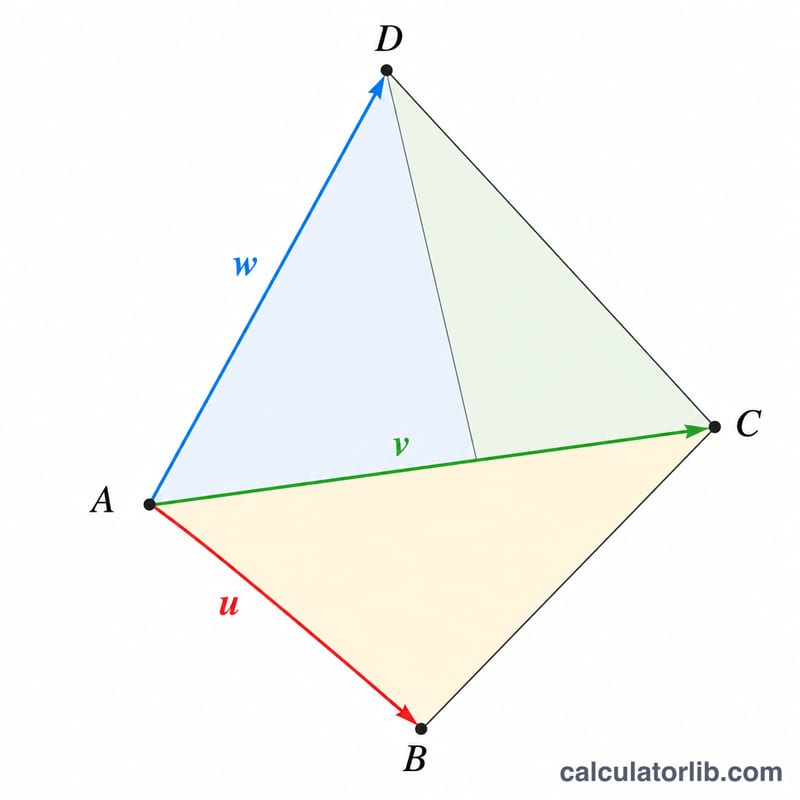
Build three edge vectors from point A: \(\vec{u} = \text{B} - \text{A}\), \(\vec{v} = \text{C} - \text{A}\), \(\vec{w} = \text{D} - \text{A}\). The scalar triple product \(T = \vec{u} \cdot (\vec{v} \times \vec{w})\) equals the determinant of the matrix whose rows are \(\vec{u}\), \(\vec{v}\) and \(\vec{w}\). Geometrically \(|T|\) is the volume of the parallelepiped these vectors span. A tetrahedron occupies exactly one sixth of that parallelepiped, so the tetrahedron volume is \(|T| / 6\).
$$V_{\text{tet}} = \frac{1}{6}\left| \vec{u} \cdot (\vec{v} \times \vec{w}) \right|$$$$V_{\text{par}} = \left| \vec{u} \cdot (\vec{v} \times \vec{w}) \right| = 6\,V_{\text{tet}}$$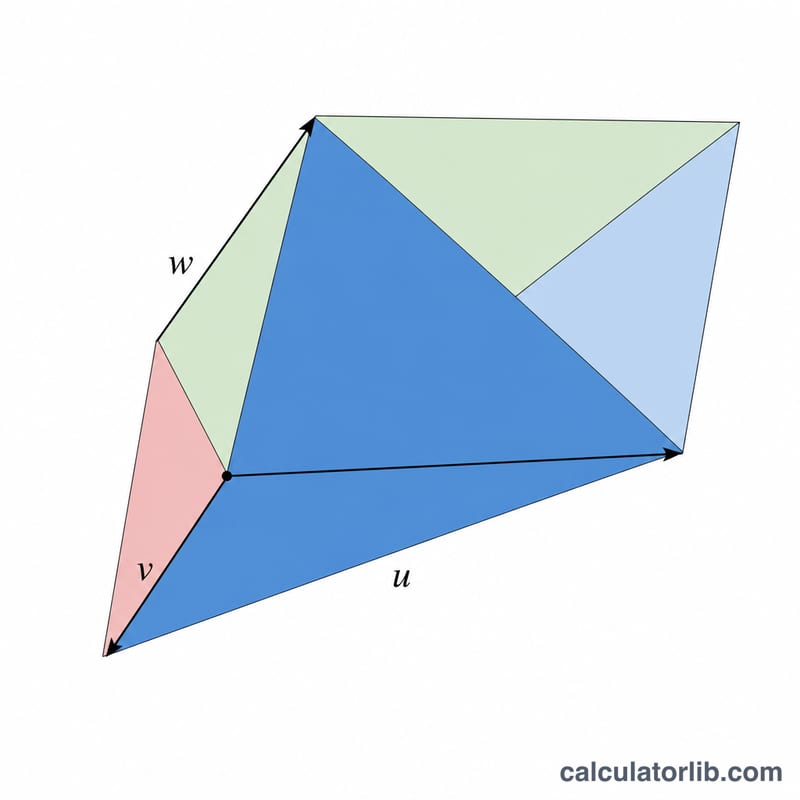
Worked example
Let \(\text{A} = (0,0,0)\), \(\text{B} = (2,0,0)\), \(\text{C} = (0,2,0)\), \(\text{D} = (0,0,2)\). Then \(\vec{u} = (2,0,0)\), \(\vec{v} = (0,2,0)\), \(\vec{w} = (0,0,2)\). The cross product \(\vec{v} \times \vec{w} = (4,0,0)\), and \(T = \vec{u} \cdot (4,0,0) = 8\). So the parallelepiped volume is 8 and the tetrahedron volume is $$8 / 6 = 1.3333$$ cubic units.
FAQ
Does point order matter? No. Reordering the points can flip the sign of \(T\) but never changes the magnitude, and we report the absolute value.
Why is my answer zero? The four points are coplanar, so the tetrahedron has no volume.
What units does the result use? Whatever length unit your coordinates use, raised to the third power. Centimeter coordinates give cubic centimeters.