
What is a regular tetrahedron?
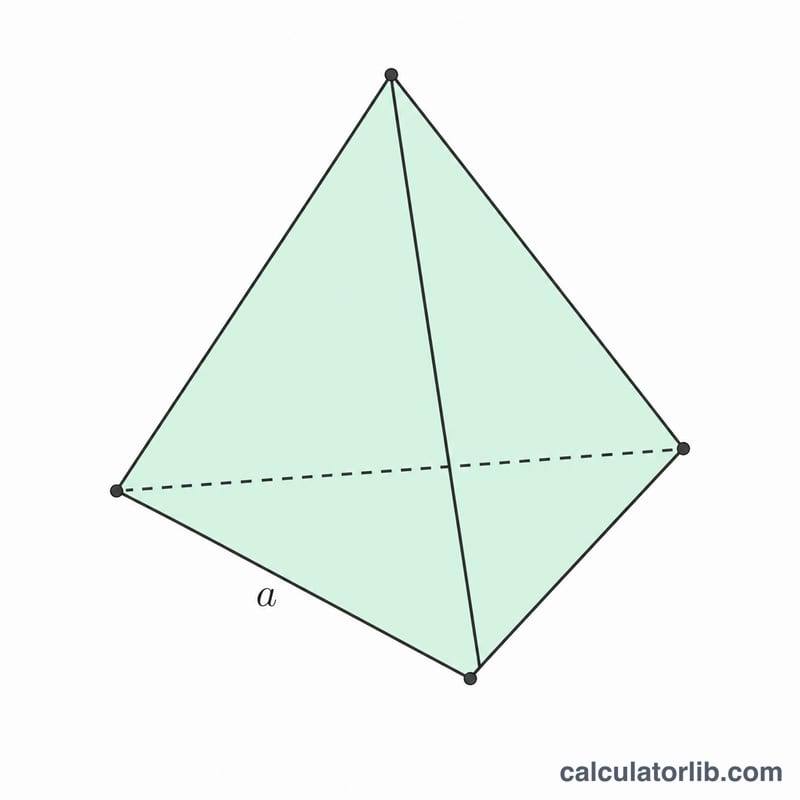
A regular tetrahedron is one of the five Platonic solids. It has four faces, each a congruent equilateral triangle, four vertices, and six edges of equal length. Because every edge is the same length a, both its volume and its total surface area can be expressed with a single number. This is a pure-mathematics geometry tool and applies everywhere; no region-specific rules are involved.
How to use this calculator
Enter the edge length a in whatever consistent unit you like (cm, m, inches, and so on) and the calculator returns the volume and surface area in the matching cubic and square units. No unit conversion is performed: if you enter a in centimetres, the volume comes out in cm³ and the surface area in cm². The edge length must be greater than zero; a negative value is treated as its absolute value.
The formulas explained
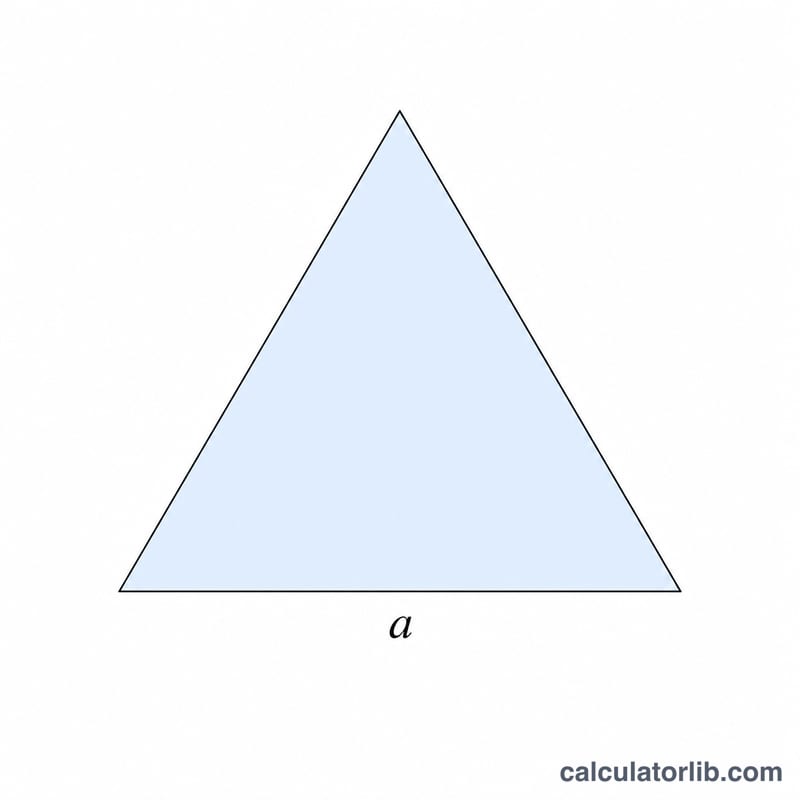
The volume is \(V = \frac{\sqrt{2}}{12}\cdot a^{3}\). The total surface area is four equilateral triangles. One equilateral triangle of side a has area \(\frac{\sqrt{3}}{4}\cdot a^{2}\), so four of them give \(S = 4\cdot\frac{\sqrt{3}}{4}\cdot a^{2} = \sqrt{3}\cdot a^{2}\). Here \(\sqrt{2} \approx 1.41421356\) and \(\sqrt{3} \approx 1.73205081\).
Worked example
For an edge length of a = 3: \(a^{3} = 27\), so $$V = \frac{1.41421356}{12} \times 27 = 0.117851130 \times 27 \approx 3.18198052 \text{ cubic units.}$$ \(a^{2} = 9\), so $$S = 1.73205081 \times 9 \approx 15.58845727 \text{ square units.}$$
FAQ
What units does the answer use? The same length unit you used for a: volume in that unit cubed, surface area in that unit squared.
What if a = 1? Then \(V \approx 0.117851130\) and \(S \approx 1.732050808\).
Is this only for regular tetrahedra? Yes. These formulas assume all four faces are equilateral and all six edges equal. Irregular tetrahedra need different calculations.