
What this calculator does
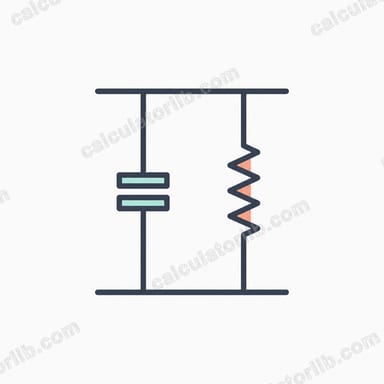
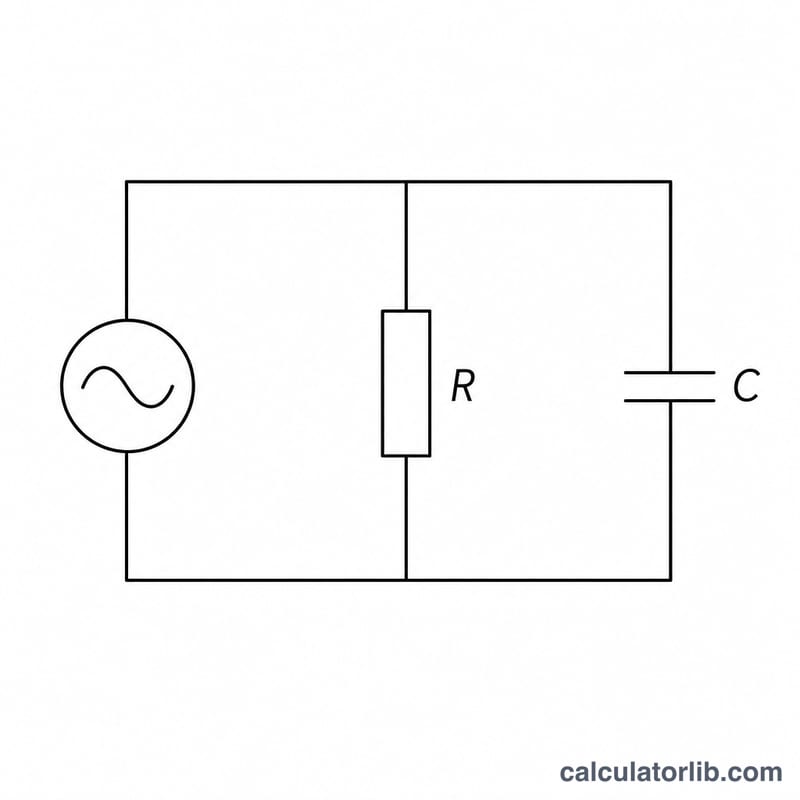
This tool computes the complex impedance of a parallel RC circuit: a resistor R connected in parallel with a capacitor C, driven by a sinusoidal source at frequency f. It returns the impedance magnitude |Z| in ohms and the phase angle in degrees. The result is universal physics and applies anywhere.
How to use it
Enter the resistance, capacitance and frequency, and pick the matching unit for each from the dropdowns (for example MOhm, uF, kHz). The display precision selector only changes how many digits are shown; it does not affect the underlying math. Press calculate to get |Z| and the phase angle.
The formula explained
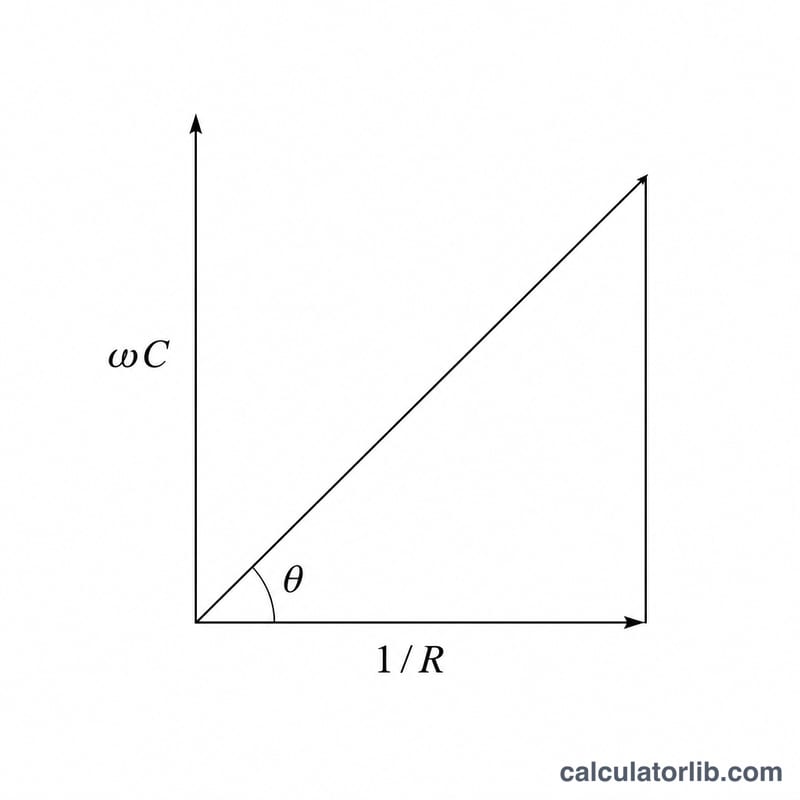
For parallel elements it is easiest to add admittances. The admittance is \(1/Z = 1/R + j\omega C\), where \(\omega = 2\pi f\) is the angular frequency. Taking the magnitude gives $$|Z| = \frac{1}{\sqrt{\left(\frac{1}{R}\right)^{2} + (\omega C)^{2}}}.$$ The phase of the impedance is \(\arctan(-\omega C R)\), which is always between 0 and -90 degrees because the capacitive branch makes the current lead the voltage.
Worked example
With \(R = 10\,\Omega\), \(C = 5\,\mu\text{F} = 5\times 10^{-6}\,\text{F}\) and \(f = 1\,\text{kHz} = 1000\,\text{Hz}\): \(\omega = 2\pi\cdot 1000 = 6283.19\,\text{rad/s}\), so \(\omega C = 0.0314159\,\text{S}\) and \(1/R = 0.1\,\text{S}\). Then $$|Z| = \frac{1}{\sqrt{0.01 + 0.000986960}} = 9.5402\ \Omega.$$ The phase is \(\arctan(-0.0314159 \times 10) = \arctan(-0.314159) = -0.30445\,\text{rad} = -17.4406^\circ\).
FAQ
Why is the phase negative? A capacitor draws leading current, so the parallel combination looks capacitive and the impedance phase falls between 0 and -90 degrees.
What happens at DC (f = 0)? The capacitor is an open circuit, so the impedance is just R and the phase is 0 degrees.
What if R is very large? As R grows, the resistor branch carries little current and the circuit behaves like a pure capacitor, pushing the phase toward -90 degrees.