
What is a circular permutation?
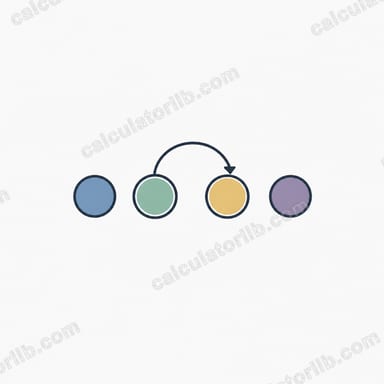
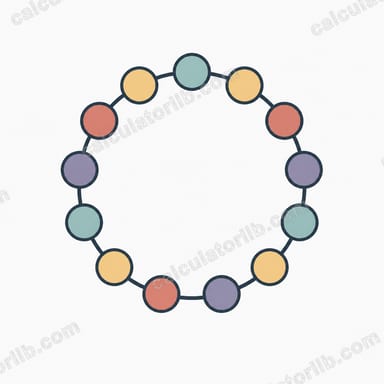
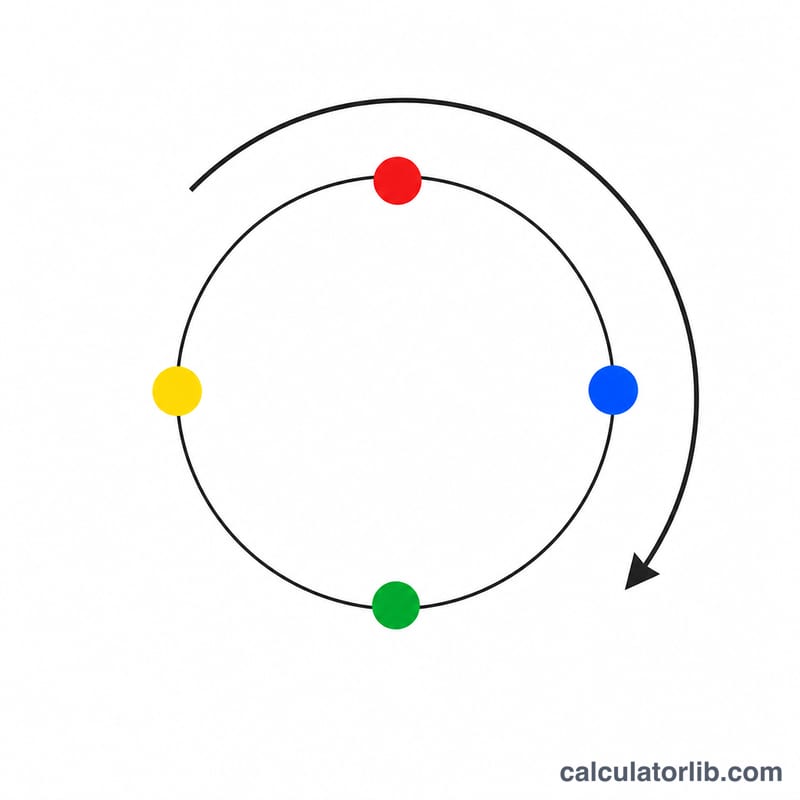
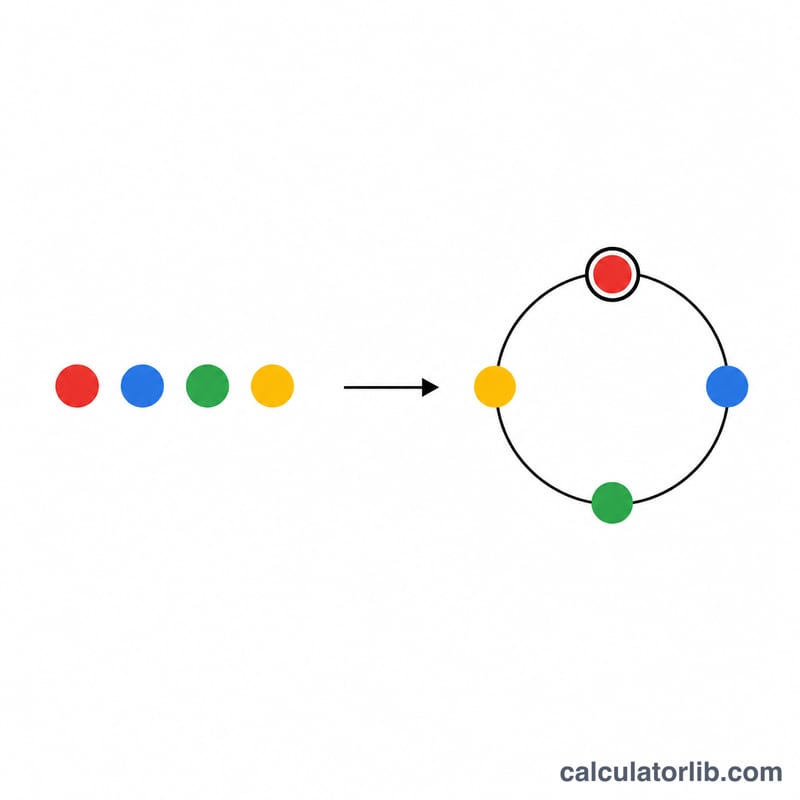
A circular permutation counts the number of distinct ways to arrange n distinct objects around a circle when rotations of the same arrangement are considered identical. Unlike a row (a linear arrangement), a circle has no fixed starting point, so rotating everyone one seat to the left produces the same arrangement. This calculator returns the exact count, \((n - 1)!\), using arbitrary-precision arithmetic so even large values stay exact.
How to use this calculator
Enter the number of distinct objects n (a positive integer, n ≥ 1) and read off the number of circular permutations. For example, the number of ways to seat n people around a round table, or arrange n distinct beads in a fixed ring orientation, is \((n - 1)!\).
The formula explained
The number of linear permutations of n distinct objects is n!. In a circle, each unique arrangement can be rotated into n different but equivalent positions (one for each possible starting object). Dividing the linear count by these n rotations gives:
$$\frac{n!}{n} = (n - 1)!$$
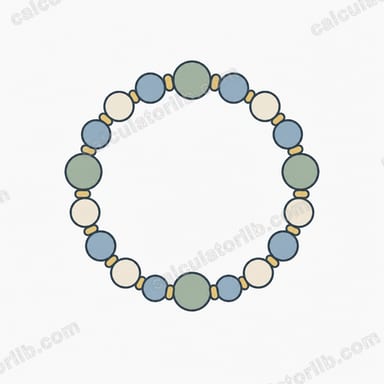
Note: this is the standard circular permutation. It does not treat mirror reflections (clockwise vs counter-clockwise) as the same. If reflections were also identical — as with a flippable necklace or bracelet — the count would be \((n - 1)! / 2\) for n ≥ 3.
Worked example
For n = 5: $$(5 - 1)! = 4! = 4 \times 3 \times 2 \times 1 = 24.$$ So five distinct people can be seated around a round table in 24 distinct ways once rotations are treated as the same.
FAQ
What is the answer for n = 1 or n = 2? For n = 1, \((1 - 1)! = 0! = 1\). For n = 2, \((2 - 1)! = 1! = 1\) — two objects in a circle have only one distinct arrangement up to rotation.
Why divide by n instead of subtracting? Because each circular arrangement corresponds to exactly n equivalent linear orderings (one per rotation), you divide the total n! by n, which simplifies to \((n - 1)!\).
Does this count necklaces or bracelets? No. This computes the standard circular permutation \((n - 1)!\). Necklace/bracelet counts that also collapse mirror images use \((n - 1)! / 2\) for n ≥ 3.