
What is a circular permutation?
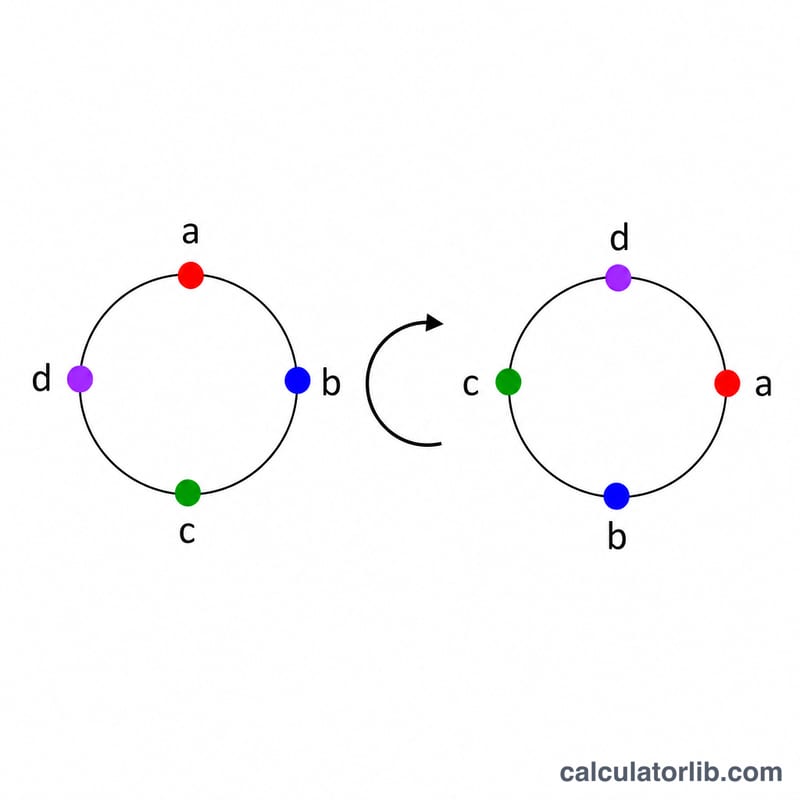
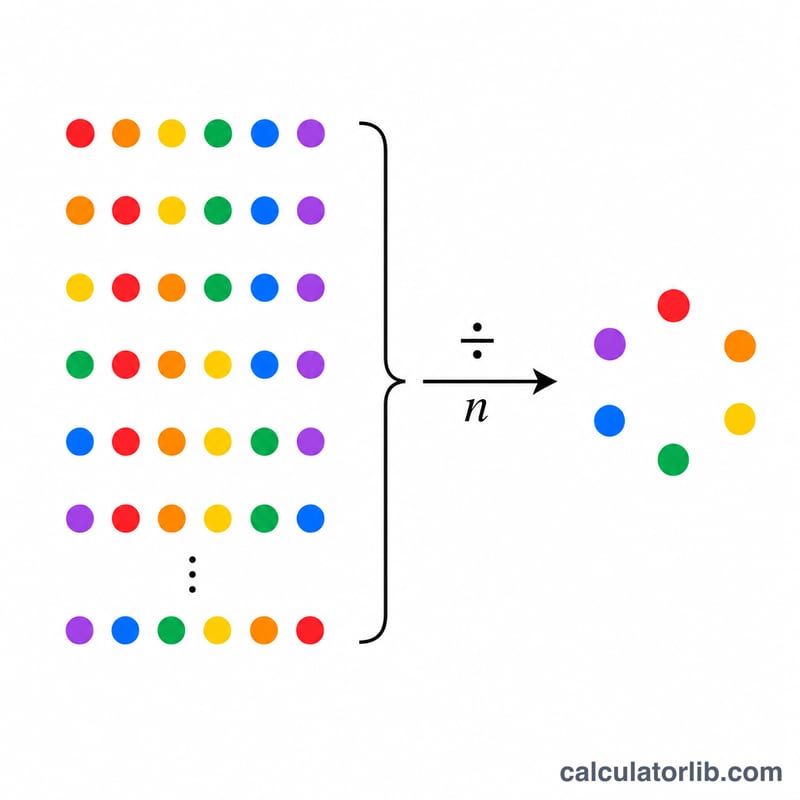
A circular permutation counts the distinct ways to arrange n distinct objects around a circle, treating arrangements that differ only by rotation as the same. While there are \(n!\) ways to arrange n objects in a line, each circular arrangement corresponds to n rotated copies, so the number of distinct circular arrangements is \(n! / n = (n - 1)!\). This calculator builds a table of \((n - 1)!\) for every integer n in a range you choose.
How to use this calculator
Enter a start value and an end value for n (each between 1 and 100), then pick how many significant digits to display. The tool computes \((n - 1)!\) exactly using arbitrary-precision integers, then prints the full integer when it fits within your chosen digit count, or rounds it to scientific notation otherwise. Because factorials grow extremely fast, values for large n are shown like \(8.84 \times 10^{30}\).
The formula explained
Fix one object in place to remove rotational symmetry; the remaining \((n - 1)\) objects can be arranged in \((n - 1)!\) ways. That is why circular permutations equal \((n - 1)!\) rather than \(n!\). Note that reflections are NOT treated as identical here, so this is the standard directed count, not the necklace count \((n - 1)! / 2\).
Worked example
For n from 3 to 6: n=3 gives \(2! = 2\), n=4 gives \(3! = 6\), n=5 gives \(4! = 24\), and n=6 gives \(5! = 120\). The table therefore has 4 rows. For a larger value, n=30 gives $$29! = 8{,}841{,}761{,}993{,}739{,}701{,}954{,}543{,}616{,}000{,}000,$$ roughly \(8.84 \times 10^{30}\).
FAQ
Why do n=1 and n=2 both give 1? Because \(0! = 1\) and \(1! = 1\); a single object or two objects on a circle each have exactly one distinct arrangement.
Why scientific notation? 99! has about 156 digits, so full integers become unreadable; the significant-digits setting controls display only and does not affect the underlying exact computation.
Are reflections counted as the same? No. This tool computes \((n - 1)!\). Identifying reflections would halve the count to \((n - 1)! / 2\).