
What is the Three Phase Power Calculator?
This calculator finds the electrical power delivered by a balanced three-phase AC system. Three-phase supplies are used worldwide for motors, industrial machinery and large commercial loads because they deliver power more efficiently than single-phase. Given the line-to-line voltage, the line current and the power factor, it returns the real (active) power in watts and kilowatts, the apparent power in volt-amperes, and the reactive power in volt-amperes reactive.
How to use it
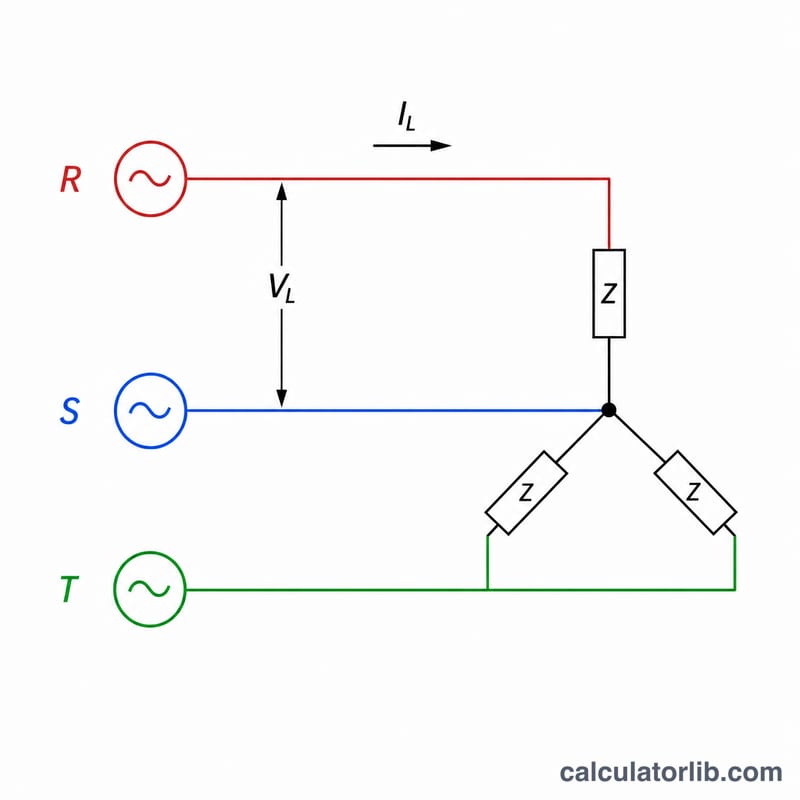
Enter the line voltage (\(V_{L}\), the voltage measured between two line conductors), the line current (\(I_{L}\)) flowing in each phase conductor, and the power factor (\(\cos\varphi\)), a value between 0 and 1. For a purely resistive load the power factor is 1; for inductive loads such as motors it is typically 0.8–0.95. Press calculate to see all three power quantities.
The formula explained
For a balanced three-phase load the real power is:
$$P = \sqrt{3}\cdot\text{V}_{L}\cdot\text{I}_{L}\cdot\cos\varphi$$
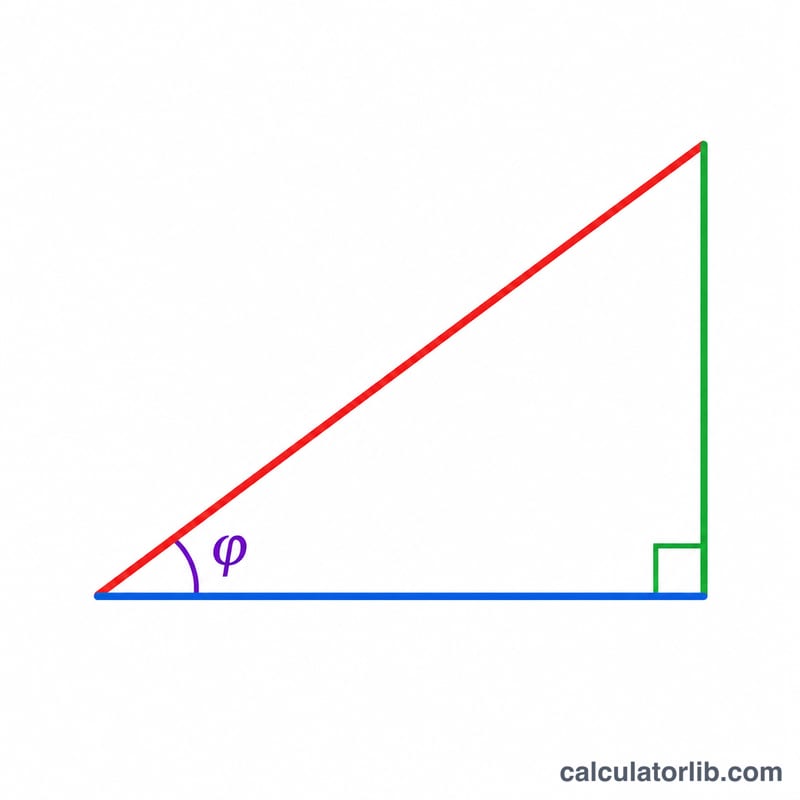
The factor \(\sqrt{3}\) (≈1.732) appears because line-to-line voltage is \(\sqrt{3}\) times the phase voltage. Apparent power is \(S = \sqrt{3}\cdot\text{V}_{L}\cdot\text{I}_{L}\), and reactive power is \(Q = S\cdot\sqrt{1-\cos^{2}\varphi}\). Real power does useful work; reactive power circulates between source and load without doing work.
Worked example
Suppose \(V_{L} = 400\,\text{V}\), \(I_{L} = 10\,\text{A}\) and power factor = 0.8. Then $$P = 1.732 \times 400 \times 10 \times 0.8 = 5{,}542.6\,\text{W} \approx 5.54\,\text{kW}.$$ Apparent power $$S = 1.732 \times 400 \times 10 = 6{,}928.2\,\text{VA},$$ and reactive power $$Q = 6{,}928.2 \times \sqrt{1 - 0.64} = 6{,}928.2 \times 0.6 = 4{,}156.9\,\text{VAR}.$$
FAQ
Should I use line or phase voltage? This calculator uses line-to-line voltage (e.g. 400 V or 415 V), which already includes the \(\sqrt{3}\) factor. Do not multiply by \(\sqrt{3}\) again if you only have phase voltage.
What if I don't know the power factor? Use 1.0 for resistive heating loads, or about 0.8 for typical motor loads. The nameplate of equipment usually lists it.
Does this work for unbalanced loads? No — the \(\sqrt{3}\) formula assumes a balanced system where all three phases carry equal current. Unbalanced systems must be analysed phase by phase.