
What is a necklace permutation?
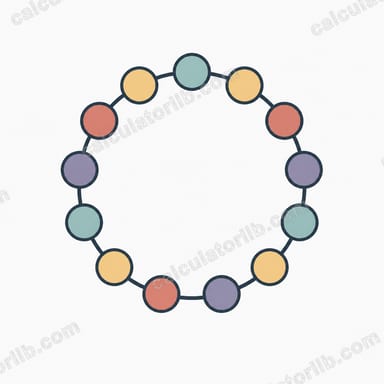
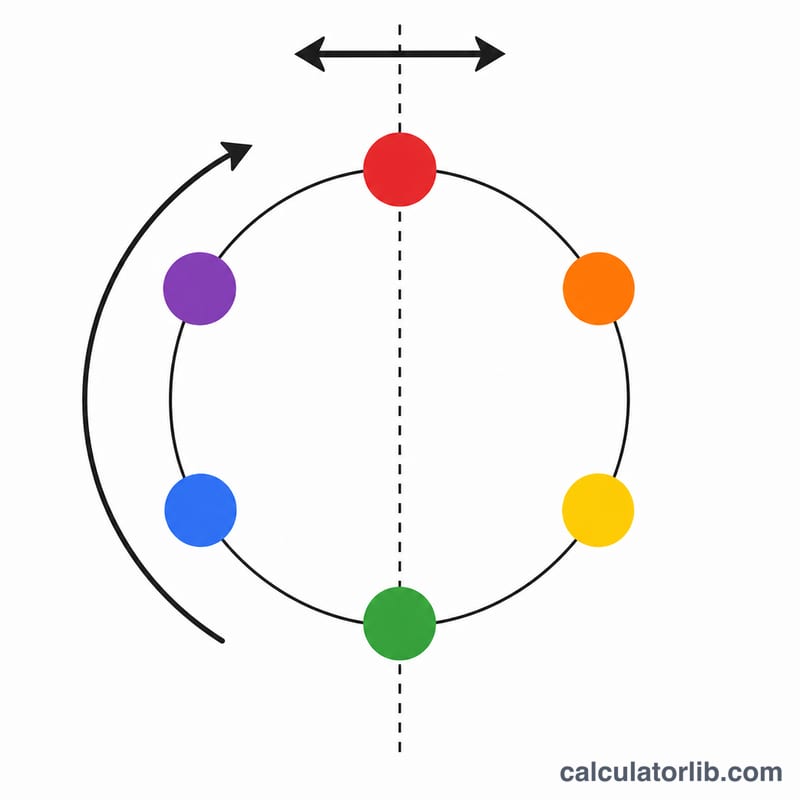
A necklace permutation (also called a bracelet arrangement, or in Japanese a "juzu" permutation) counts the number of distinct ways to arrange n different objects around a closed loop, where two arrangements are considered the same if one can be turned into the other by rotating the loop or by flipping it over (a reflection). It sits one step beyond the circular permutation: a circular permutation removes only rotational symmetry, while a necklace also removes mirror symmetry.
How to use this calculator
Enter the number of distinct objects n (a non-negative whole number) and the calculator returns the number of distinct necklace arrangements. For comparison it also shows the linear permutation count (\(n!\)) and the circular permutation count (\((n-1)!\)). Because factorials grow extremely fast, the result is computed with exact arbitrary-precision integer arithmetic, so even large values of n are displayed exactly.
The formula explained
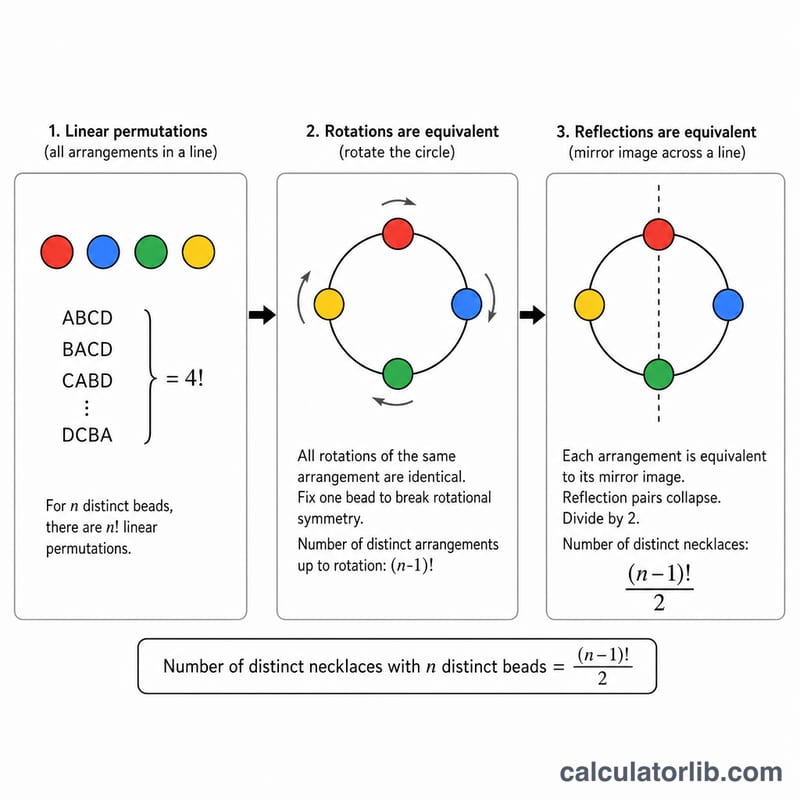
For n linear arrangements there are \(n!\) orderings. Fixing one object on the loop to remove the n equivalent rotations leaves \((n-1)!\) circular arrangements. A necklace additionally treats a clockwise pattern and its counter-clockwise mirror image as identical, so we divide once more by 2:
$$N = \frac{\left(\text{Objects }(n) - 1\right)!}{2}$$ for \(n \ge 3\).
For n = 0, 1 and 2 the simple formula would give a non-integer or undercount, so by convention the answer is 1 in each of those cases: there is exactly one (or empty) distinct loop.
Worked example
For n = 5: $$\frac{(5 - 1)!}{2} = \frac{4!}{2} = \frac{24}{2} = 12$$ distinct necklaces. For n = 6: \(\frac{5!}{2} = \frac{120}{2} = 60\). For n = 4: \(\frac{3!}{2} = 3\).
FAQ
How is this different from a circular permutation? A circular permutation is \((n-1)!\) and counts rotations as identical but treats mirror images as different. A necklace permutation divides that by 2 because flips are also treated as identical.
Why is the answer 1 for n = 2? With two objects there is only one possible loop; rotating or flipping it simply swaps the two positions, so all arrangements coincide. The formula \((2-1)!/2 = 1/2\) is not valid here, which is why a special case is used.
Does the formula assume all objects are different? Yes. This calculator assumes n distinct objects. If some objects are identical, the count is smaller and requires a different (Burnside/Polya) treatment.