
What is a necklace permutation?
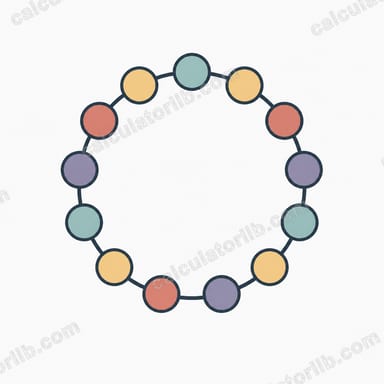
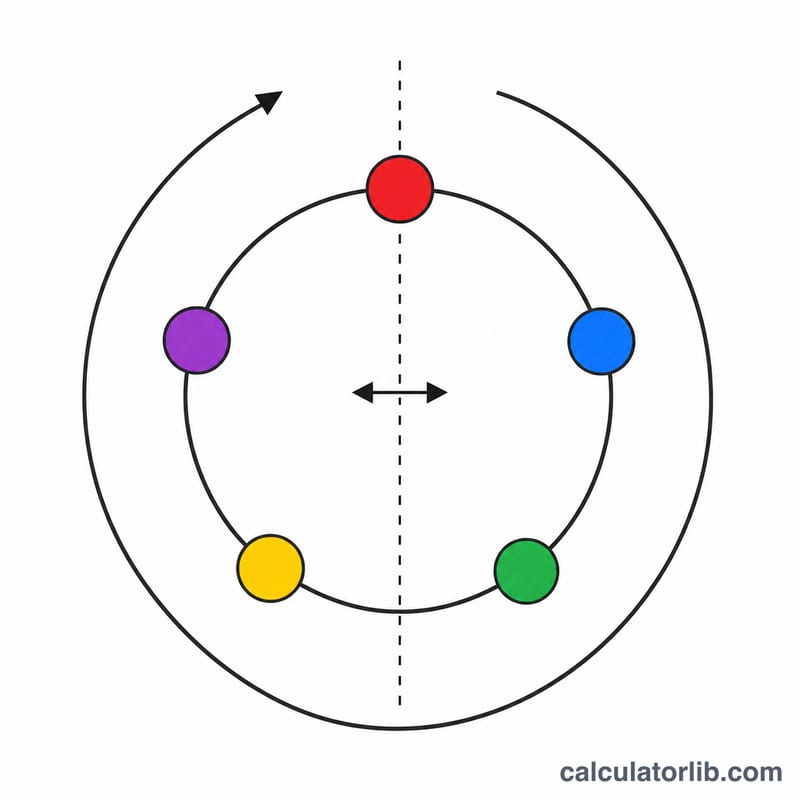
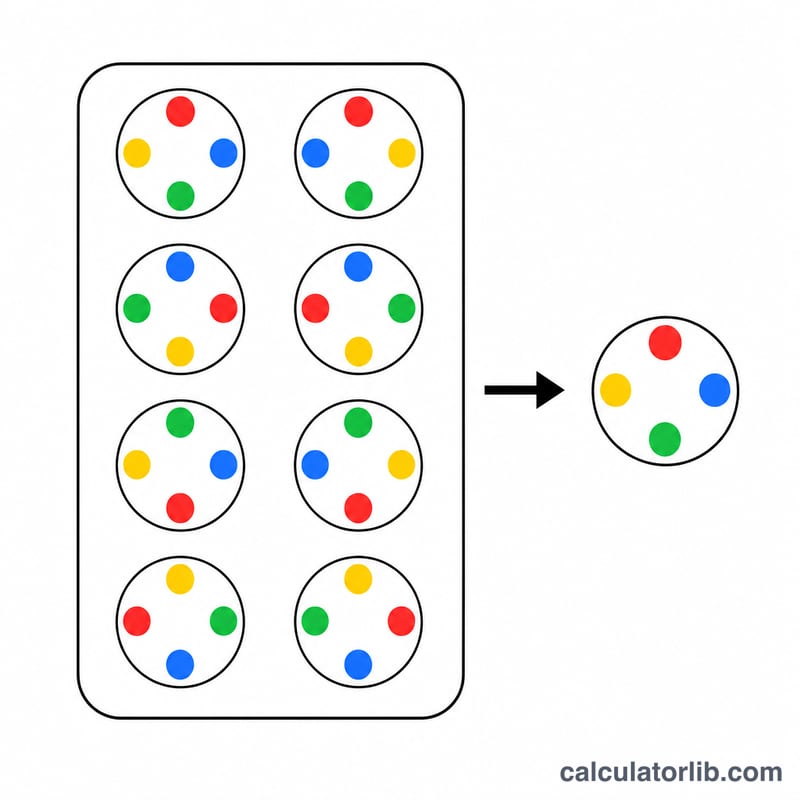
A necklace permutation (in Japanese, "juzu junretsu" or rosary permutation) counts the distinct ways to arrange n different objects around a circle when two arrangements are considered the same if one can be turned into the other by rotating the circle OR by flipping the whole necklace over (reflection). This contrasts with a circular permutation ("en junretsu"), which only treats rotations as equivalent. This is a universal combinatorics result — the formula is the same everywhere.
How to use this calculator
Enter a starting value and an ending value for \(n\) (each between 1 and 100), choose a display precision in significant digits, and the tool prints one row per integer \(n\) in that range with its necklace permutation count. Because the counts grow factorially, large values are shown in scientific notation rounded to your chosen number of significant digits, while values that fit exactly are shown in full.
The formula explained
Start with all \(n!\) linear orderings of \(n\) distinct objects. Placing them in a circle makes the \(n\) rotations of any ordering identical, so divide by \(n\) to get circular permutations:
$$\frac{n!}{n} = (n-1)!$$A necklace can also be flipped over, pairing each arrangement with its mirror image, so divide by a further 2:
$$\text{necklace permutations} = \frac{(n-1)!}{2}$$For \(n = 1\) or \(n = 2\) this would not be a whole number, so by convention each gives exactly 1 arrangement.
Worked example
For the range \(n = 3\) to \(8\): n=3 gives
$$\frac{(3-1)!}{2} = \frac{2}{2} = 1$$n=4 gives
$$\frac{6}{2} = 3$$n=5 gives
$$\frac{24}{2} = 12$$n=6 gives
$$\frac{120}{2} = 60$$n=7 gives
$$\frac{720}{2} = 360$$n=8 gives
$$\frac{5040}{2} = 2520$$At the top of the default range, n=30 gives
$$\frac{29!}{2} = 4{,}420{,}880{,}996{,}869{,}850{,}977{,}271{,}808{,}000{,}000$$roughly \(4.42 \times 10^{30}\).
FAQ
Why divide by 2? The 2 removes reflection symmetry: a necklace looks the same flipped over, so clockwise and counter-clockwise versions of the same cyclic order are counted once.
Why are n=1 and n=2 special? The general formula gives 0.5 for both, which is not a valid count; geometrically there is only one way to arrange one or two objects, so we report 1.
What is the difference from circular permutations? Circular permutations count up to rotation only and equal \((n-1)!\); necklace permutations additionally allow reflection and equal \(\frac{(n-1)!}{2}\) for \(n \geq 3\).