
What is a Wheatstone Bridge?
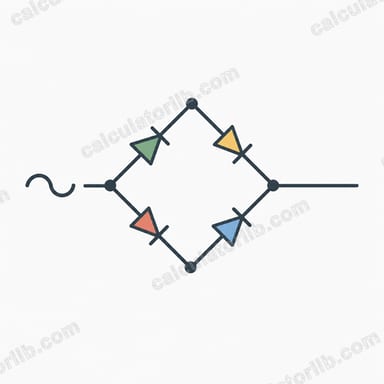
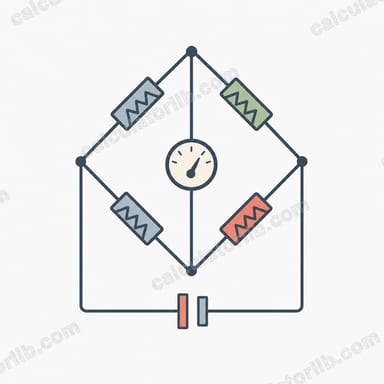
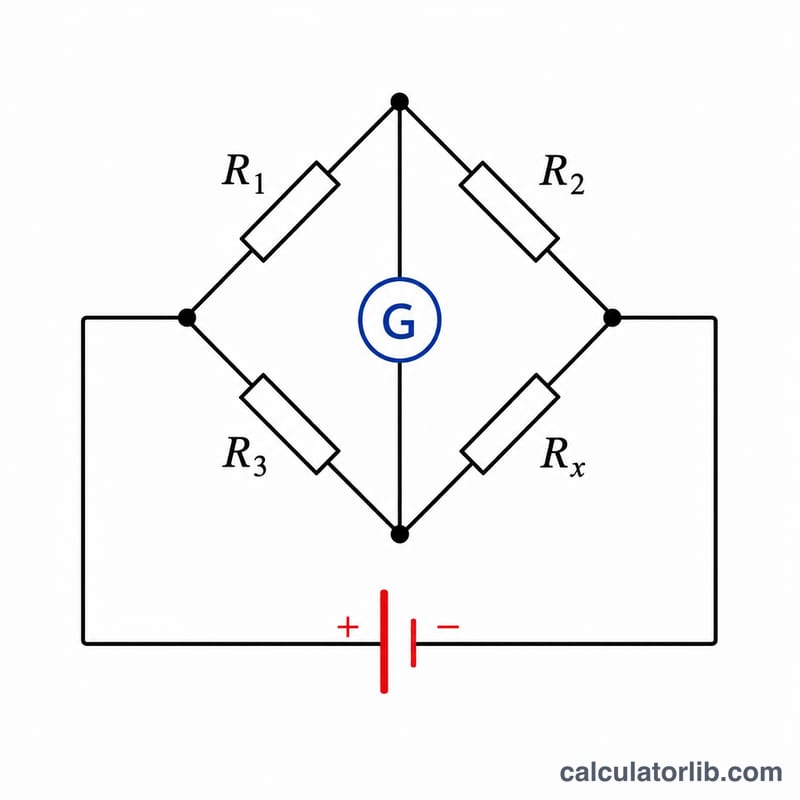
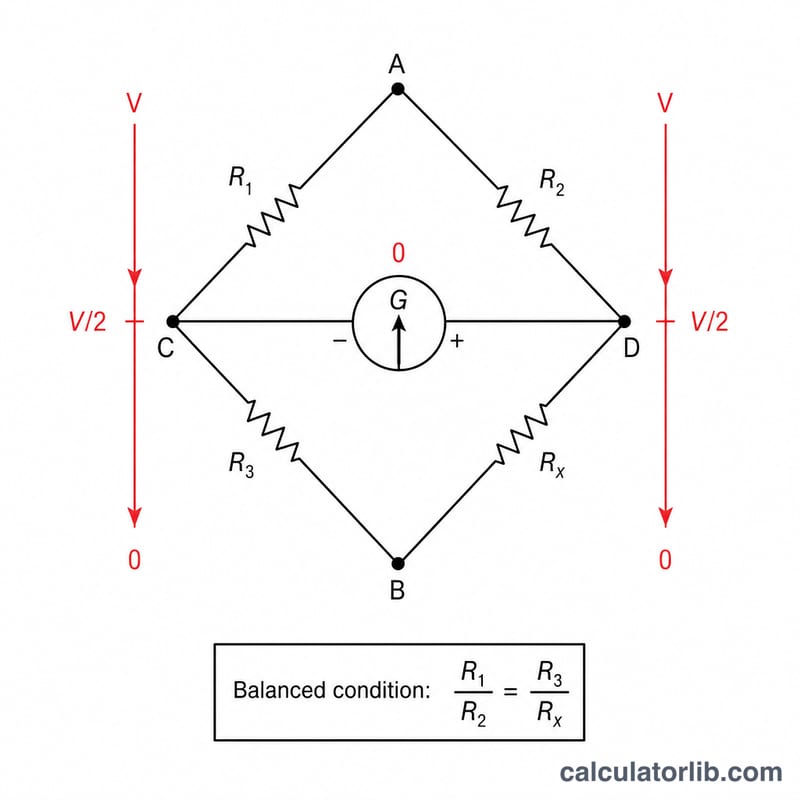
A Wheatstone bridge is a classic circuit used to measure an unknown electrical resistance with high precision. It consists of four resistors arranged in a diamond shape with a galvanometer (sensitive current detector) bridging the midpoints. When the bridge is "balanced," no current flows through the galvanometer, and the four resistances satisfy a simple ratio relationship. This calculator finds the unknown resistor Rx from three known resistors R1, R2 and R3.
How to Use This Calculator
Enter the values of the three known resistors in ohms (Ω): R1 and R2 form one ratio arm, and R3 is in series with the unknown Rx. Click calculate to instantly get Rx assuming the bridge is balanced. The result updates as soon as you change any input.
The Formula Explained
At balance the bridge condition is \(R1/R2 = R3/Rx\). Rearranging to isolate the unknown gives:
$$R_x = \frac{\text{R2 }(\Omega) \cdot \text{R3 }(\Omega)}{\text{R1 }(\Omega)}$$
The galvanometer reads zero because the voltage at both midpoints is identical, so the unknown resistance depends only on the ratios of the known resistors — not on the supply voltage. This is why Wheatstone bridges are so accurate: they are immune to fluctuations in the source voltage.
Worked Example
Suppose \(R1 = 100\ \Omega\), \(R2 = 200\ \Omega\) and \(R3 = 150\ \Omega\). Then $$R_x = \frac{200 \times 150}{100} = \frac{30000}{100} = 300\ \Omega.$$ So the unknown resistor measures 300 ohms.
FAQ
What does "balanced" mean? Balanced means no current flows through the galvanometer because both midpoint voltages are equal. The formula here applies only at balance.
Does the supply voltage matter? No. At balance, Rx depends solely on the ratio of the known resistors, making the measurement independent of source voltage.
Can I use any units? Use consistent units for all resistors (ohms recommended). Rx will be returned in the same unit you entered.