
What Is the Buoyancy Calculator?
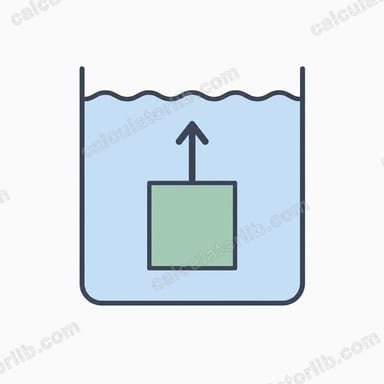
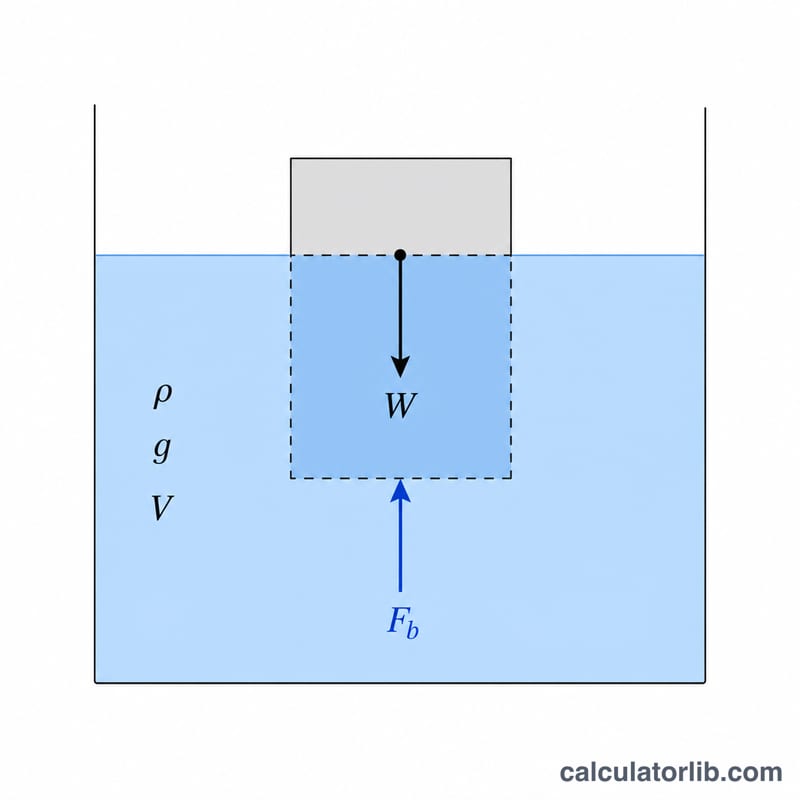
This calculator finds the buoyant force acting on an object immersed in a fluid using Archimedes' principle. The buoyant force equals the weight of the fluid that the object displaces, and it always pushes upward — opposing gravity. It applies universally to any fluid (water, oil, air) and any consistent SI units.
How to Use It
Enter three values: the fluid density (\(\rho\)) in kilograms per cubic meter, the gravitational acceleration (\(g\), usually 9.81 m/s²), and the displaced volume (\(V\)) in cubic meters — the volume of fluid pushed aside by the object. The result is the buoyant force in newtons, plus the equivalent mass it can support.
The Formula Explained
The governing equation is $$F_b = \rho \times g \times V$$ Here \(\rho \cdot V\) is the mass of displaced fluid, and multiplying by \(g\) converts it into a weight (force). Common densities: fresh water \(\approx 1000\) kg/m³, seawater \(\approx 1025\) kg/m³, air \(\approx 1.225\) kg/m³.
Worked Example
A block displaces 0.5 m³ of fresh water (\(\rho = 1000\) kg/m³) at \(g = 9.81\) m/s². The buoyant force is $$F_b = 1000 \times 9.81 \times 0.5 = 4905 \text{ N}$$ Dividing by \(g\) gives an equivalent supported mass of 500 kg.
Constants & Gravity Values
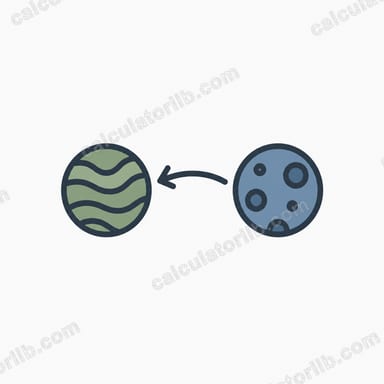
The gravitational acceleration \(g\) used in \(F_b = \rho \cdot g \cdot V\) sets how strongly the displaced fluid's mass is pulled, and therefore the upward force. On Earth the standard value is fixed by definition; on other bodies it differs substantially.
| Location | Gravity \(g\) (m/s²) | Use case |
|---|---|---|
| Earth (standard, defined) | 9.80665 | Precise, reference value |
| Earth (common rounded) | 9.81 | Everyday engineering |
| Moon | 1.62 | Lunar / low-gravity scenarios |
| Mars | 3.71 | Planetary exploration |
| Jupiter (cloud-top) | 24.79 | Gas-giant atmospheres |
Buoyant force scales linearly with \(g\): the same object in the same fluid would feel only about \(1.62 / 9.81 \approx 16.5\%\) of its Earth buoyancy on the Moon, because the displaced fluid weighs that much less.
FAQ
Does the object's own density matter? Not for the buoyant force itself — only the displaced volume does. The object's density determines whether it floats or sinks once you compare its weight to \(F_b\).
What volume should I use if the object floats? Use only the submerged volume, since only the submerged part displaces fluid.
Why use 9.81 m/s²? That is Earth's standard gravity. Use the local value for other planets or precise work.