
What Is the Drag Force Calculator?
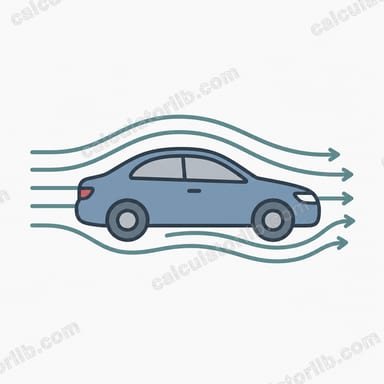
The drag force calculator finds the resistive aerodynamic (or hydrodynamic) force acting on an object as it moves through a fluid such as air or water. It applies the standard drag equation used throughout physics and engineering, making it ideal for students, cyclists, automotive designers, and anyone studying fluid dynamics. This is a universal physics tool that works in SI units regardless of country.
How to Use It
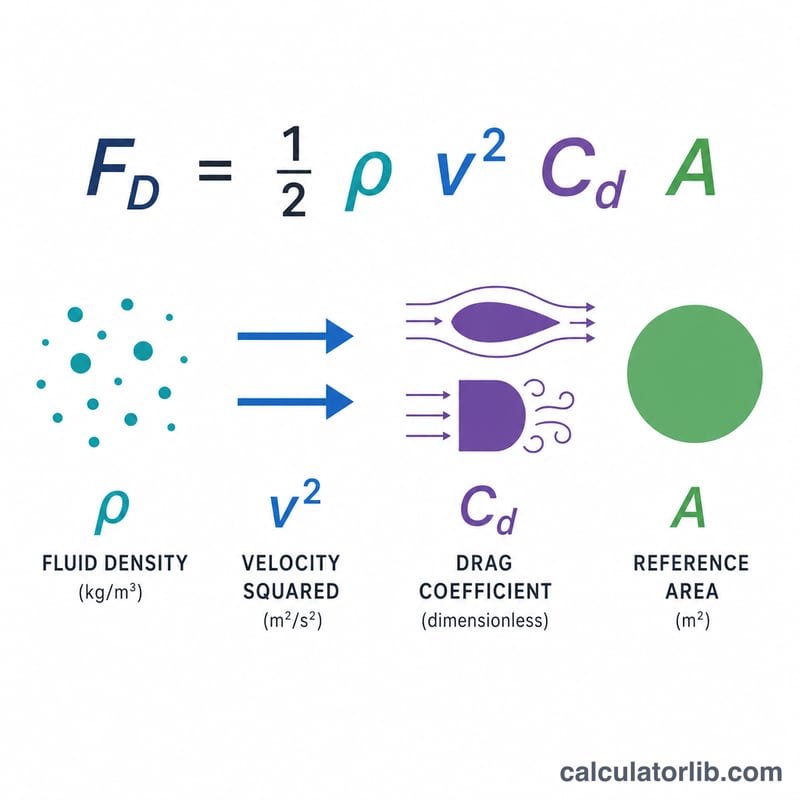
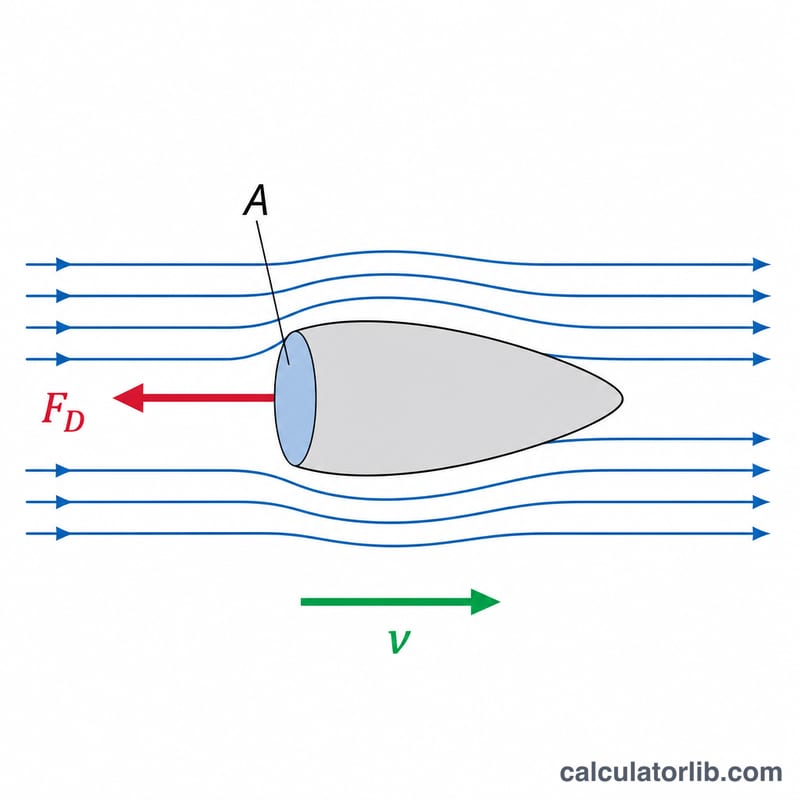
Enter four values: the fluid density \(\rho\) (about 1.225 kg/m³ for air at sea level, 1000 kg/m³ for water), the velocity \(v\) of the object relative to the fluid in metres per second, the dimensionless drag coefficient \(C_d\) (≈0.47 for a sphere, ≈0.3 for a car), and the reference (frontal) area \(A\) in square metres. The calculator returns the drag force in newtons along with the dynamic pressure.
The Formula Explained
The drag equation is $$F_d = \frac{1}{2} \cdot \rho \cdot v^{2} \cdot C_d \cdot A$$. Drag rises with the square of velocity, so doubling speed quadruples the drag force. The term \(\frac{1}{2}\rho v^{2}\) is the dynamic pressure of the fluid, and multiplying it by \(C_d \cdot A\) gives the effective force on the body.
Worked Example
Consider a sphere in air: \(\rho = 1.225\), \(v = 30\) m/s, \(C_d = 0.47\), \(A = 1.0\) m². Then $$F_d = 0.5 \times 1.225 \times 30^{2} \times 0.47 \times 1.0 = 0.5 \times 1.225 \times 900 \times 0.47 = 259.1 \text{ N}.$$ The dynamic pressure is \(0.5 \times 1.225 \times 900 = 551.25\) Pa.
FAQ
What is the drag coefficient? \(C_d\) is a dimensionless number that captures how aerodynamic a shape is; lower values mean less drag.
What density should I use? Use 1.225 kg/m³ for standard sea-level air, lower at altitude, or 1000 kg/m³ for fresh water.
Why does drag grow so fast with speed? Because the force depends on \(v^{2}\), small increases in velocity produce large increases in drag—key to fuel economy and terminal velocity.