
What Is Joule Heating?
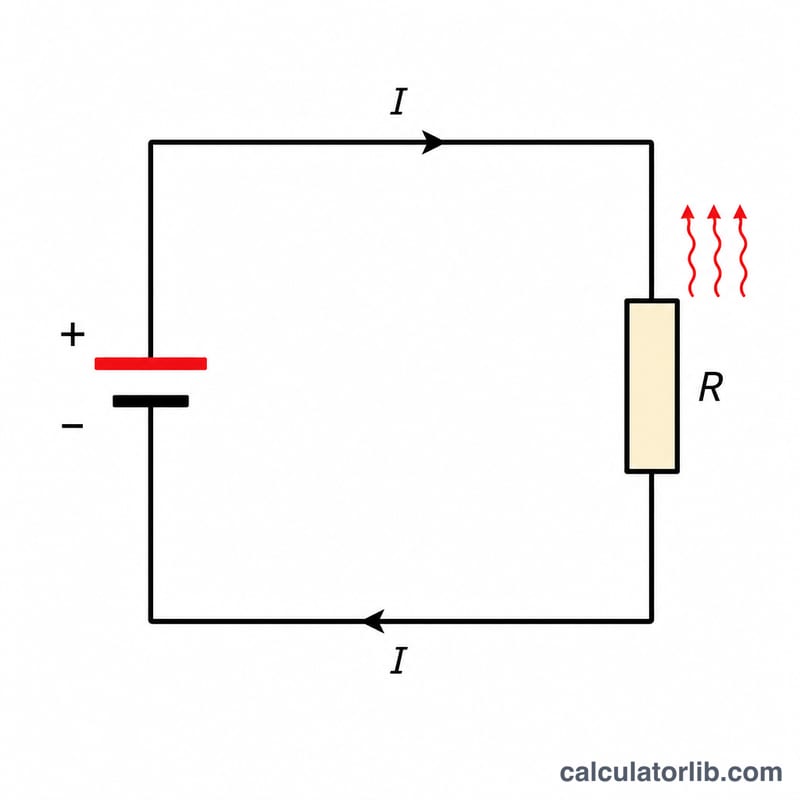
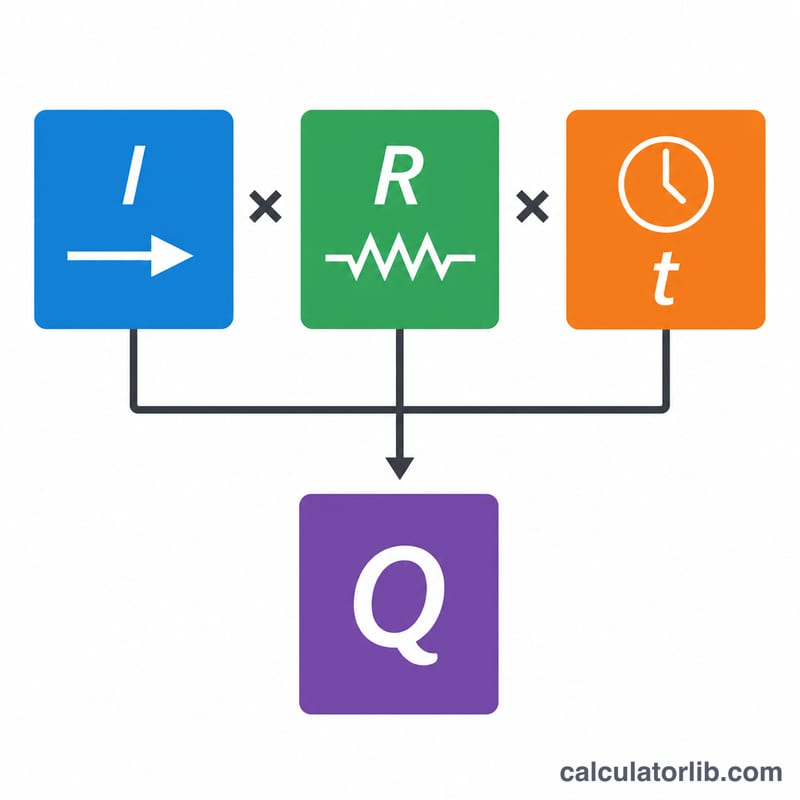
Joule heating (also called resistive or Ohmic heating) is the process by which electrical energy is converted into heat as current flows through a conductor. This calculator uses Joule's first law, \(Q = I^{2} \cdot R \cdot t\), to find the total heat energy released. It applies universally to any resistive element — heating coils, fuses, wires, light bulbs, and electronic components.
How to Use the Calculator
Enter three values: the current \(I\) in amperes, the resistance \(R\) in ohms, and the time \(t\) in seconds. The calculator returns the total heat energy \(Q\) in joules, along with the power dissipated (\(P = I^{2}R\)), the voltage drop across the resistor (\(V = IR\)), and the heat expressed in kilojoules and calories for convenience.
The Formula Explained
The core equation is $$Q = I^{2} \cdot R \cdot t$$ Because Ohm's law states \(V = IR\), the same heat can equally be written as \(Q = V \cdot I \cdot t = (V^{2}/R) \cdot t\). Power is simply heat per unit time, \(P = Q/t = I^{2}R\). Doubling the current quadruples the heat (the \(I^{2}\) term), which is why high-current circuits demand careful conductor sizing.
Worked Example
A heater draws 2 A through a 10 Ω element for 60 seconds. Heat = $$Q = I^{2} \cdot R \cdot t = 2^{2} \times 10 \times 60 = 4 \times 10 \times 60 = 2{,}400 \text{ J}$$ (2.4 kJ). Power dissipated = \(I^{2}R = 4 \times 10 = 40 \text{ W}\), and the voltage drop = \(IR = 2 \times 10 = 20 \text{ V}\).
FAQ
Does this work for AC circuits? Yes, if you use the RMS current value and a purely resistive load. For reactive loads only the resistive part produces heat.
Why is heat shown in calories too? \(1 \text{ calorie} = 4.184 \text{ joules}\). Calories are useful when relating electrical heating to temperature changes in water or other substances.
What if time is in minutes? Convert to seconds first (multiply minutes by 60) since the formula uses SI units.