
What Is the Van't Hoff Factor?
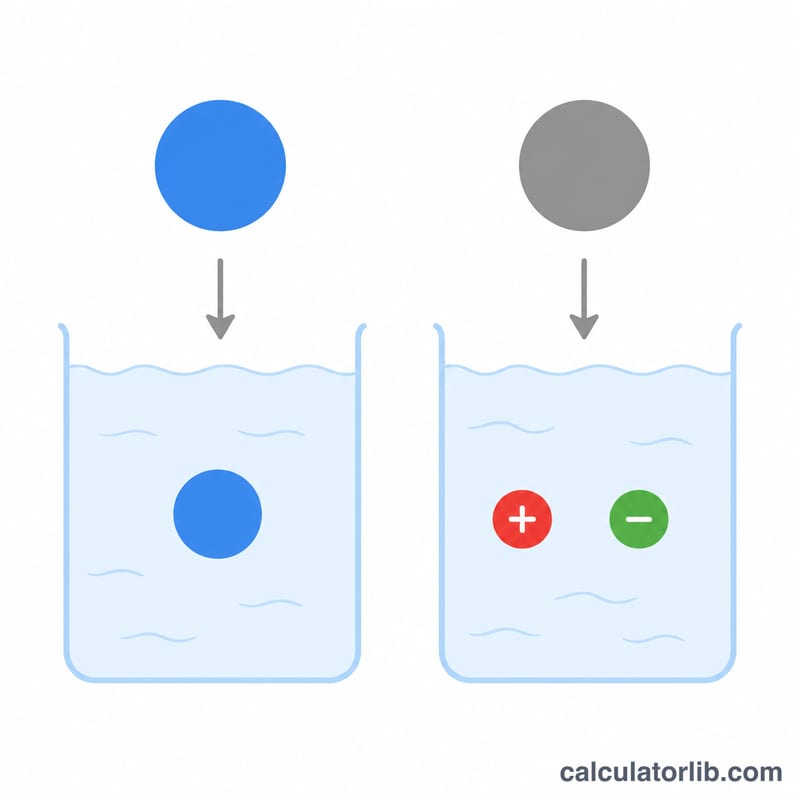
The Van't Hoff factor (i) describes how many particles a solute produces in solution per formula unit dissolved. For a non-electrolyte like sugar, \(i \approx 1\) because each molecule stays whole. For an ionic compound like NaCl, \(i\) approaches 2 (Na⁺ + Cl⁻), and CaCl₂ approaches 3. Because colligative properties depend on the number of dissolved particles, comparing the observed effect to the expected effect reveals how completely a solute dissociates.
How to Use This Calculator
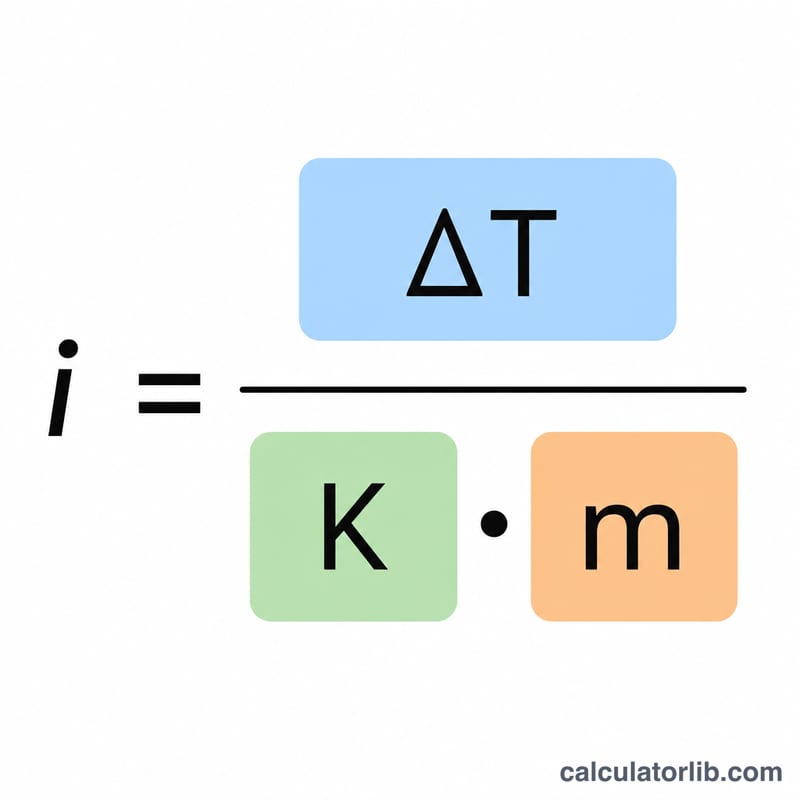
Enter three values: the observed freezing point depression \(\Delta T_f\) (in °C), the cryoscopic constant \(K_f\) of the solvent (water is 1.86 °C·kg/mol), and the molality \(m\) of the solution (mol of solute per kg of solvent). The calculator divides the observed depression by the expected depression (\(K_f \times m\)) to give the Van't Hoff factor.
The Formula Explained
The freezing point depression equation is $$\Delta T_f = i \cdot K_f \cdot m.$$ Solving for \(i\) gives $$i = \frac{\Delta T_{f,\text{obs}}}{K_f \cdot m}.$$ The denominator \(K_f \times m\) is the depression you would expect if \(i = 1\). The ratio therefore tells you the effective number of particles per formula unit, accounting for partial or incomplete dissociation and ion pairing.
Worked Example
A 0.1 mol/kg aqueous solution shows a freezing point depression of 0.37 °C. With \(K_f = 1.86\) for water, the expected depression is $$1.86 \times 0.1 = 0.186 \text{ °C}.$$ Then $$i = \frac{0.37}{0.186} \approx 1.99$$ — close to 2, consistent with a fully dissociated 1:1 salt such as NaCl.
FAQ
What does \(i > 1\) mean? The solute dissociates into multiple particles (an electrolyte).
Why is the measured \(i\) often slightly below the ideal value? Ion pairing at higher concentrations reduces the number of independent particles.
Can I use it with other colligative properties? Yes — the same ratio (observed ÷ expected) applies to boiling point elevation, osmotic pressure, and vapor pressure lowering.