
What this calculator does
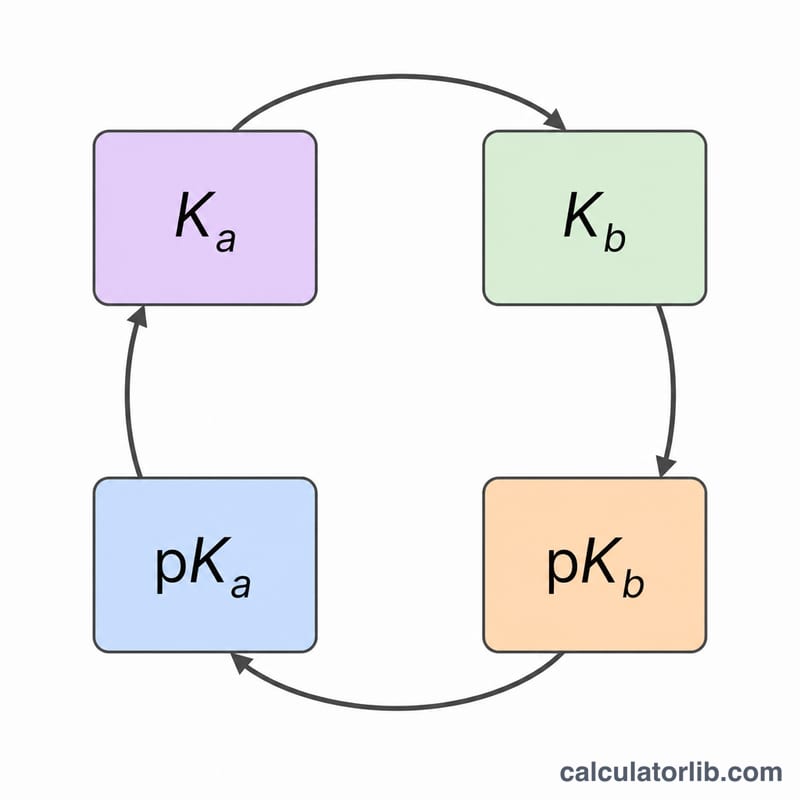
This tool converts between the four common acid-base strength descriptors: the acid dissociation constant Ka, the base dissociation constant Kb, and their logarithmic forms pKa and pKb. Enter any single value and the calculator returns the other three for the conjugate acid-base pair, assuming aqueous solution at 25 °C where the ion product of water \(\text{Kw} = 1\times10^{-14}\).
How to use it
Pick which quantity you know from the dropdown, then type its value. For Ka or Kb, use scientific notation such as 1.8e-5. For pKa or pKb, enter the plain number such as 4.74. The result panel shows pKa as the headline value and lists Ka, Kb, pKa and pKb together so you can read off whichever you need.
The formulas explained
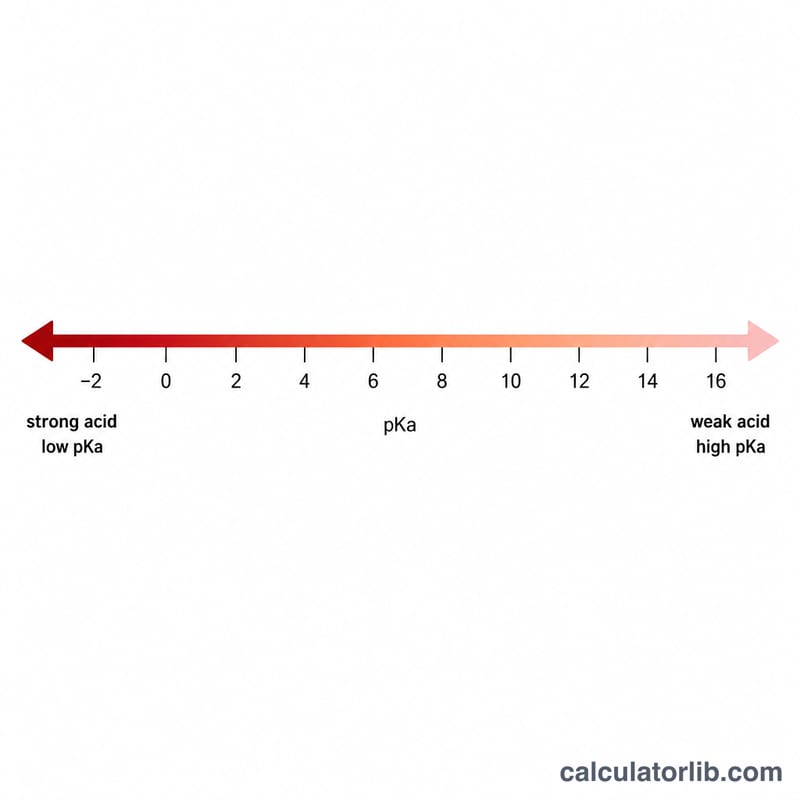
The "p" prefix means "negative base-10 logarithm," so $$\text{pKa} = -\log_{10}\!\left(\text{Ka}\right)$$ and inversely $$\text{Ka} = 10^{-\text{pKa}}$$ A smaller pKa means a stronger acid. Because every weak acid has a conjugate base, their constants are linked by water's autoionization: $$\text{Ka} \times \text{Kb} = \text{Kw} = 1\times10^{-14}$$ which in logarithmic form becomes $$\text{pKa} + \text{pKb} = 14$$ Knowing one therefore fixes all four.
Worked example
Acetic acid has \(\text{Ka} = 1.8\times10^{-5}\). Then $$\text{pKa} = -\log_{10}\!\left(1.8\times10^{-5}\right) \approx 4.745$$ Its conjugate base (acetate) has $$\text{pKb} = 14 - 4.745 = 9.255$$ and $$\text{Kb} = 10^{-9.255} \approx 5.56\times10^{-10}$$ These match the calculator output.
FAQ
Does the 14 always apply? The value 14 (and \(\text{Kw} = 10^{-14}\)) holds only at 25 °C. At other temperatures Kw changes, so \(\text{pKa} + \text{pKb}\) shifts slightly.
Strong vs weak? A low pKa (or large Ka) means a strong acid; a high pKa means a weak acid. The same logic applies to pKb for bases.
Can I enter pKb to find Ka? Yes — choose pKb in the dropdown and the tool back-calculates pKa, Ka and Kb automatically.