
What is the Ka and pKa Calculator?
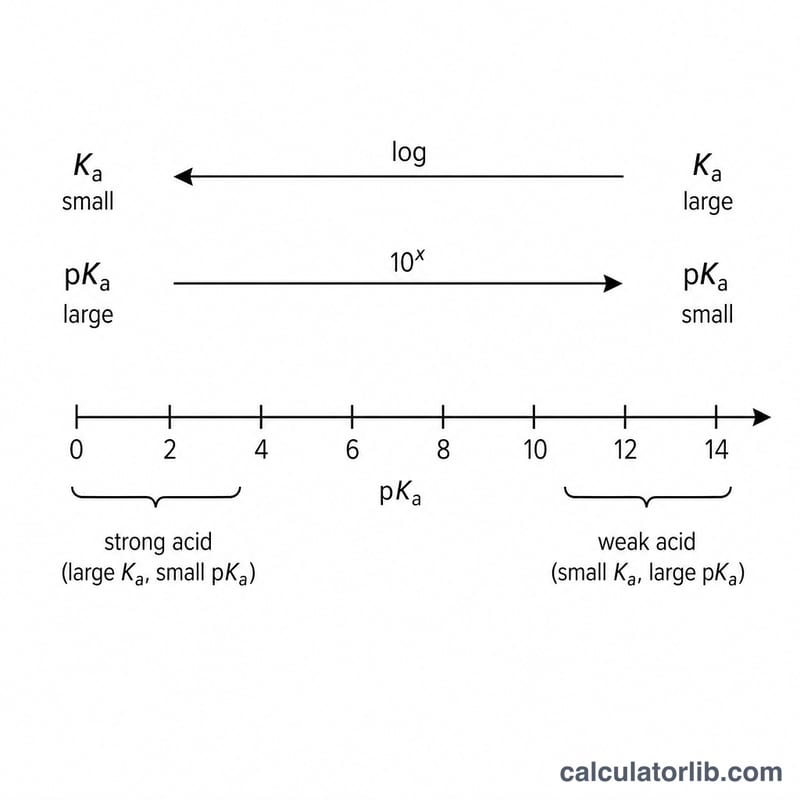
This tool converts between the acid dissociation constant (Ka) and its logarithmic form (pKa). Both describe the same property — how strongly an acid donates a proton in aqueous solution — but on different scales. Ka values often span many orders of magnitude (from about \(10^{-2}\) for moderately strong acids to \(10^{-10}\) for very weak ones), which makes the compact pKa scale far easier to compare and remember.
How to use it
Pick a conversion direction. To find pKa, choose Ka → pKa and enter the Ka value (for example 1.8e-5). To find Ka, choose pKa → Ka and enter the pKa. The calculator returns the converted value plus the matching pair so you can record both.
The formula explained
The relationships are $$\text{pKa} = -\log_{10}\left(\text{Ka}\right)$$ and $$\text{Ka} = 10^{-\text{pKa}}$$ Because the log is base 10, every whole-number change in pKa corresponds to a tenfold change in Ka. A lower pKa (and therefore a larger Ka) means a stronger acid that dissociates more completely.
Worked example
Acetic acid has \(\text{Ka} \approx 1.8 \times 10^{-5}\). Then $$\text{pKa} = -\log_{10}\left(1.8 \times 10^{-5}\right) = -(-4.745) = 4.74$$ Reversing it: \(\text{Ka} = 10^{-4.74} \approx 1.8 \times 10^{-5}\), confirming the conversion.
FAQ
Does a higher pKa mean a stronger acid? No — a higher pKa means a weaker acid. Strong acids have low (even negative) pKa values.
What is the relationship between pKa and pH? They are equal at the half-equivalence point of a titration, where the acid and conjugate base concentrations match (Henderson–Hasselbalch equation).
Can I enter scientific notation? Yes, values like 1.8e-5 are accepted for Ka.