
What This Calculator Does
The Mass Needed for Molarity Calculator tells you exactly how many grams of a solute you must weigh out to prepare a solution of a desired concentration (molarity) and volume. It is an essential bench tool for chemistry students, lab technicians, and researchers who prepare standard solutions.
How to Use It
Enter three values: the desired molarity in moles per liter (mol/L), the final volume of solution in liters, and the molar mass of your compound in grams per mole (g/mol). The calculator returns the mass of solute in grams, along with the total moles required.
The Formula Explained
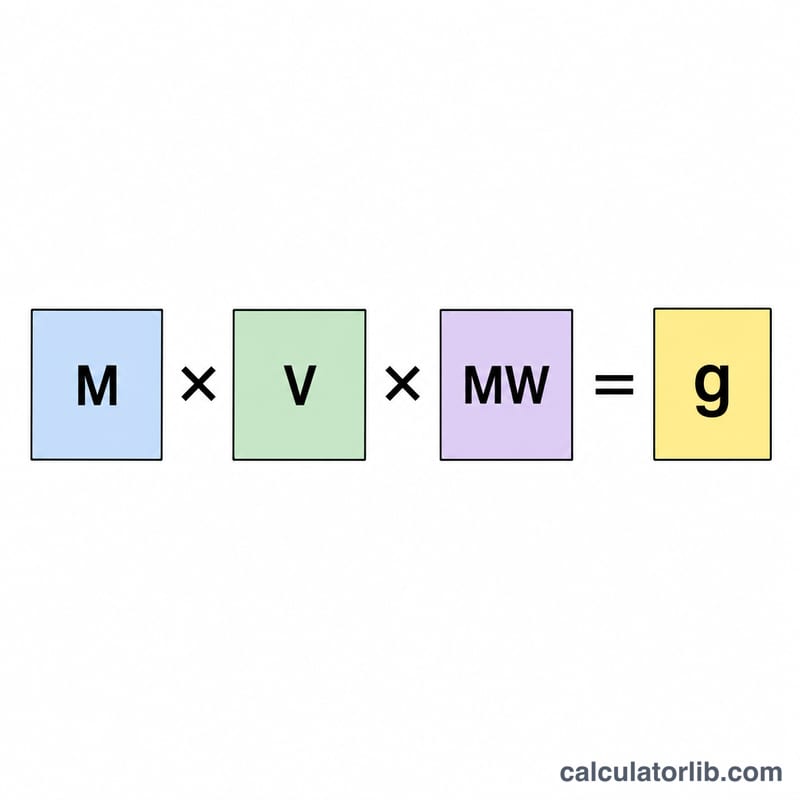
The calculation is based on the definition of molarity, \(M = \text{moles} \div \text{volume}\). Rearranging gives \(\text{moles} = M \times V\). Since \(\text{mass} = \text{moles} \times \text{molar mass}\), we combine these into a single step:
$$\text{mass (g)} = M \times V\text{(L)} \times MW$$
Molarity must be in mol/L, volume in liters, and molar mass in g/mol so that the units cancel to leave grams.
Worked Example
Suppose you want to make 0.5 liters of a 2 mol/L sodium chloride (NaCl) solution. NaCl has a molar mass of about 58.44 g/mol. The mass needed is:
$$\text{mass} = 2 \times 0.5 \times 58.44 = \mathbf{58.44 \text{ g}}$$ You would also need \(2 \times 0.5 = 1\) mole of NaCl.
FAQ
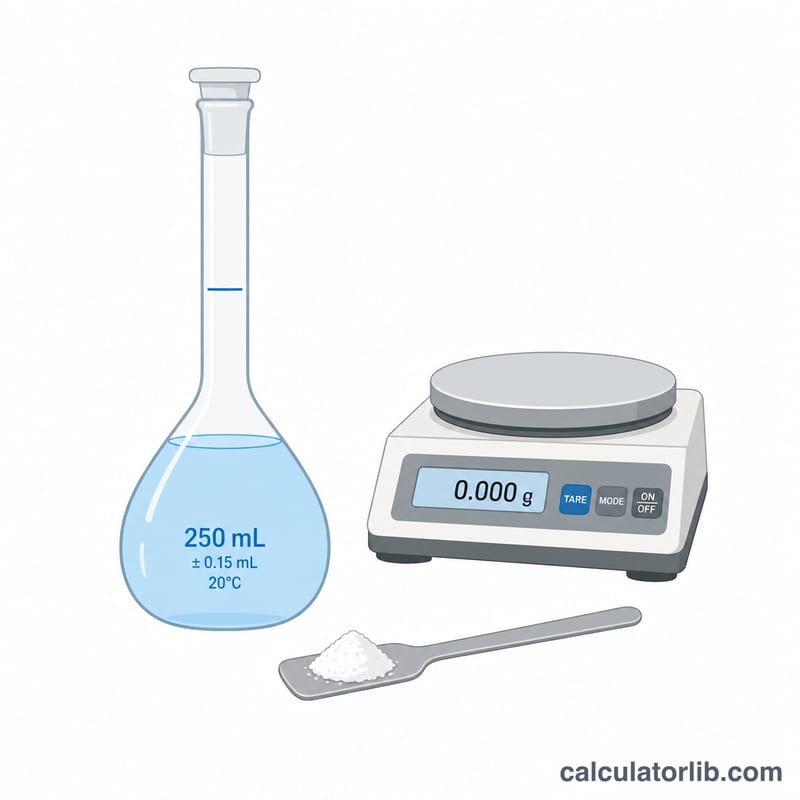
What if my volume is in milliliters? Convert to liters first by dividing by 1000 (e.g. 250 mL = 0.25 L).
Where do I find the molar mass? Add up the atomic masses of all atoms in the chemical formula, or look it up on a periodic table or chemical supplier datasheet.
Does this account for hydrates or purity? No. If your reagent is a hydrate, use the hydrated molar mass. For reagents below 100% purity, divide the result by the fractional purity.