
What is a Hex to Decimal Converter?
A hexadecimal (base 16) number uses sixteen symbols — 0-9 and A-F — to represent values, where A=10, B=11, C=12, D=13, E=14 and F=15. This converter turns any hex value into its everyday decimal (base 10) equivalent. Hexadecimal is common in computing for memory addresses, color codes (like #FF8800), and byte values, so converting to decimal makes those numbers easier to understand.
How to use it
Type a hex value into the box — uppercase or lowercase letters both work, and an optional 0x prefix is accepted. Press calculate and the tool shows the exact decimal value plus how many hex digits were read. If a character outside 0-9 or A-F is entered, the result is flagged as invalid.
The formula explained
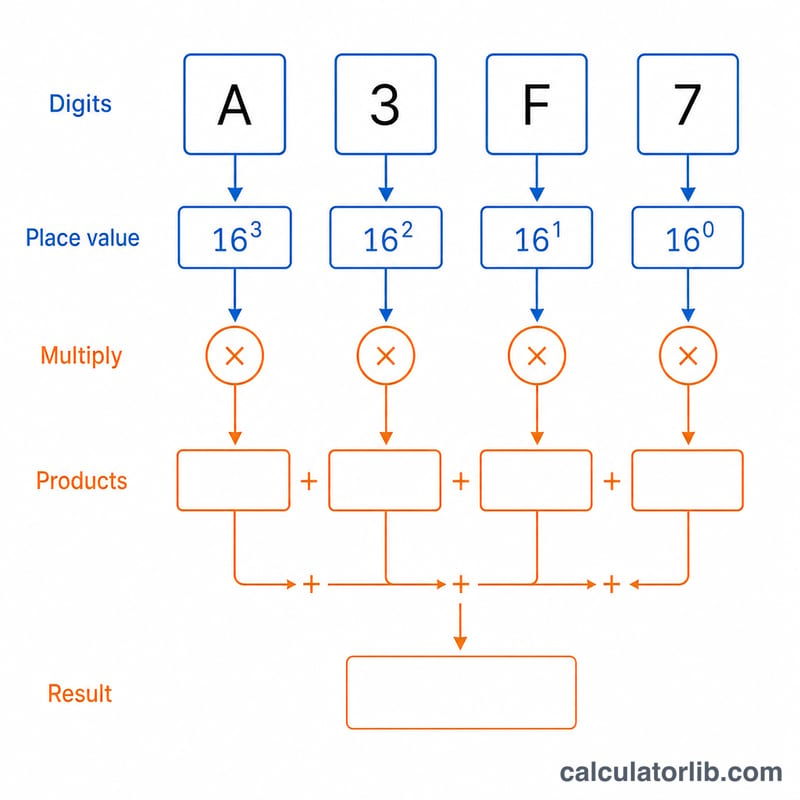
Each digit contributes its face value multiplied by a power of 16 based on its position from the right (the rightmost position is 0). The total is the sum of all contributions:
$$\text{decimal} = \sum_{i=0}^{n-1} d_i \times 16^{\,i}$$
Worked example
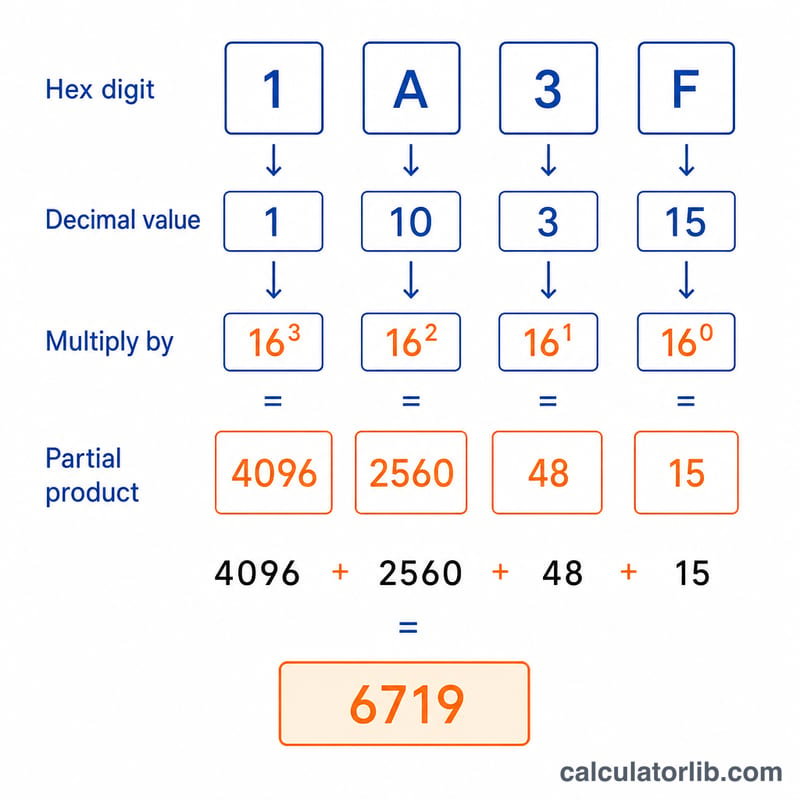
Convert 1A3F:
\(1 \times 16^3 = 1 \times 4096 = 4096\)
\(\text{A } (10) \times 16^2 = 10 \times 256 = 2560\)
\(3 \times 16^1 = 3 \times 16 = 48\)
\(\text{F } (15) \times 16^0 = 15 \times 1 = 15\)
$$\text{Sum} = 4096 + 2560 + 48 + 15 = 6719$$ So hex 1A3F equals decimal 6719.
FAQ
Is hex case-sensitive? No — FF and ff convert to the same value (255).
Can I include the 0x prefix? Yes, 0x1A3F and 1A3F give the same answer.
What is the largest value I can convert? Very large hex numbers are supported, though extremely long inputs may lose precision beyond about 15–16 decimal digits due to floating-point limits.