
What is pOH?
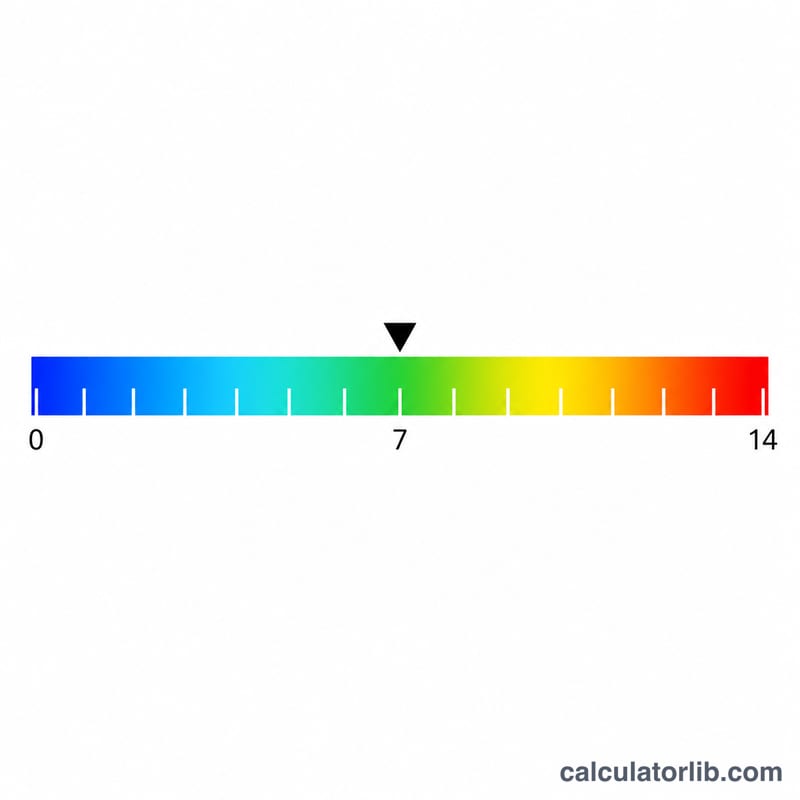
pOH is a measure of the hydroxide ion (OH⁻) concentration in an aqueous solution. Just as pH tracks the acidity (hydrogen ion concentration), pOH tracks the basicity. It is defined as the negative base-10 logarithm of the hydroxide ion concentration in moles per liter. A low pOH means a strongly basic solution, while a high pOH means a more acidic one.
How to use this calculator
Choose how you want to calculate. If you know the hydroxide concentration [OH⁻] in mol/L, select that option and enter the value — the calculator returns pOH, the matching pH, and confirms the concentration. If you only know the pH, select "pH value" and the calculator uses \(\text{pH} + \text{pOH} = 14\) to find pOH, then back-calculates [OH⁻].
The formula explained
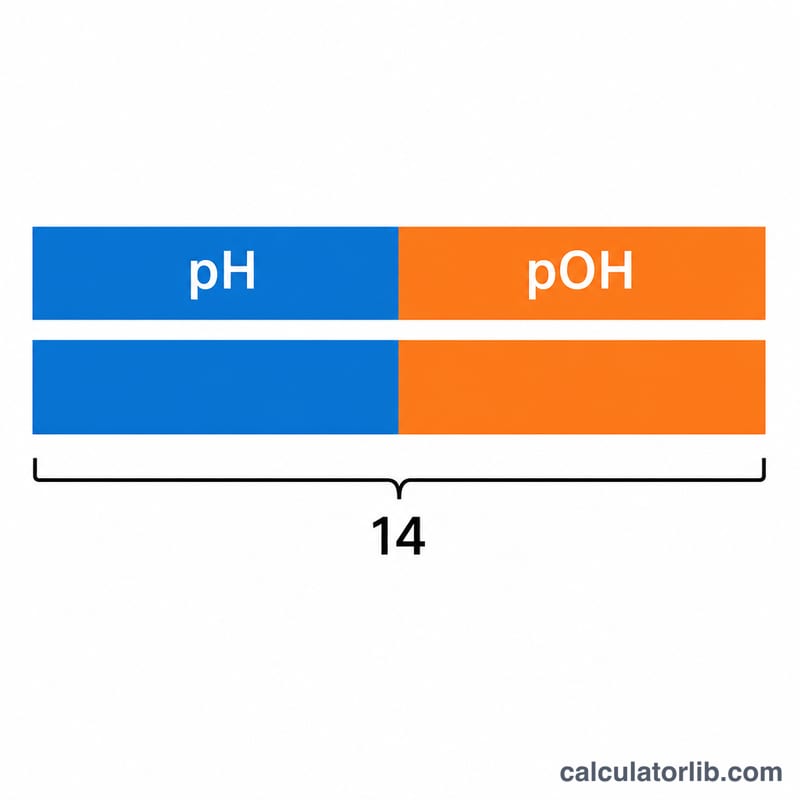
The core equation is $$\text{pOH} = -\log_{10}\left(\text{[OH}^-\text{]}\right)$$ Because water self-ionizes with an ion product \(K_w = 1\times10^{-14}\) at 25 °C, the pH and pOH of any aqueous solution always add to 14: $$\text{pH} + \text{pOH} = 14$$ You can rearrange this to get \(\text{[OH}^-\text{]} = 10^{-\text{pOH}}\).
Worked example
Suppose [OH⁻] = 0.001 mol/L (1×10⁻³). Then $$\text{pOH} = -\log_{10}(0.001) = -(-3) = 3$$ The corresponding \(\text{pH} = 14 - 3 = 11\), indicating a basic solution. Conversely, if you enter pH = 11, the calculator returns pOH = 3 and \(\text{[OH}^-\text{]} = 10^{-3} = 0.001\) mol/L.
FAQ
Does pH + pOH always equal 14? Only at 25 °C, where \(K_w = 1\times10^{-14}\). At other temperatures Kw changes, so the sum differs slightly. This calculator assumes 25 °C.
What pOH means a basic solution? A pOH below 7 corresponds to a basic (alkaline) solution; above 7 is acidic; exactly 7 is neutral.
Can pOH be negative? Yes — for very concentrated strong bases where [OH⁻] exceeds 1 mol/L, pOH becomes negative, mirroring how very strong acids can have a negative pH.