
What Is the Wire Resistance Calculator?
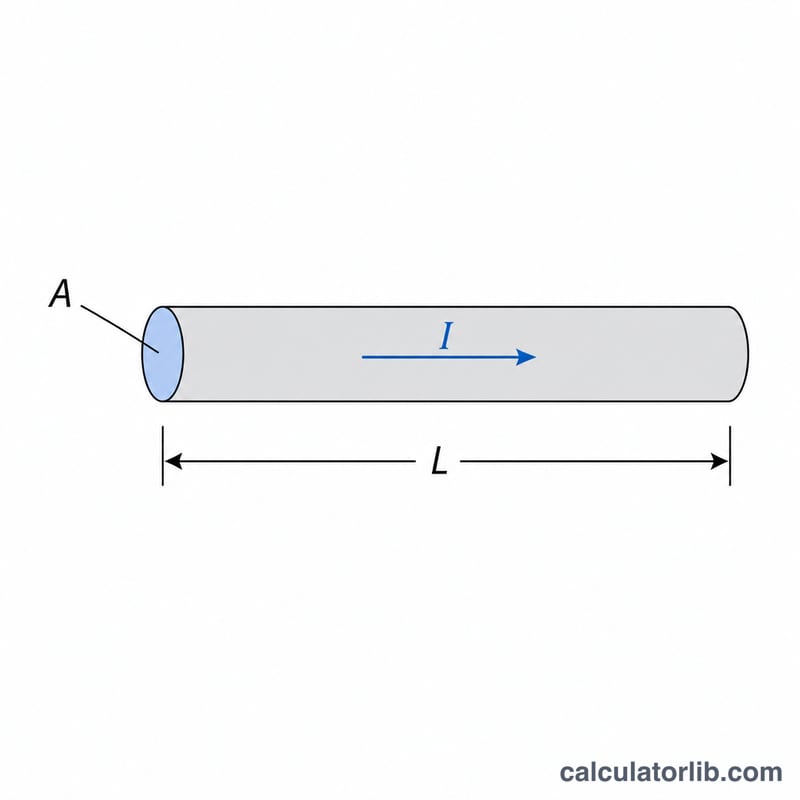
This calculator finds the electrical resistance of a conductor (a wire) from three physical properties: the material's resistivity (\(\rho\)), the wire's length (\(L\)), and its cross-sectional area (\(A\)). It applies universally to any straight, uniform conductor and uses SI units throughout.
How to Use It
Enter the resistivity of the wire material in ohm-meters (\(\Omega\cdot\text{m}\)). Common values are copper \(\approx 1.68\times10^{-8}\ \Omega\cdot\text{m}\) and aluminum \(\approx 2.82\times10^{-8}\ \Omega\cdot\text{m}\). Then enter the wire length in meters and the cross-sectional area in square meters. For a round wire of radius \(r\), the area \(A = \pi r^2\). The calculator returns the resistance in ohms (\(\Omega\)).
The Formula Explained
The governing equation is $$R = \frac{\rho L}{A}$$ Resistance rises directly with length — a longer wire opposes current more — and falls as the cross-sectional area grows, since a thicker wire offers more room for electrons to flow. Resistivity \(\rho\) is an intrinsic property of the material that captures how strongly it resists current at a given temperature.
Worked Example
Suppose a copper wire is 10 m long with a cross-sectional area of \(1\times10^{-6}\ \text{m}^2\) (1 mm²). With \(\rho = 1.68\times10^{-8}\ \Omega\cdot\text{m}\): $$R = \frac{1.68\times10^{-8} \times 10}{1\times10^{-6}} = \frac{1.68\times10^{-7}}{1\times10^{-6}} = 0.168\ \Omega$$ The wire has about 0.168 ohms of resistance.
FAQ
Does temperature affect this? Yes — resistivity increases with temperature for metals. The value you enter should match the operating temperature; reference tables usually quote \(\rho\) at 20 °C.
What units must I use? SI units: \(\rho\) in \(\Omega\cdot\text{m}\), length in meters, area in square meters. The result is then in ohms.
How do I get the area from wire gauge? Convert the diameter to meters and use \(A = \pi(d/2)^2\). For a 1 mm diameter wire, \(A = \pi(0.0005)^2 \approx 7.85\times10^{-7}\ \text{m}^2\).