
What Is Internal Resistance?
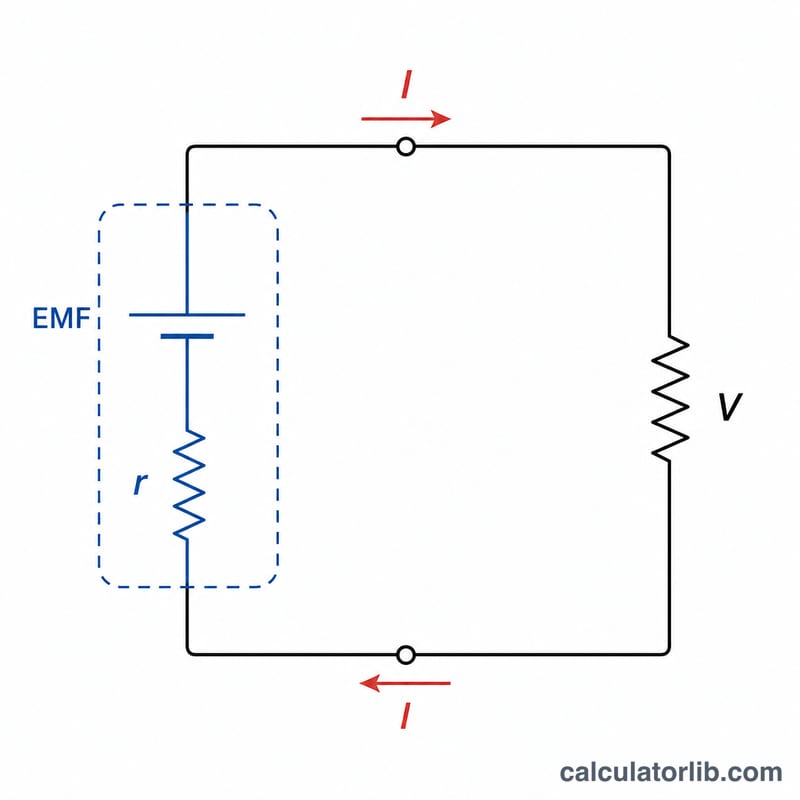
Every real battery or electrochemical cell has a small amount of resistance inside it, caused by the electrolyte, electrode materials, and connections. This internal resistance (\(r\)) is why the voltage you measure across a battery's terminals drops when it supplies current to a load. The internal resistance converts some electrical energy into heat, reducing the useful voltage and limiting how much current the cell can deliver.
How to Use This Calculator
Enter three values: the cell's electromotive force (EMF, its open-circuit voltage), the terminal voltage measured while current flows, and the current drawn by the circuit. The calculator instantly returns the internal resistance in ohms, along with the total voltage drop across the internal resistance.
The Formula Explained
The relationship comes from Kirchhoff's voltage law applied to a cell driving a load:
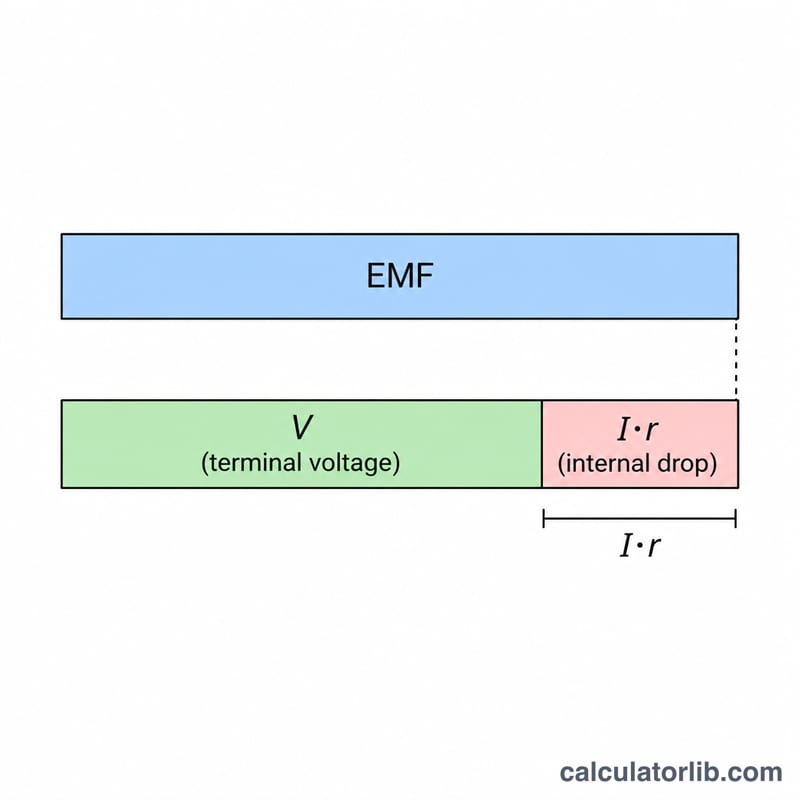
$$r = \frac{\text{EMF} - V}{I}$$
Here EMF is the no-load voltage, \(V\) is the terminal voltage under load, and \(I\) is the current. The numerator \((\text{EMF} - V)\) is the voltage "lost" inside the battery, and dividing by the current gives the resistance responsible for that loss. Lower internal resistance means a healthier, more efficient cell.
Worked Example
A 12 V battery (EMF) shows a terminal voltage of 11.4 V while delivering 2 A to a headlight. The voltage drop is \(12 - 11.4 = 0.6\) V. Dividing by the 2 A current: $$r = \frac{0.6}{2} = \mathbf{0.3\ \Omega}$$ So this battery has an internal resistance of 0.3 ohms.
FAQ
Why does internal resistance increase over time? As batteries age, chemical changes and corrosion raise their internal resistance, which lowers terminal voltage under load and reduces capacity.
How do I measure EMF? Measure the open-circuit voltage with a high-impedance voltmeter while no current flows — that reading approximates the EMF.
What is a good internal resistance value? It depends on the cell. A healthy AA alkaline is often well under \(1\ \Omega\), while large lead-acid batteries can be a few milliohms. Lower is generally better.