
What is the PCB Trace Resistance Calculator?
This tool estimates the DC electrical resistance of a copper trace on a printed circuit board. Knowing trace resistance helps engineers predict voltage drop, power loss, and heating in power and signal paths, and decide whether a trace needs to be wider or heavier copper.
How to use it
Enter the trace length in millimetres, the trace width in mils, the copper weight in ounces (commonly 0.5, 1, or 2 oz), and the operating temperature in degrees Celsius. The calculator returns the resistance in ohms and milliohms.
The formula explained
Resistance follows the classic relation \(R = \rho L / A\), where the cross-sectional area \(A\) equals width \(\times\) thickness. Copper resistivity \(\rho\) is taken as \(1.724 \times 10^{-8}\ \Omega\cdot\text{m}\). Copper weight is converted to thickness using 1 oz \(\approx\) 1.378 mil, and 1 mil = 0.0254 mm. A temperature term \((1 + \alpha(T-25))\) with \(\alpha = 0.00393\ /^\circ\text{C}\) adjusts resistance away from the 25°C reference.
$$R = \frac{\rho \, L}{A}\left[1 + \alpha\left(\text{Temp} - 25\right)\right]$$ $$\text{where}\quad \left\{ \begin{aligned} \rho &= 1.724\times10^{-8}\ \Omega\cdot\text{m},\quad \alpha = 0.00393 \\ L &= \text{Length (mm)}\times 10^{-3} \\ A &= \left(\text{Width (mil)}\times 0.0254\times10^{-3}\right)\cdot\left(\text{Weight (oz)}\times 1.378\times 0.0254\times10^{-3}\right) \end{aligned} \right.$$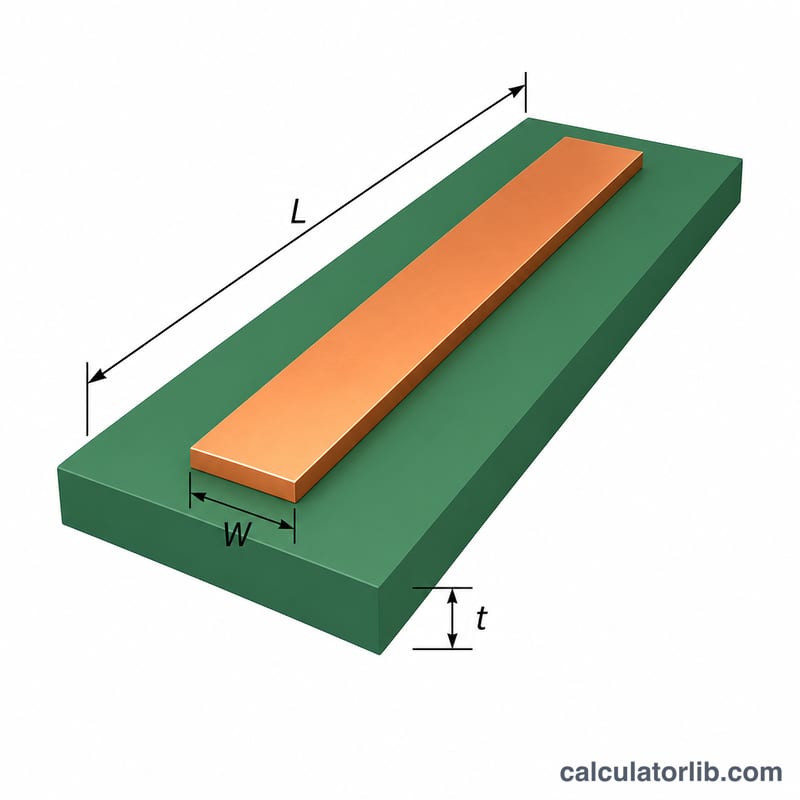
Worked example
For a 100 mm long, 10 mil wide, 1 oz trace at 25 °C: thickness = 1.378 mil = 0.0350 mm, width = 0.254 mm, area = \(0.0350 \times 0.254\ \text{mm}^2\).
$$R = \frac{1.724\times10^{-8} \times 0.1}{\text{area in m}^2} \approx 0.000194\ \Omega,\ \text{or about } 194\ \text{m}\Omega.$$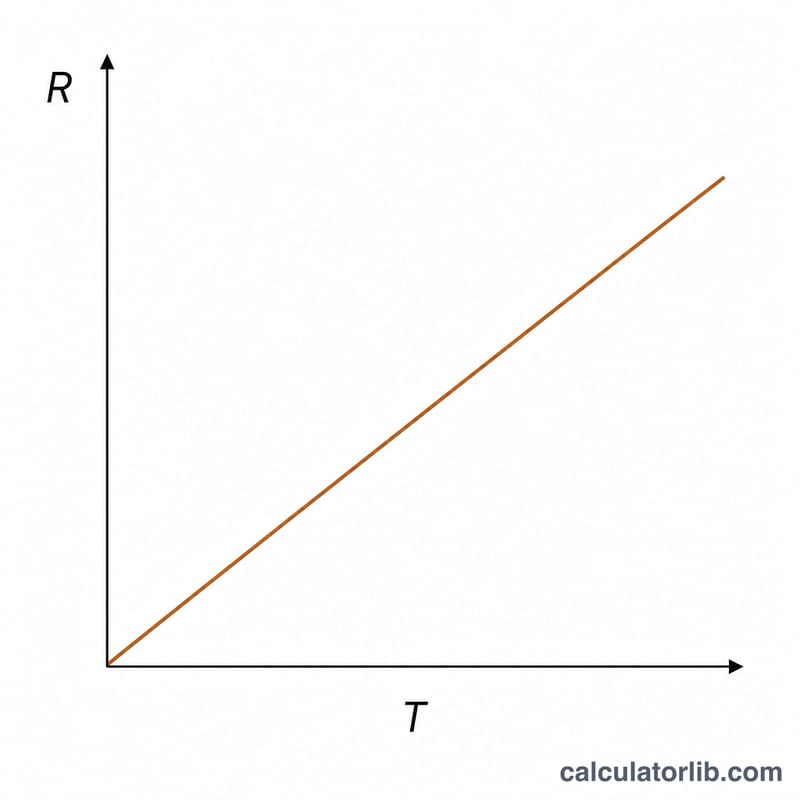
FAQ
Does this include the temperature rise of the trace itself? No. It applies the resistance at the ambient temperature you enter; self-heating from current is not modeled.
Why mils for width but mm for length? Trace widths are conventionally specified in mils in PCB design tools, while board dimensions are often in millimetres. You can use any consistent values.
Is this AC or DC resistance? This is the DC resistance. Skin effect at high frequency would increase effective resistance.