
What Is Thermal Resistance?
Thermal resistance (R) measures how strongly a material layer opposes the conductive flow of heat. A higher R value means better insulation, since the material lets less heat pass for a given temperature difference. It is a fundamental quantity in building physics, electronics cooling, and heat-transfer engineering. This calculator uses the steady-state conduction relationship to find R from a layer's geometry and material properties.
How to Use This Calculator
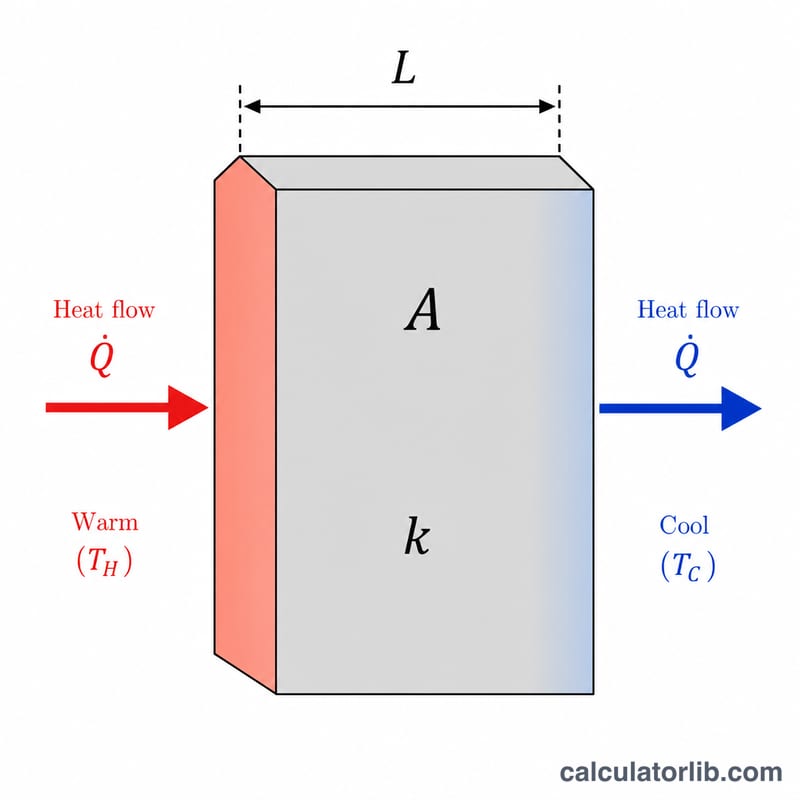
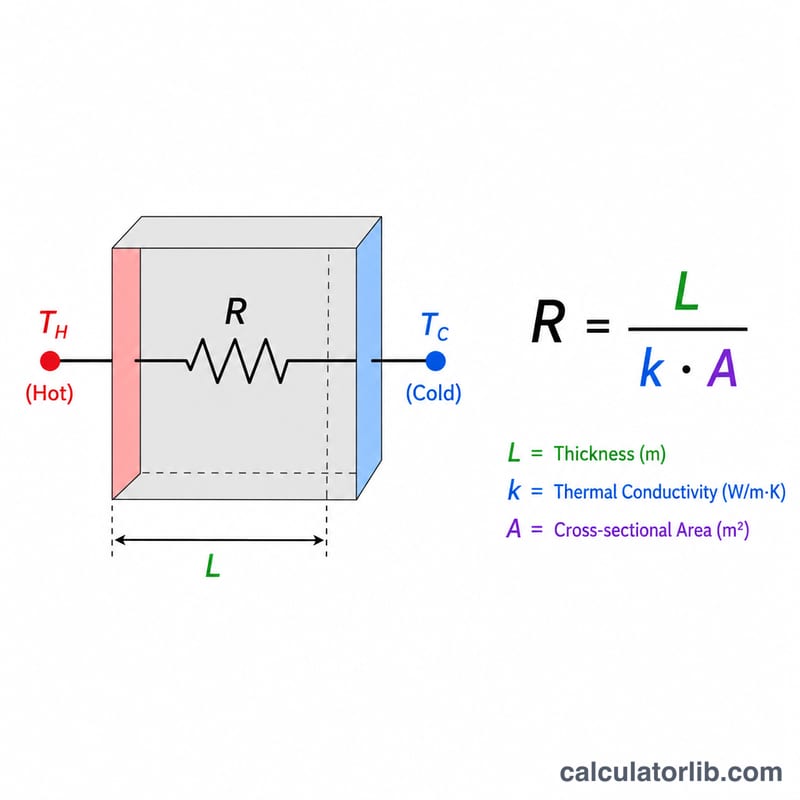
Enter three values: the thickness of the material L in metres (the distance heat must travel), the thermal conductivity k in W/m·K (a material property), and the area A in square metres through which heat flows. The calculator returns the thermal resistance R in kelvin per watt (K/W) and the thermal conductance \(U = 1/R\) in W/K.
The Formula Explained
The governing equation is $$R = \frac{\text{Thickness } L}{\text{Conductivity } k \cdot \text{Area } A}$$ Resistance grows with thickness because heat has farther to travel, and it shrinks with higher conductivity or larger area because both make it easier for heat to pass. Materials with low \(k\) (like foam or fibreglass, \(k \approx 0.04\) W/m·K) produce high resistance and are good insulators, while metals (high \(k\)) produce very low resistance.
Worked Example
Consider a 0.1 m thick foam panel with conductivity \(k = 0.04\) W/m·K covering an area of 10 m². Then $$R = \frac{0.1}{0.04 \times 10} = \frac{0.1}{0.4} = 0.25 \text{ K/W}$$ The conductance is \(U = 1/0.25 = 4\) W/K, meaning 4 watts flow per kelvin of temperature difference across the panel.
FAQ
What units does this use? SI units: metres, W/m·K, and m², giving resistance in K/W.
What's the difference between R-value and this R? Building "R-value" is often the area-normalised resistance (\(R = L/k\), units m²·K/W). This calculator includes area, giving the absolute resistance of the whole component in K/W.
Can I add layers? Yes — for layers in series, the total resistance is the sum of each layer's R.