
What Is Thermal Equilibrium?
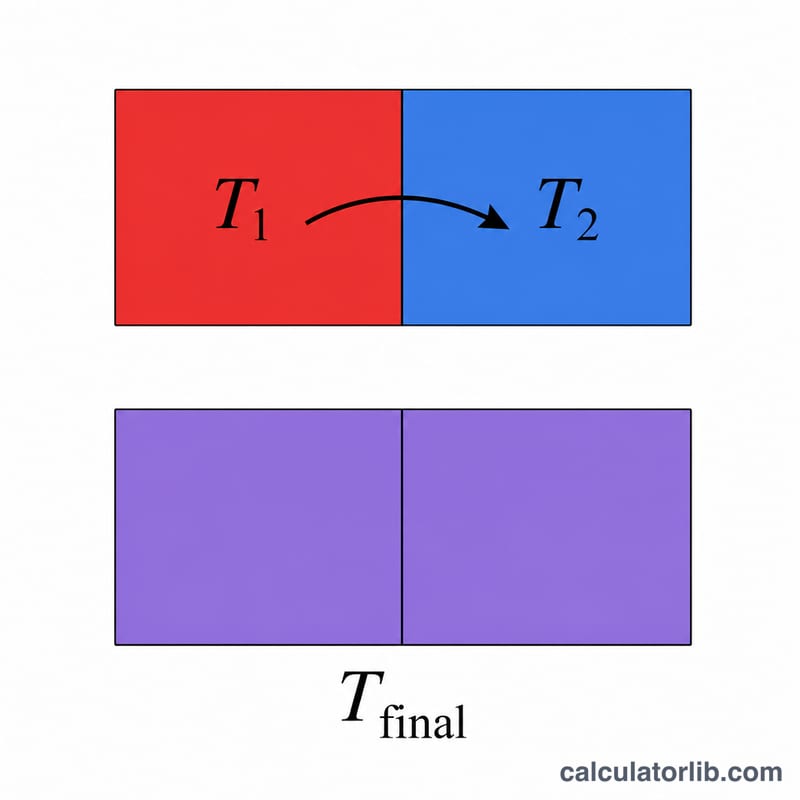
When two objects or substances at different temperatures are brought into thermal contact in an insulated system, heat flows from the hotter body to the colder one until they reach a single shared temperature called the thermal equilibrium temperature. This calculator finds that final temperature from the mass, specific heat, and starting temperature of each substance — a classic problem in physics and chemistry calorimetry.
How to Use This Calculator
Enter the mass, specific heat capacity, and initial temperature for both substances. Use consistent units: if mass is in grams, use specific heat in J/g·°C (water ≈ 4.186 J/g·°C). The result shows the equilibrium temperature plus each substance's heat capacity and the heat (Q) it gains or loses. A negative Q means the substance lost heat (cooled); a positive Q means it gained heat (warmed).
The Formula Explained
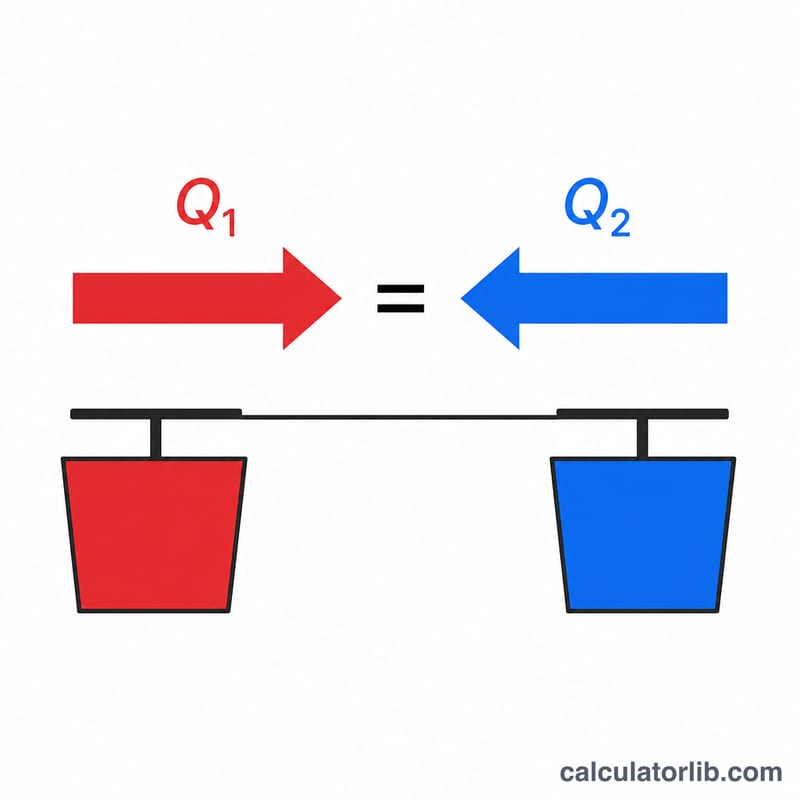
Conservation of energy requires that the heat lost by the hot substance equals the heat gained by the cold one: \(m_1 c_1 (T_f - T_1) + m_2 c_2 (T_f - T_2) = 0\). Solving for \(T_f\) gives a heat-capacity-weighted average of the two temperatures:
$$T_{\text{final}} = \frac{m_1 c_1 T_1 + m_2 c_2 T_2}{m_1 c_1 + m_2 c_2}$$
The product \(m \cdot c\) is the heat capacity — a larger value pulls the final temperature toward that substance's starting temperature.
Worked Example
Mix 200 g of water at 80 °C with 300 g of water at 20 °C (c = 4.186 J/g·°C each). Heat capacities are 837.2 and 1255.8 J/°C. $$T_{\text{final}} = \frac{837.2 \times 80 + 1255.8 \times 20}{837.2 + 1255.8} = \frac{66976 + 25116}{2093} = \frac{92092}{2093} \approx 44\ ^\circ\text{C}$$
FAQ
Does this assume no heat loss? Yes — it models a perfectly insulated system with no heat lost to surroundings or container.
Can I use Kelvin? Yes. Because the formula is a weighted average, the final temperature comes out in whatever temperature unit you input, as long as both are the same.
What if the substances are different? Just enter each substance's own specific heat — for example metal (c ≈ 0.385 for copper) dropped into water works the same way.