
What Is the Bohr Model Calculator?
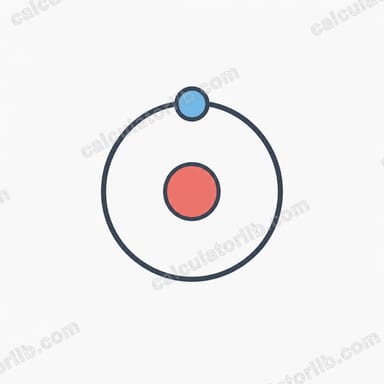
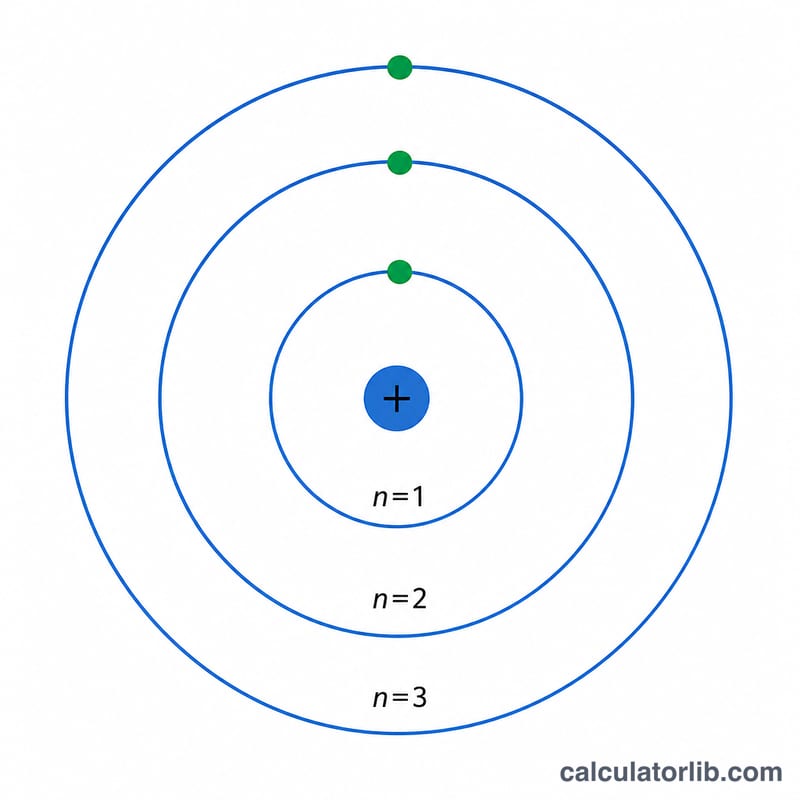
The Bohr model, proposed by Niels Bohr in 1913, describes a hydrogen-like atom as a small positively charged nucleus orbited by an electron in fixed, quantized circular orbits. This calculator computes the radius of an electron orbit and its energy level for any hydrogen-like (single-electron) atom or ion. It works for hydrogen (Z = 1) as well as ions such as He⁺ (Z = 2) and Li²⁺ (Z = 3).
How to Use It
Enter two integers: the principal quantum number n (1, 2, 3, …), which labels the orbit, and the atomic number Z (the number of protons in the nucleus). The calculator returns the orbit radius in nanometers and picometers, the energy of that level in electron-volts (eV), and the electron's orbital speed.
The Formulas Explained
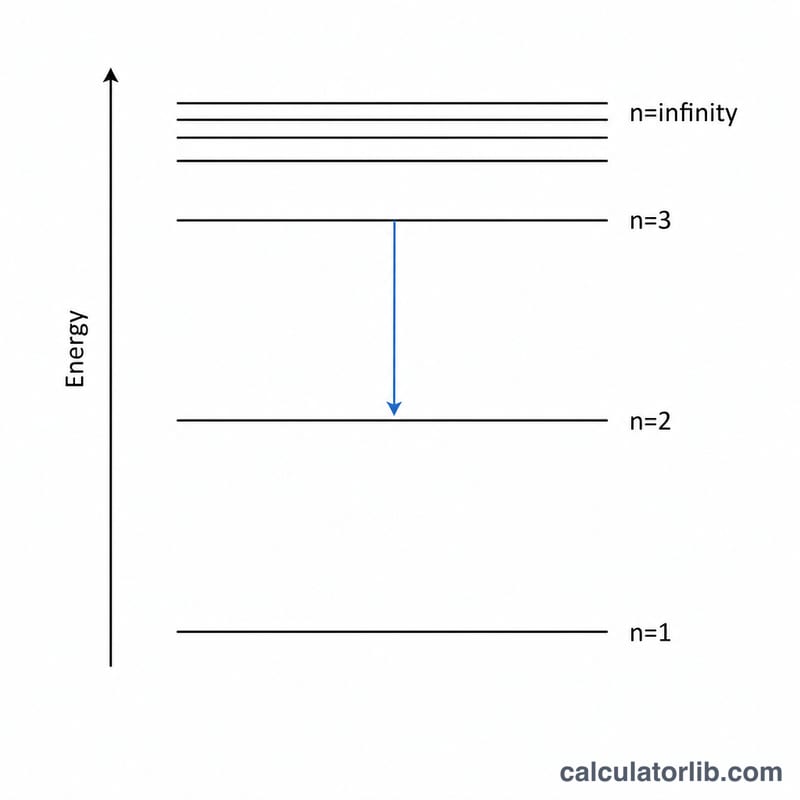
The orbit radius is $$r_n = \frac{n^{2} \cdot a_0}{Z}$$ where \(a_0 \approx 0.0529\ \text{nm}\) is the Bohr radius — the radius of hydrogen's ground state. Orbits grow with the square of \(n\) and shrink as nuclear charge \(Z\) increases. The energy level is $$E_n = -13.6 \cdot \frac{Z^{2}}{n^{2}}\ \text{eV}$$ Energies are negative because the electron is bound; the value 13.6 eV is hydrogen's ground-state ionization energy.
Worked Example
For hydrogen (Z = 1) in the second orbit (n = 2): $$r_2 = \frac{2^{2} \times 0.0529}{1} = 0.2117\ \text{nm}$$ and $$E_2 = -13.6 \times \frac{1}{4} = -3.4\ \text{eV}$$ The electron is farther out and less tightly bound than in the ground state (\(-13.6\ \text{eV}\)).
Constants & Reference Values
The Bohr model uses a small set of fundamental constants. The orbit radius scales with the Bohr radius \(a_0\), while the energy levels scale with the Rydberg energy. The values below are the modern CODATA-recommended figures.
| Quantity | Symbol | Value (SI) |
|---|---|---|
| Bohr radius | \(a_0\) | 0.05292 nm = 52.92 pm = 5.292 × 10⁻¹¹ m |
| Rydberg energy (ground state) | \(E_1\) (H) | 13.606 eV = 2.180 × 10⁻¹⁸ J |
| Electron rest mass | \(m_e\) | 9.109 × 10⁻³¹ kg |
| Elementary charge | \(e\) | 1.602 × 10⁻¹⁹ C |
| Coulomb constant | \(k = \frac{1}{4\pi\varepsilon_0}\) | 8.988 × 10⁹ N·m²·C⁻² |
| Reduced Planck constant | \(\hbar\) | 1.055 × 10⁻³⁴ J·s |
| Ground-state orbital speed (H) | \(v_1\) | 2.188 × 10⁶ m/s |
| Fine-structure constant | \(\alpha = v_1/c\) | 7.297 × 10⁻³ ≈ 1/137 (dimensionless) |
The orbital speed at the ground state of hydrogen equals \(\alpha c\), where \(c\) is the speed of light. This is why \(\alpha\) is also called the fine-structure constant — it sets the scale of the electron's motion relative to light.
FAQ
Does this work for multi-electron atoms? The Bohr model is exact only for single-electron systems (H, He⁺, Li²⁺, etc.). For other atoms it gives an approximation.
Why is the energy negative? A bound electron has less energy than a free one at rest infinitely far away (defined as 0), so bound states are negative.
What is the Bohr radius? \(a_0 \approx 0.0529\ \text{nm}\) (52.9 pm) is the most probable distance between the proton and electron in ground-state hydrogen.