
What Is Compton Scattering?
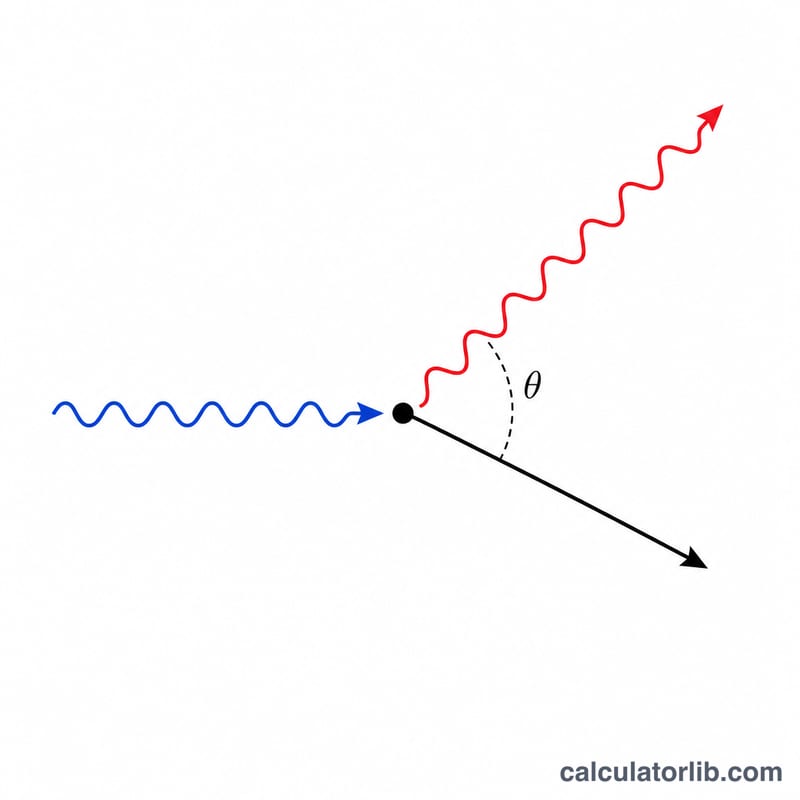
Compton scattering describes how an X-ray or gamma-ray photon loses energy when it collides with a free or loosely bound electron. Discovered by Arthur Compton in 1923, the effect provided decisive evidence that light carries momentum and behaves as a particle. After the collision the scattered photon has a longer wavelength than the incident photon, and the difference is called the Compton shift, \(\Delta\lambda\).
The Formula Explained
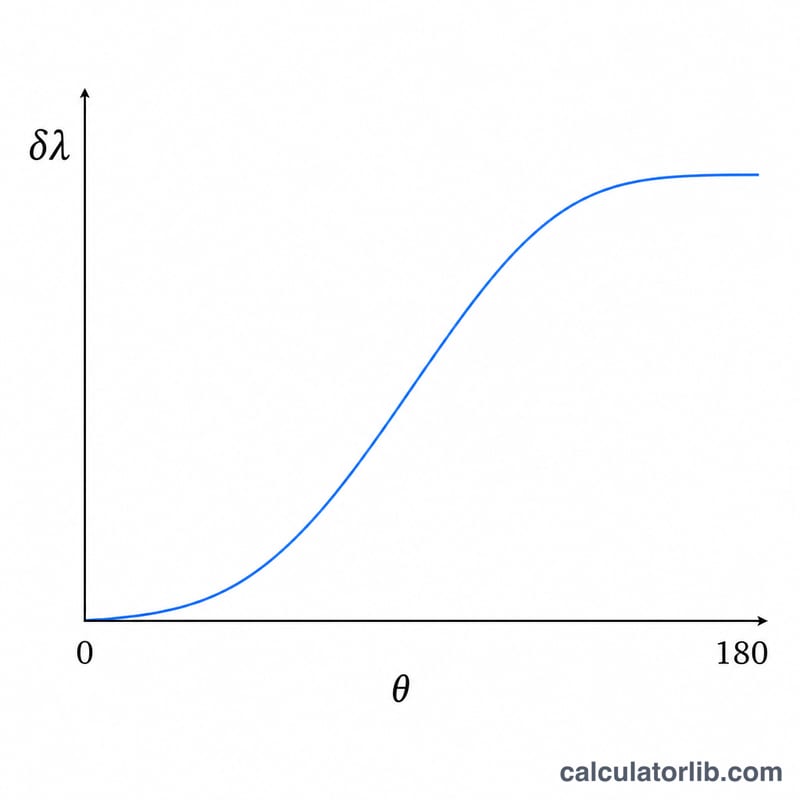
The wavelength shift depends only on the scattering angle \(\theta\), not on the original wavelength:
$$\Delta\lambda = \frac{h}{m_e c}\left(1 - \cos\theta\right)$$
Here \(h\) is Planck's constant (\(6.626 \times 10^{-34}\ \text{J}\cdot\text{s}\)), \(m_e\) is the electron rest mass (\(9.109 \times 10^{-31}\ \text{kg}\)) and \(c\) is the speed of light (\(2.998 \times 10^{8}\ \text{m/s}\)). The combination \(h/(m_e c)\) is the electron Compton wavelength, \(\approx 2.426 \times 10^{-12}\ \text{m}\) (\(2.426\ \text{pm}\)). The shift is zero at \(\theta = 0^\circ\) (forward scatter) and maximal at \(\theta = 180^\circ\) (back-scatter), where \(\Delta\lambda = 2 \times 2.426\ \text{pm}\).
How to Use the Calculator
Enter the incident photon wavelength in nanometers and the scattering angle in degrees (0–180). The calculator returns the Compton shift \(\Delta\lambda\) in picometers and nanometers, plus the resulting scattered wavelength \(\lambda^{\prime} = \lambda + \Delta\lambda\).
Worked Example
For a 90° scattering angle, \(\cos 90^\circ = 0\), so $$\Delta\lambda = \frac{h}{m_e c} \times (1 - 0) = 2.426\ \text{pm}.$$ If the incident X-ray has a wavelength of 0.005 nm (5 pm), the scattered wavelength becomes \(5 + 2.426 = 7.426\ \text{pm} \approx 0.007426\ \text{nm}\).
FAQ
Why doesn't the shift depend on incident wavelength? The formula contains only constants and the angle, so a given angle always produces the same absolute shift \(\Delta\lambda\) regardless of the starting wavelength.
What is the maximum possible shift? At \(\theta = 180^\circ\) the factor \((1 - \cos\theta) = 2\), giving the largest shift of \(4.852\ \text{pm}\).
Does this apply to visible light? The shift (a few pm) is negligible compared with visible wavelengths (hundreds of nm), so the effect is only measurable for X-rays and gamma rays.