
What Is the Compton Wavelength?
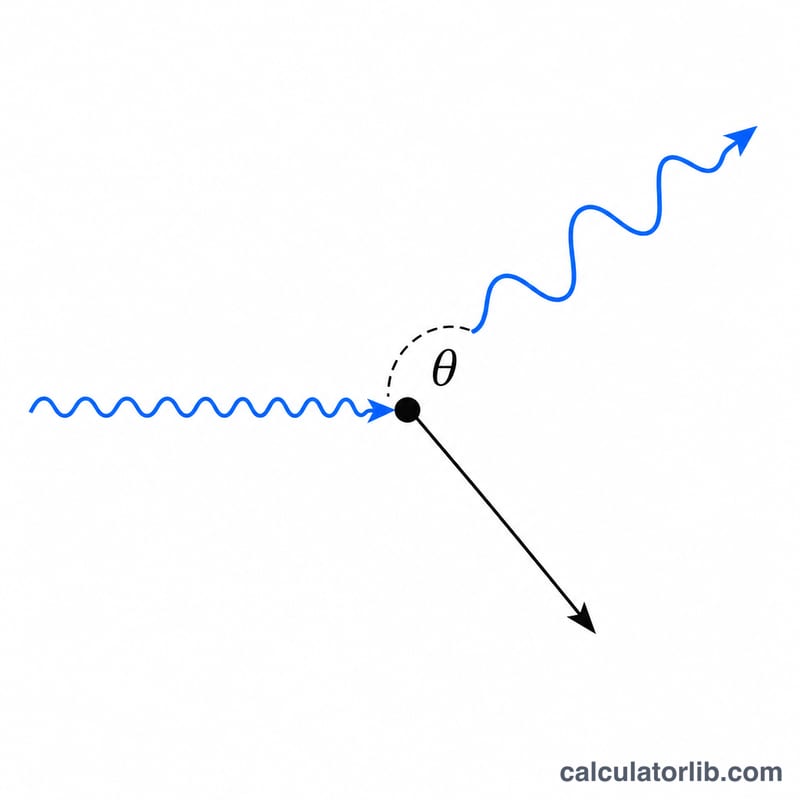
The Compton wavelength is a fundamental quantum-mechanical property of a particle, defined as the wavelength of a photon whose energy equals the rest-mass energy of that particle. It sets a natural length scale below which quantum field effects become important. For the electron, the Compton wavelength is about 2.43 picometers. This calculator works for any particle — simply enter its mass in kilograms.
How to Use the Calculator
Enter the particle's rest mass in kilograms. The field defaults to the electron mass (9.1093837015 × 10⁻³¹ kg). Press calculate to obtain the Compton wavelength in meters along with the equivalent photon frequency. To use a proton, enter 1.67262192e-27; for a muon, enter 1.883531627e-28.
The Formula Explained
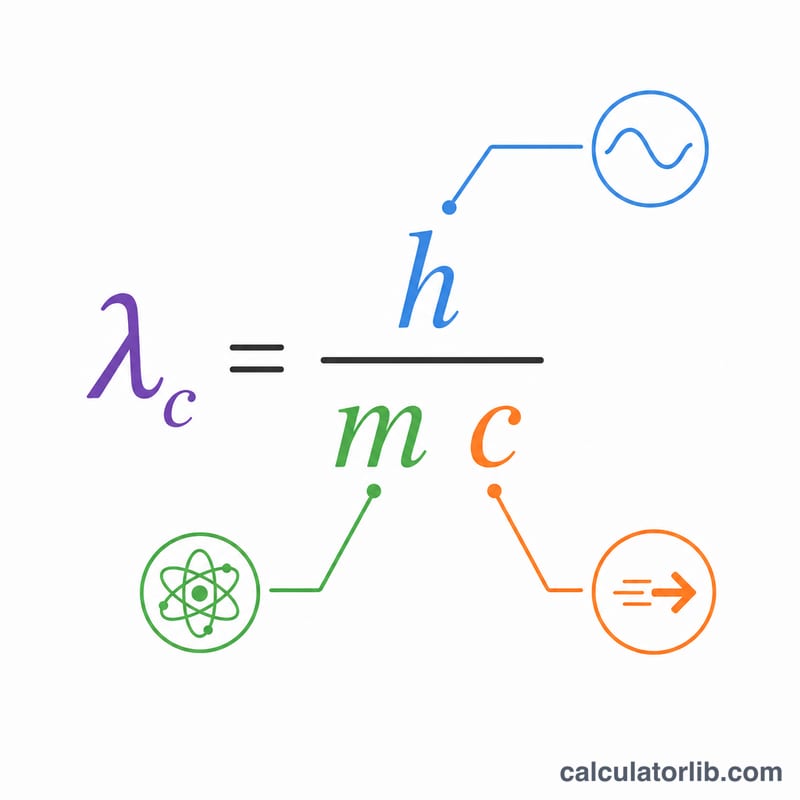
The Compton wavelength is given by:
$$\lambda = \frac{h}{m \cdot c}$$
where h = \(6.62607015 \times 10^{-34}\ \text{J}\cdot\text{s}\) is the Planck constant, m is the particle mass in kg, and c = \(299{,}792{,}458\ \text{m/s}\) is the speed of light. The equivalent frequency follows from \(f = c / \lambda\).
Worked Example
For an electron with m = \(9.1093837015 \times 10^{-31}\ \text{kg}\):
$$\lambda = \frac{6.62607015 \times 10^{-34}}{9.1093837015 \times 10^{-31} \times 299792458} \approx 2.426310 \times 10^{-12}\ \text{m}$$ or about 2.43 pm. This matches the accepted electron Compton wavelength.
FAQ
Is this the reduced Compton wavelength? No. This calculator returns the standard Compton wavelength \(\lambda = h/(mc)\). The reduced version divides by 2π.
Why is a heavier particle's wavelength smaller? Wavelength is inversely proportional to mass, so more massive particles such as protons have much shorter Compton wavelengths than electrons.
Can I use it for photons? No — the formula requires a nonzero rest mass, and photons are massless.