
What Is Thermal Expansion?
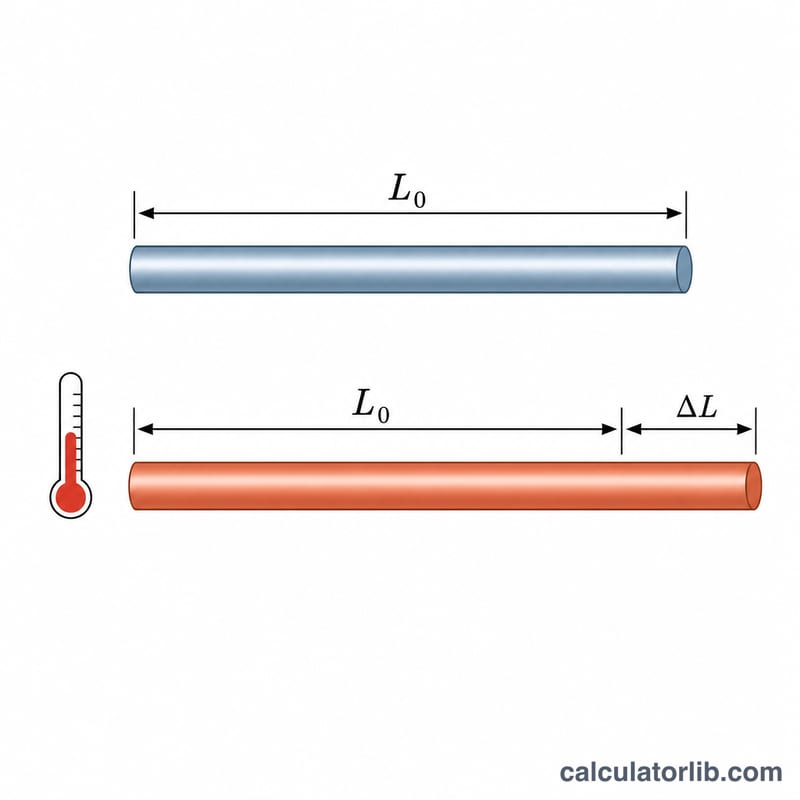
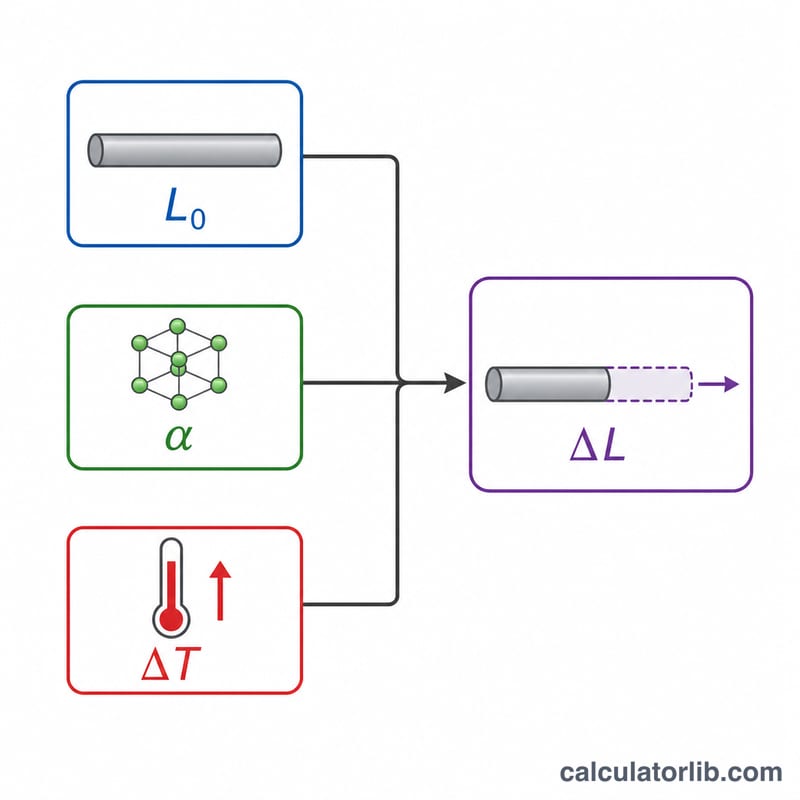
Most solid materials expand when heated and contract when cooled. Linear thermal expansion describes how a one-dimensional object — such as a metal rod, rail, pipe, or bridge span — changes length as its temperature changes. This calculator computes the change in length (\(\Delta L\)) and the resulting final length (\(L\)) of an object given its original length, its coefficient of linear expansion, and the temperature change.
How to Use It
Enter the original length \(L_0\) (in metres), the material's coefficient of linear expansion \(\alpha\) (in 1/°C), and the initial and final temperatures (in °C). The calculator finds the temperature change \(\Delta T = T_2 - T_1\), then the change in length and the final length. Typical \(\alpha\) values: steel ≈ 0.000012, aluminium ≈ 0.000023, copper ≈ 0.000017, glass ≈ 0.000009 per °C.
The Formula Explained
The governing equation is $$\Delta L = \alpha \cdot L_0 \cdot \Delta T$$ where \(\alpha\) is the fractional length change per degree, \(L_0\) is the starting length, and \(\Delta T\) is the temperature change. The final length is simply $$L = L_0 + \Delta L = L_0(1 + \alpha \cdot \Delta T)$$ A negative \(\Delta T\) (cooling) yields a negative \(\Delta L\), meaning the object contracts.
Worked Example
A 10 m steel rail (\(\alpha = 0.000012\) /°C) heats from 20 °C to 45 °C. \(\Delta T = 25\) °C. $$\Delta L = 0.000012 \times 10 \times 25 = 0.003 \text{ m} = 3 \text{ mm}$$ Final length = 10.003 m. This small but real expansion is why rails and bridges include expansion gaps.
FAQ
Does this work for cooling? Yes — enter a final temperature lower than the initial; \(\Delta L\) becomes negative (contraction).
What units should I use? Length in metres and \(\alpha\) in 1/°C give \(\Delta L\) in metres. Any consistent length unit works as long as \(\alpha\) matches the temperature unit.
Is this linear or volumetric expansion? This is linear (1D) expansion. For area use \(\approx 2\alpha\) and for volume use \(\approx 3\alpha\) for isotropic materials.