
What is the Moore's Law Calculator?
This tool estimates how many times semiconductor integration density (the transistor count packed onto a chip) will multiply over a chosen number of years. It is based on Moore's Law, the famous empirical observation made by Gordon Moore, a co-founder of Intel, in a 1965 paper. The law states that the density of components on an integrated circuit roughly doubles at regular intervals. This calculator uses the 18-month (1.5-year) doubling convention.
How to use it
Enter the number of years from now into the future for which you want the projected growth multiple, then read the result. The output is a dimensionless factor: a value of 16 means density is projected to be 16 times its current level. Decimal years are allowed, and the input should be zero or greater (a value of 0 returns 1, the present-day baseline).
The formula explained
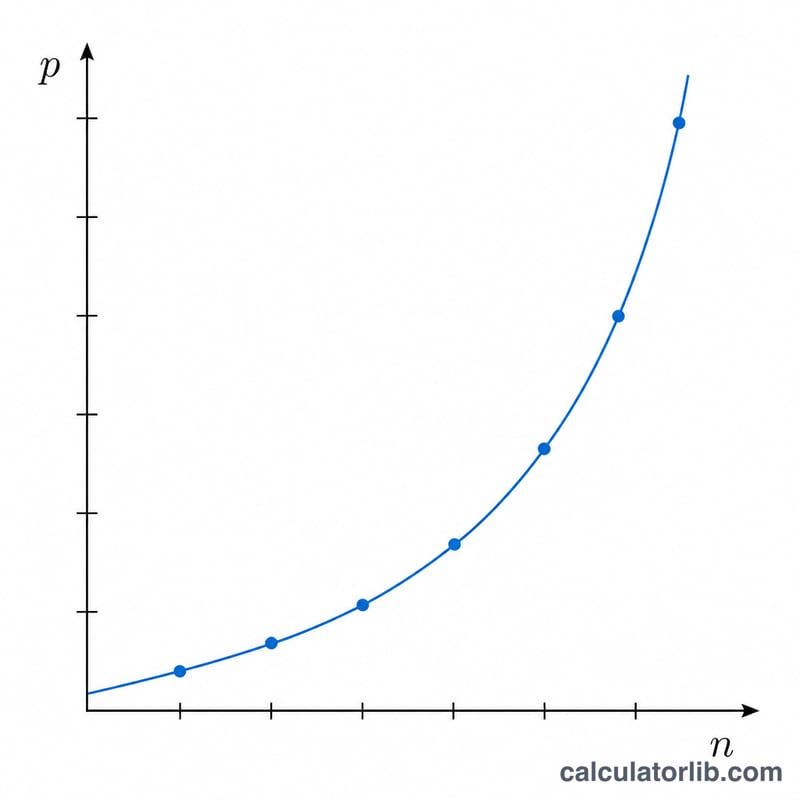
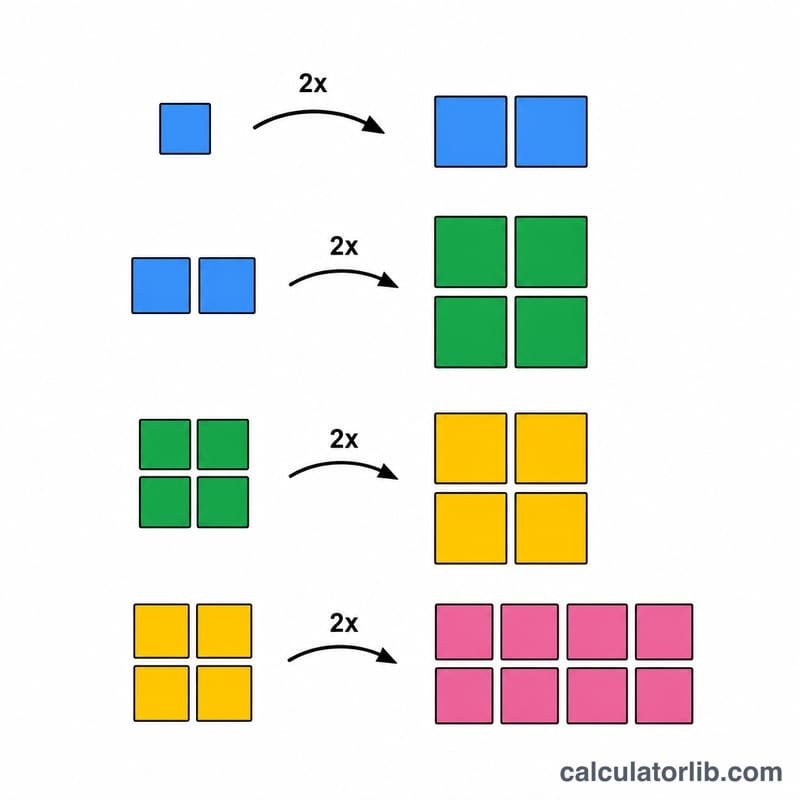
The projection uses $$p = 2^{\frac{n}{1.5}}$$, where \(n\) is the number of years and 1.5 is the number of years per doubling (18 months). The exponent \(n / 1.5\) simply counts how many doubling periods fit inside \(n\) years. Each completed doubling period multiplies density by 2, so two periods give \(2\times2 = 4\), four periods give 16, and so on. The result is rounded to two decimal places.
Worked example
Suppose you want the multiple six years from now. The exponent is \(6 / 1.5 = 4\), so $$p = 2^4 = 16.$$ Density is projected to grow 16-fold, having doubled four times. For three years, \(3 / 1.5 = 2\) and \(p = 2^2 = 4\). For a single year, \(1 / 1.5 = 0.6667\) and \(p = 2^{0.6667} = 1.59\).
FAQ
Why 1.5 years? The original observation and many popular restatements use an 18-month doubling period. Some sources instead use two years; this calculator hard-codes 1.5 years.
Is Moore's Law still accurate? It is an empirical trend, not a physical law, and the pace has slowed as transistors approach atomic scales. Treat the result as an illustrative projection, not a guarantee.
What does a multiple below 1 mean? If you enter a negative number of years the formula evaluates to a fraction, representing past (lower) density. For meaningful future projections keep the input at zero or above.