
What Is Thermal Energy?
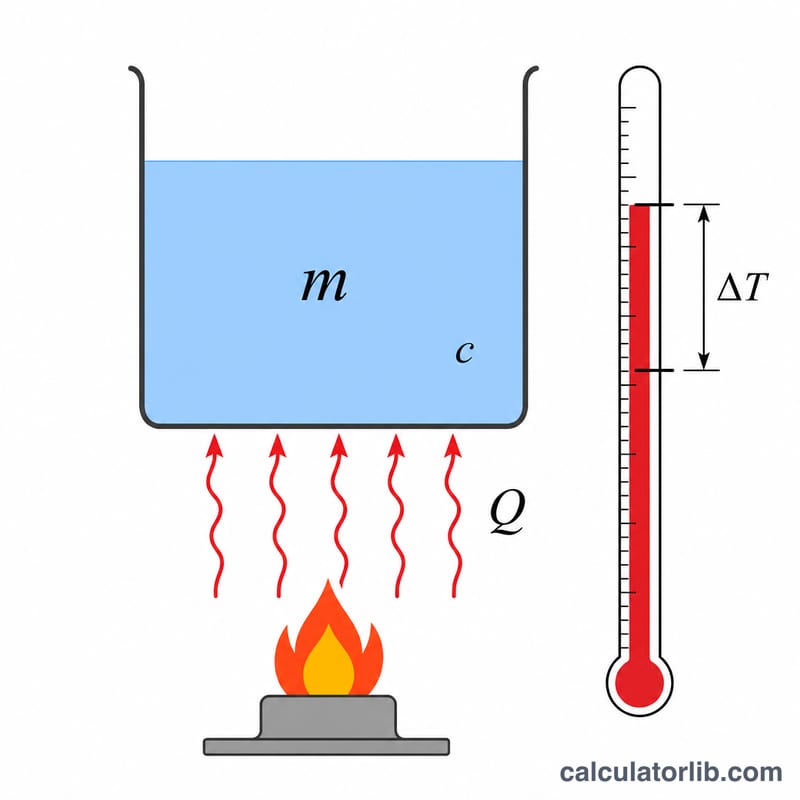
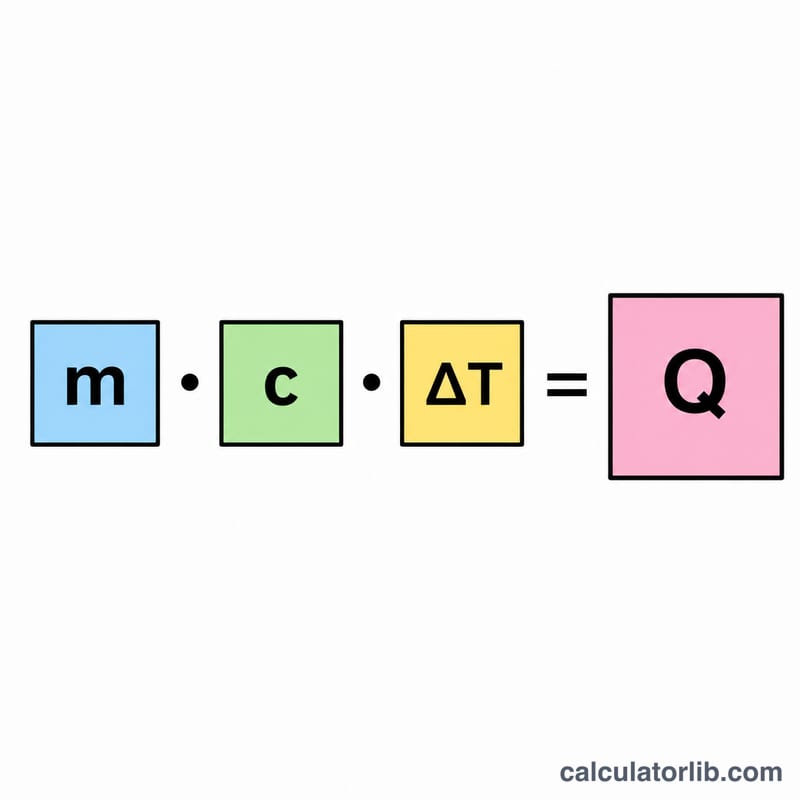
Thermal energy (or heat, Q) is the amount of energy that must be added to or removed from a substance to change its temperature. It depends on three things: how much material there is (mass), how resistant that material is to temperature change (specific heat capacity), and how large the temperature swing is. This calculator uses the universal physics relationship \(Q = m \cdot c \cdot \Delta T\), which applies to any substance and region.
How to Use the Calculator
Enter the mass in kilograms, the specific heat capacity in joules per kilogram per degree Celsius (J/kg\(\cdot\)°C), and the initial and final temperatures in °C. The tool computes the temperature change \(\Delta T = T_2 - T_1\), multiplies it by mass and specific heat, and returns the energy in both joules and kilojoules. A positive result means energy is absorbed (heating); a negative result means energy is released (cooling).
The Formula Explained
The equation $$Q = m \cdot c \cdot \Delta T$$ breaks down as follows: m is mass (kg), c is the specific heat capacity, and \(\Delta T\) is the change in temperature. Common specific heats include water (4186 J/kg\(\cdot\)°C), aluminum (897), copper (385), and air (~1005). Because c is a material property, the same temperature change requires very different amounts of energy for different substances.
Worked Example
Suppose you heat 2 kg of water from 20°C to 80°C. The temperature change is \(\Delta T = 80 - 20 = 60\)°C. Then $$Q = 2 \times 4186 \times 60 = 502{,}320 \text{ joules},$$ or about 502.32 kJ. That's roughly the energy needed to bring a small pot of water close to boiling.
FAQ
Can \(\Delta T\) be in Kelvin? Yes — a change of 1°C equals a change of 1 K, so the formula gives the same result whether you use Celsius or Kelvin differences.
What if my mass is in grams? Convert to kilograms (divide by 1000) or use a specific heat expressed per gram, so the units stay consistent.
Why is my answer negative? A negative Q means the final temperature is lower than the initial one, so heat is being removed from the substance (cooling).