
What Is Thermal Efficiency?
Thermal efficiency (\(\eta\)) measures how effectively a heat engine converts thermal energy (heat input) into useful mechanical work. It is a dimensionless ratio, often expressed as a percentage. No real engine reaches 100% because some heat is always rejected to a cold reservoir, as required by the second law of thermodynamics.
How to Use This Calculator
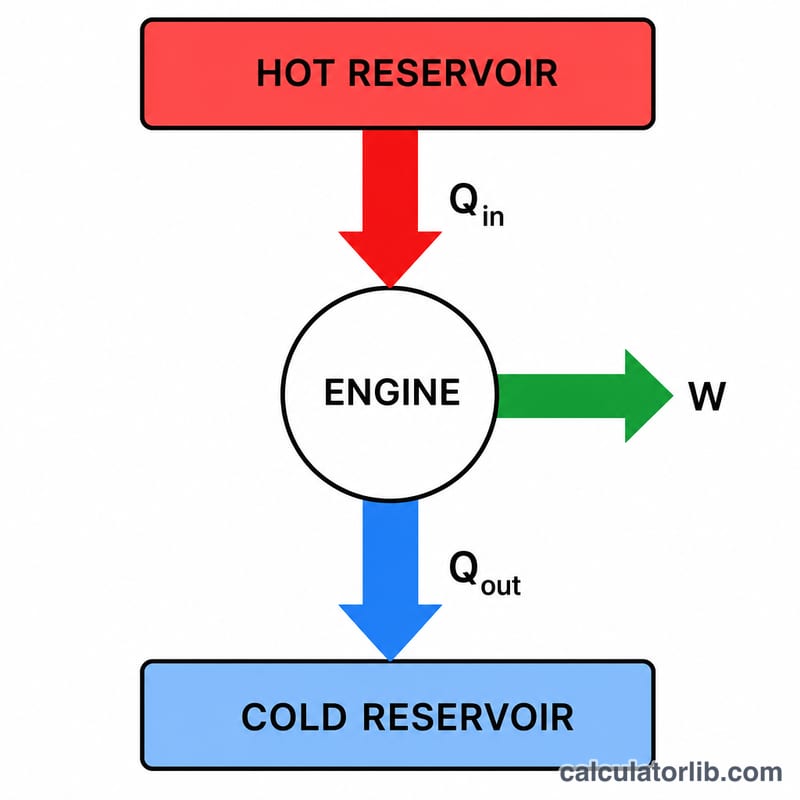
Enter the heat input Qin (the energy supplied to the engine, e.g. from burning fuel) and the heat rejected Qout (energy lost to the surroundings or cold reservoir), both in joules. The calculator returns the efficiency as a fraction and a percentage, along with the net work output.
The Formula Explained
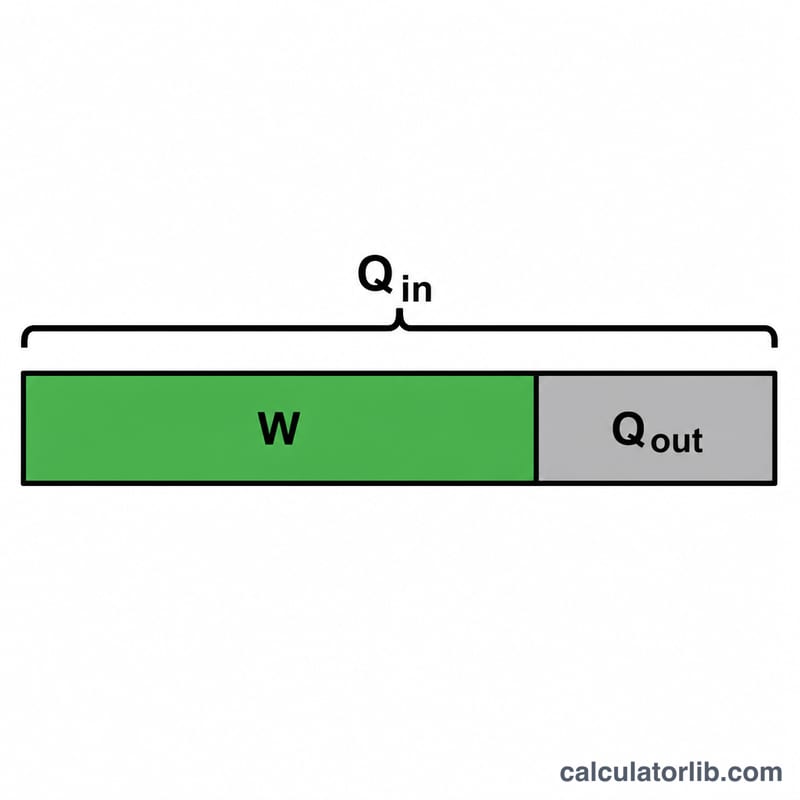
The net work output is the difference between energy in and energy out: \(W_{net} = \text{Q}_{in} - \text{Q}_{out}\). Efficiency is the fraction of input heat turned into work:
$$\eta = \frac{W_{net}}{\text{Q}_{in}} = 1 - \frac{\text{Q}_{out}}{\text{Q}_{in}}$$Multiply by 100 to express it as a percentage.
Worked Example
Suppose an engine absorbs 1000 J of heat and rejects 600 J. Then
$$W_{net} = 1000 - 600 = 400 \text{ J}$$$$\eta = \frac{400}{1000} = 0.40 = 40\%$$This means 40% of the supplied heat becomes useful work, while 60% is rejected.
FAQ
Can efficiency exceed 100%? No. \(\text{Q}_{out}\) is always greater than zero for a real engine, so \(\eta\) is always less than 1 (100%).
What units should I use? Any consistent energy unit works (joules, kJ, BTU) as long as both inputs use the same unit — efficiency is dimensionless.
How does this relate to Carnot efficiency? Carnot efficiency \(\left(1 - \frac{T_{cold}}{T_{hot}}\right)\) is the theoretical maximum. The actual efficiency computed here from measured heats is always less than or equal to it.