
What Is Propagation Delay?
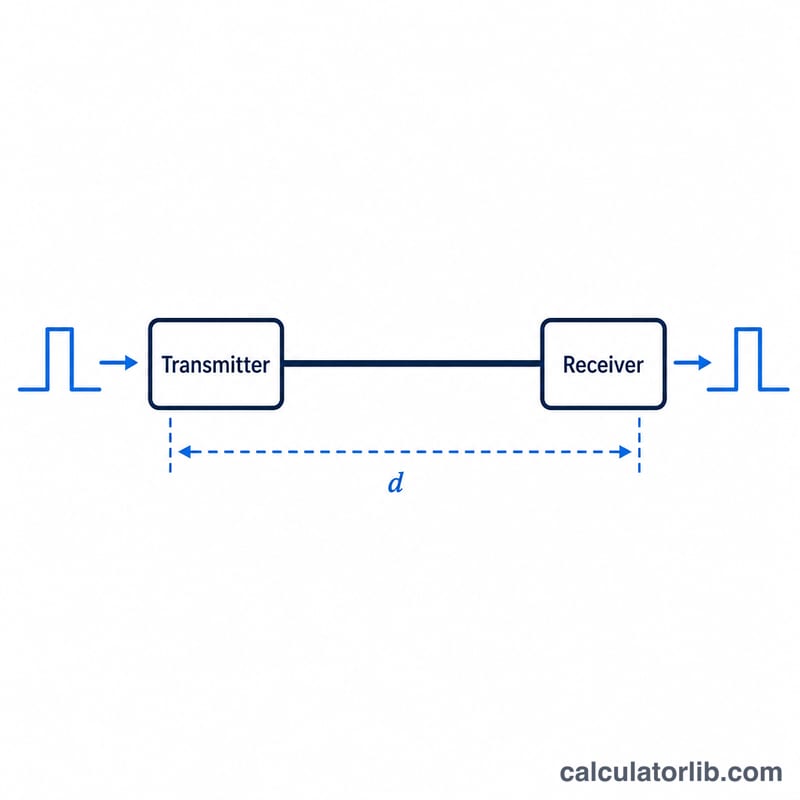
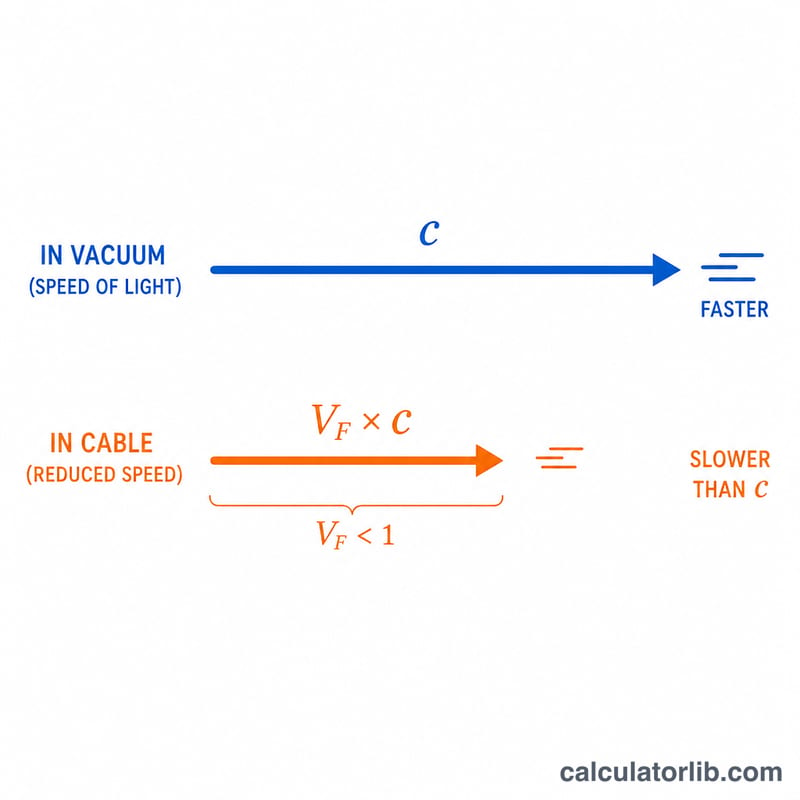
Propagation delay is the time a signal needs to travel from one point to another through a physical medium such as a copper cable, fiber-optic line, or free space. It depends on the distance traveled and how fast the signal moves through that medium, which is expressed as a velocity factor (VF) — a fraction of the speed of light.
How to Use This Calculator
Enter the distance in meters and the velocity factor of your medium. Typical velocity factors are about 0.66 for solid polyethylene coax (RG-6), 0.95–0.99 for foam dielectric, ~0.66–0.70 for twisted-pair copper, and 1.0 for a vacuum or free space. The calculator returns the delay in nanoseconds and microseconds, plus the actual signal velocity.
The Formula Explained
The delay equals distance divided by the actual signal velocity: $$t = \frac{\text{Distance (m)}}{\text{Velocity Factor} \times c}$$ where \(c\) is the speed of light (299,792,458 m/s). A lower velocity factor means slower propagation and therefore a longer delay over the same distance.
Worked Example
For 100 m of cable with VF = 0.66: velocity = \(0.66 \times 299{,}792{,}458 \approx 197{,}863{,}022 \text{ m/s}\). $$\text{Delay} = \frac{100}{197{,}863{,}022} \approx 5.054 \times 10^{-7} \text{ s} \approx 505.4 \text{ nanoseconds} \ (0.5054 \ \mu\text{s})$$
FAQ
What is velocity factor? It is the ratio of signal speed in a medium to the speed of light in a vacuum, always between 0 and 1.
Why does VF = 1 give the fastest signal? A velocity factor of 1 means the signal travels at the speed of light, as in a vacuum, giving the minimum possible delay.
Does delay matter in networking? Yes — propagation delay contributes to latency and is critical for timing, clock distribution, and long-haul links.