
What is the Tsunami Propagation Speed Calculator?
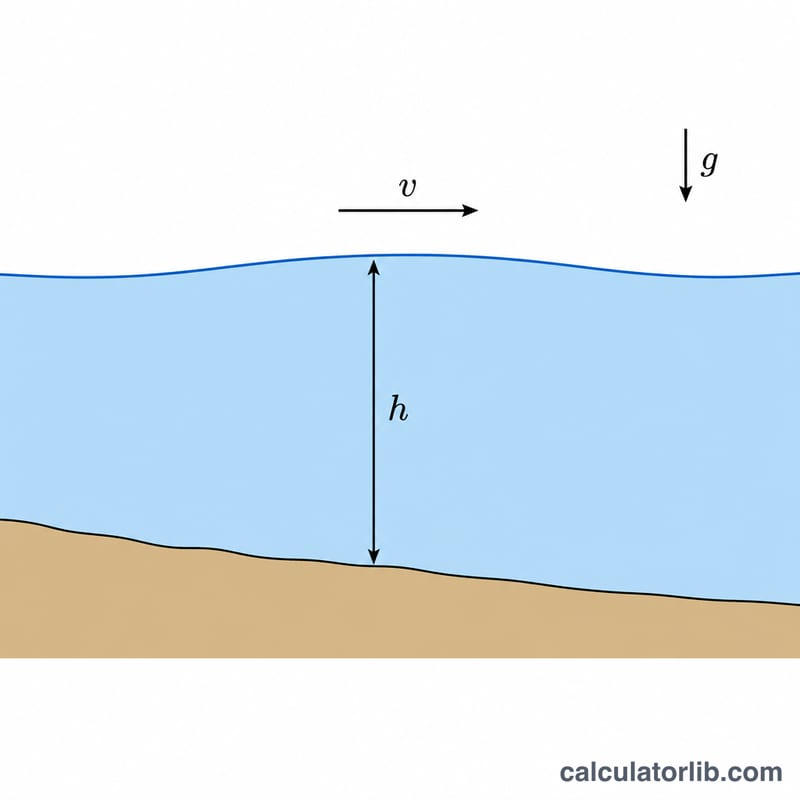
This tool computes how fast a tsunami travels across the open ocean. A tsunami is a shallow-water (long) gravity wave: its wavelength is far greater than the ocean depth, so its speed depends almost entirely on the water depth and the acceleration due to gravity. This is universal physics and applies to any ocean basin, not just one region.
How to use it
Enter the ocean depth in metres (the deeper the water, the faster the wave). The gravitational acceleration defaults to standard gravity, 9.80665 m/s², but you can edit it. The calculator returns the propagation speed in both metres per second and kilometres per hour. Water depth must be non-negative and gravity must be positive, otherwise the result is undefined.
The formula explained
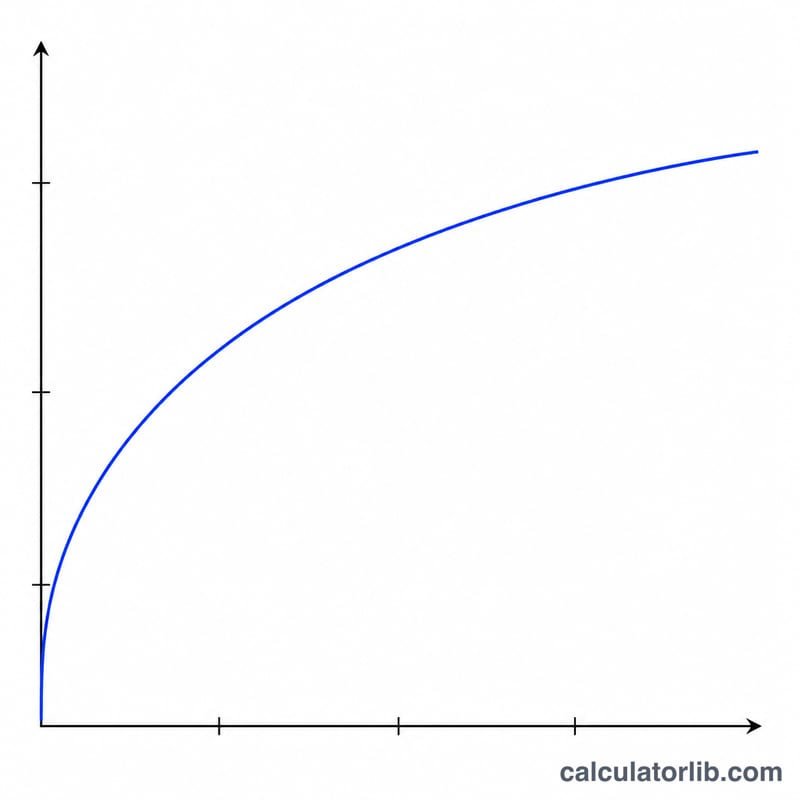
The shallow-water wave celerity is $$v = \sqrt{g \cdot h}$$, where \(g\) is gravitational acceleration in m/s² and \(h\) is depth in metres. To convert to km/h, multiply by 3.6, because one metre per second equals 3.6 kilometres per hour (3600 seconds per hour divided by 1000 metres per kilometre).
Worked example
For a 5000 m deep ocean with \(g = 9.80665\) m/s²: \(g \times h = 49033.25\), so $$v = \sqrt{49033.25} \approx 221.43 \text{ m/sec}.$$ Converting: \(221.43 \times 3.6 \approx 797\) km/h — roughly the cruising speed of a jet airliner. This matches the historical 1960 Chile earthquake tsunami, which crossed the Pacific in about 22.5 hours at an average near 750 km/h before reaching the Sanriku coast of Tohoku, Japan.
FAQ
Why does the wave slow down near the coast? As depth \(h\) decreases, \(\sqrt{g \cdot h}\) shrinks, so the wave slows and its energy piles up into a higher wall of water. At \(h = 0\) the speed is zero.
Can I use this for normal wind waves? No. The formula is only valid in the shallow-water (long-wave) regime where wavelength is much larger than depth — exactly the tsunami case, but not ordinary wind waves.
Why is negative depth rejected? A negative \(g \cdot h\) would require the square root of a negative number, which has no physical speed, so the calculator treats negative inputs as invalid.