
What is a Decagon?
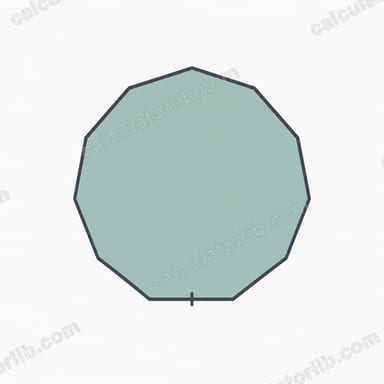
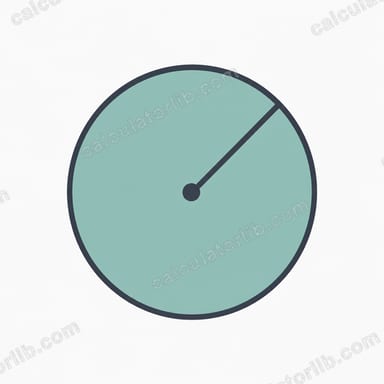
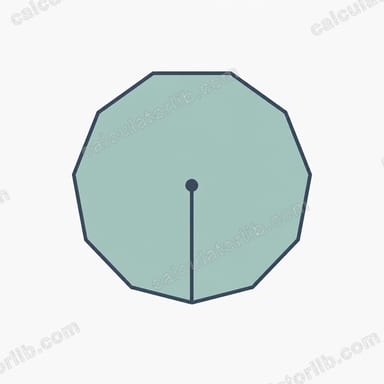
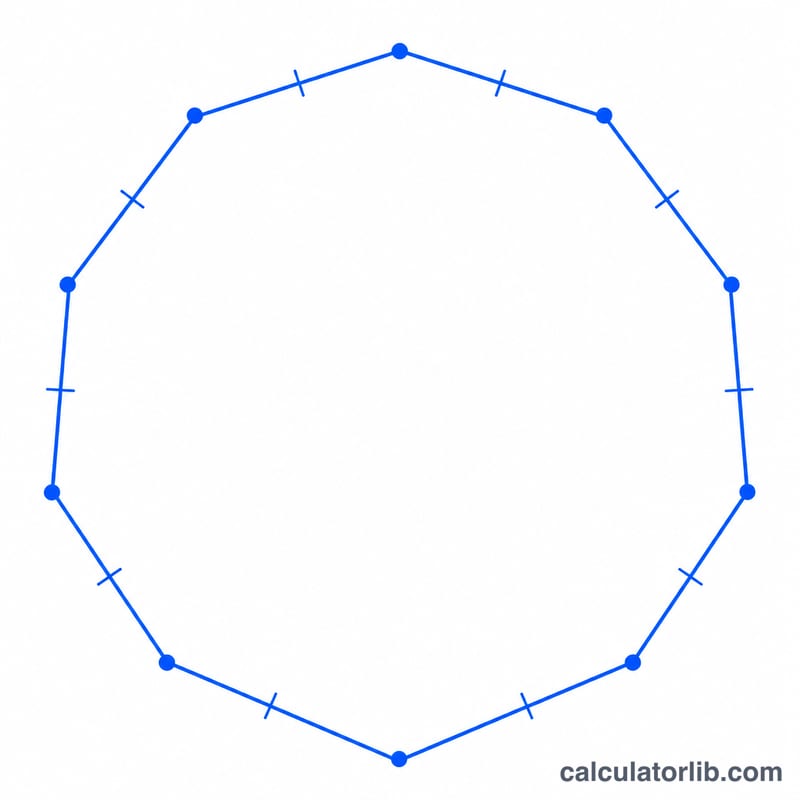
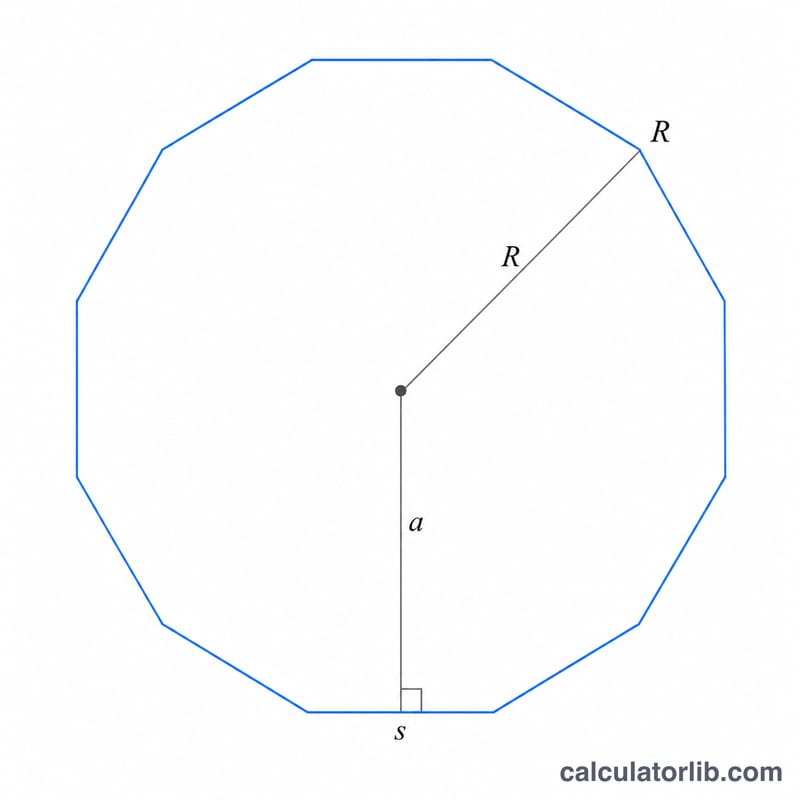
A decagon is a polygon with ten sides and ten angles. A regular decagon has all sides equal in length and all interior angles equal (each measuring 144°). This calculator works with regular decagons and computes the area, perimeter, apothem (the distance from the center to the midpoint of a side) and circumradius (the distance from the center to a vertex) directly from a single input: the side length.
How to Use the Calculator
Enter the side length s of your decagon in any unit (cm, m, inches, etc.). The results are returned in those same units — area in square units, the rest in linear units. Just type the value and the calculator does the trigonometry for you.
The Formula Explained
The area of a regular decagon is:
$$A = \frac{5}{2}\cdot s^{2}\cot\!\left(\frac{\pi}{10}\right)$$
Here \(\cot(\pi/10)\) is the cotangent of 18°, approximately \(3.077684\). The factor of \(5/2\) comes from splitting the decagon into 10 congruent triangles. The perimeter is simply $$P = 10s$$ because there are ten equal sides. The apothem equals \(\dfrac{s}{2\tan(\pi/10)}\) and the circumradius equals \(\dfrac{s}{2\sin(\pi/10)}\).
Worked Example
Suppose \(s = 10\). Then $$A = \frac{5}{2}\times 100 \times \cot(18°) = 250 \times 3.077684 \approx 769.42 \text{ square units},$$ and \(P = 10 \times 10 = 100\) units. The apothem is \(\dfrac{10}{2 \times \tan 18°} \approx 15.388\), and the circumradius is \(\dfrac{10}{2 \times \sin 18°} \approx 16.180\).
FAQ
What are the interior angles of a decagon? Each interior angle of a regular decagon is 144°, and they sum to 1440°.
Does this work for irregular decagons? No. The formulas assume a regular decagon with equal sides and angles. Irregular shapes require coordinate-based methods.
What units does it use? It is unit-agnostic. Whatever unit you enter for the side length determines the output units (and its square for area).