
What is the Cone Diameter Calculator?
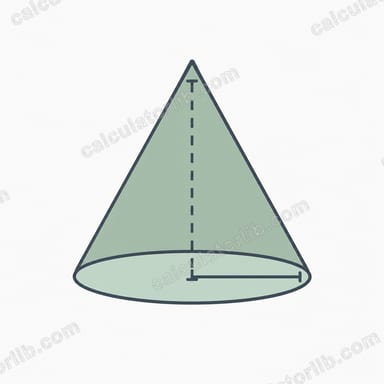
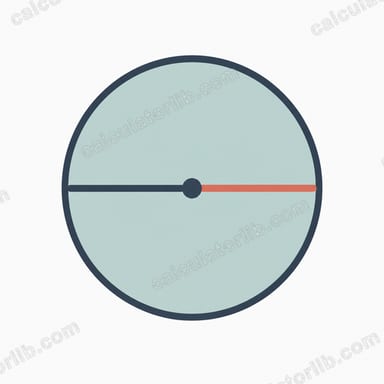
This tool determines the base diameter (and radius) of a right circular cone when you know its volume and height. It rearranges the standard cone volume formula so you can work backwards from a known capacity to the size of the circular base.
How to use it
Enter the cone's volume V and its height h in consistent units (for example cm³ and cm). The calculator returns the base diameter and radius in the matching linear unit. Make sure the height is greater than zero, since dividing by zero height has no physical meaning.
The formula explained
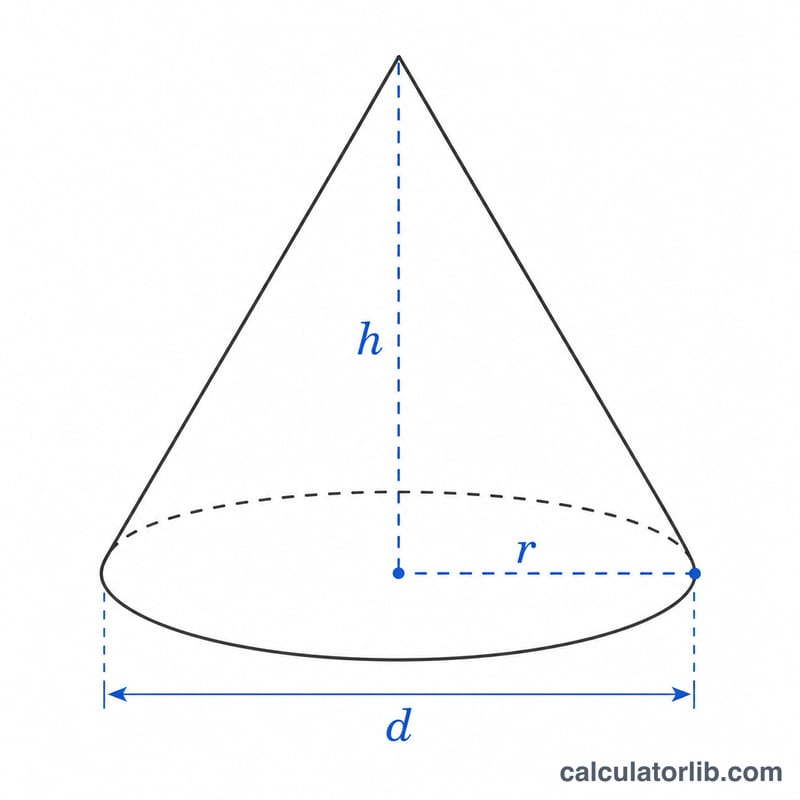
The volume of a cone is \(V = \tfrac{1}{3}\cdot\pi\cdot r^2\cdot h\). Solving for the radius gives \(r = \sqrt{\dfrac{3V}{\pi\cdot h}}\), and the diameter is simply twice the radius:
$$d = 2\cdot\sqrt{\dfrac{3V}{\pi\cdot h}}$$The cube-free square root reflects that the base area scales linearly with volume when height is fixed.
Worked example
Suppose a cone has a volume of 100 and a height of 10. Then \(r = \sqrt{\dfrac{3\cdot 100}{\pi\cdot 10}} = \sqrt{\dfrac{300}{31.4159}} = \sqrt{9.5493} \approx 3.0902\), so the diameter
$$d = 2 \times 3.0902 \approx 6.1804 \text{ units.}$$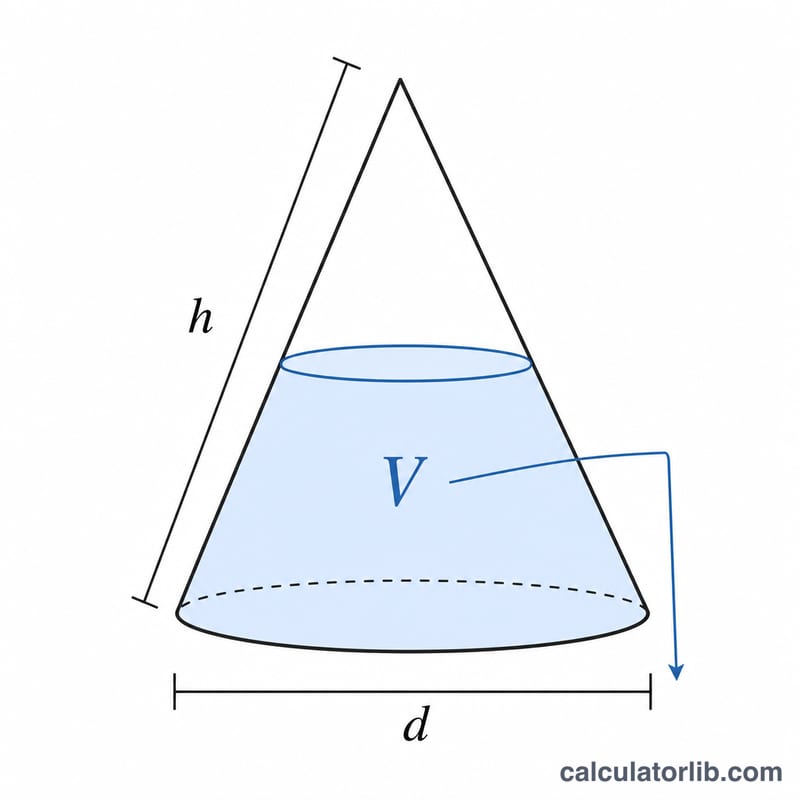
FAQ
What units should I use? Any, as long as volume and height share a consistent system — e.g. height in cm and volume in cm³ yields diameter in cm.
Can I use this for an oblique cone? The formula assumes a right circular cone. For oblique cones the volume formula still holds if h is the perpendicular height, so the diameter result remains valid.
Why is the result zero? If you enter a height of zero or less, the calculator cannot solve the equation and returns zero. Enter a positive height.