
What is the diameter of a cylinder?
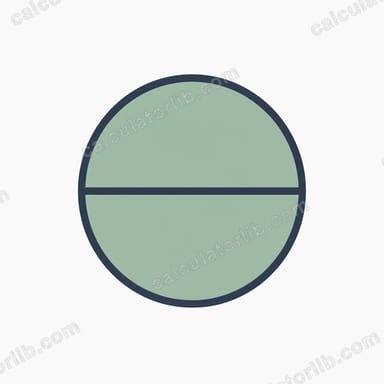
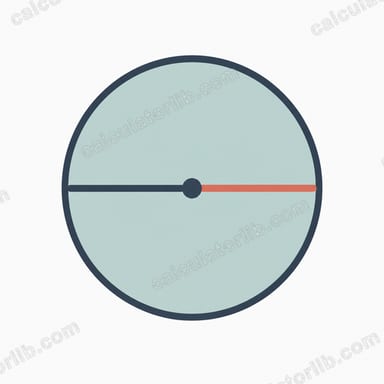
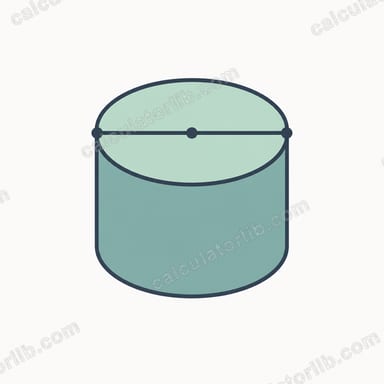
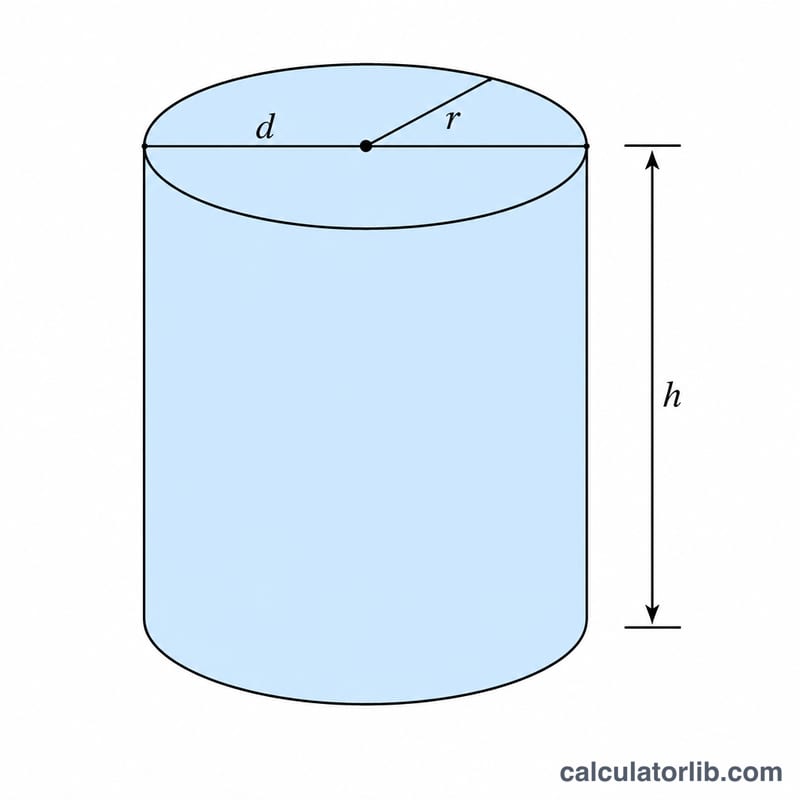
A cylinder's diameter is the width of its circular base — the straight line that passes through the center of the circle from one edge to the other. It is exactly twice the radius. This calculator finds the diameter in two ways: directly from the radius, or indirectly from the cylinder's volume and height.
How to use this calculator
Choose your input mode. If you know the radius, select Radius and enter it — the diameter is simply doubled. If you only know the volume and height, select Volume & Height; the tool back-solves the radius from the volume formula and then doubles it. All lengths must use the same unit (e.g. cm), and volume must use the cubed version of that unit (e.g. cm³).
The formula explained
The volume of a cylinder is \(V = \pi r^2 h\). Solving for the radius gives \(r = \sqrt{V / (\pi \cdot h)}\). Since the diameter is \(d = 2r\), combining these yields:
$$d = 2\sqrt{\frac{V}{\pi \cdot h}}$$When you supply the radius directly, the calculator skips this step and simply computes \(d = 2r\).
Worked example
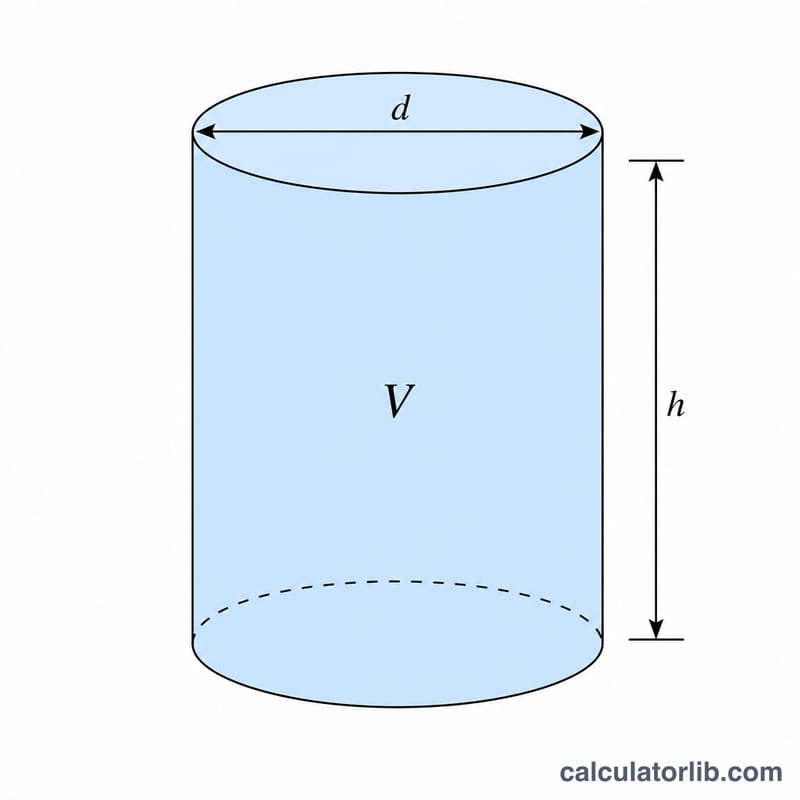
Suppose a cylinder has a volume of 1000 cm³ and a height of 10 cm. First find the radius: $$r = \sqrt{\frac{1000}{\pi \times 10}} = \sqrt{\frac{1000}{31.4159}} = \sqrt{31.831} \approx 5.642 \text{ cm}.$$ The diameter is then $$d = 2 \times 5.642 \approx 11.28 \text{ cm}.$$
FAQ
Is diameter always twice the radius? Yes. For any circle or cylinder cross-section, \(d = 2r\) exactly.
What units does the result use? The diameter is returned in the same linear unit you entered. If volume is in cm³ and height in cm, the diameter is in cm.
What if I only know the surface area? This tool uses volume and height. You would need a separate rearrangement for surface area, since that formula mixes both the side and the two circular ends.