What Is a Dodecagon Calculator?
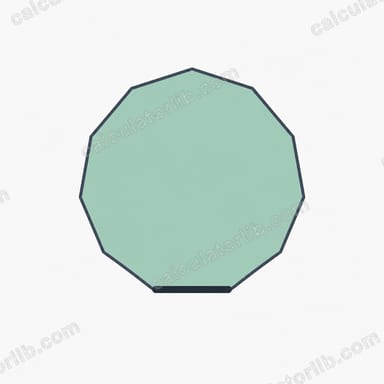
A dodecagon is a polygon with 12 sides and 12 angles. When all sides and angles are equal, it is called a regular dodecagon. This calculator computes the key geometric properties of a regular dodecagon — its area, perimeter, apothem (inradius), and circumradius — directly from a single measurement: the length of one side.

How to Use It
Enter the side length a in any unit (cm, m, inches, etc.). The calculator returns the area in square units and the perimeter, apothem and circumradius in the same linear units you entered. Because it is unit-agnostic, the result scales with whatever measurement system you use.
The Formula Explained
The area of a regular dodecagon is given by:
$$A = 3 \times \left(2 + \sqrt{3}\right) \times a^{2}$$
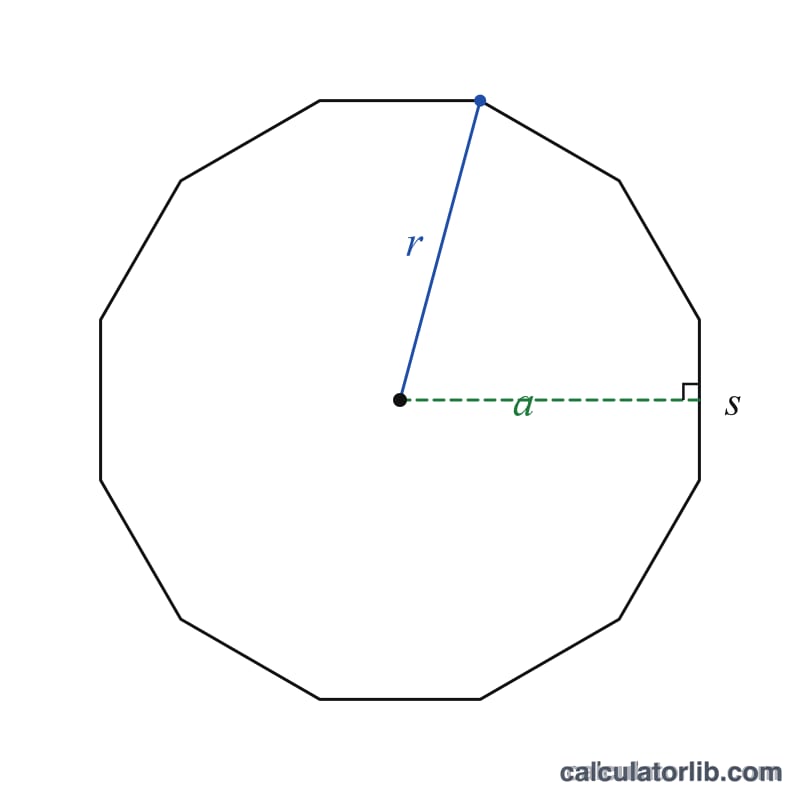
The constant \(3\left(2 + \sqrt{3}\right) \approx 11.196\) is fixed for all dodecagons, so the area always grows with the square of the side. The perimeter is simply $$P = 12a$$ since all twelve sides are equal. The apothem (distance from center to the midpoint of a side) is \(\frac{a}{2}\left(2 + \sqrt{3}\right)\), and the circumradius (center to a vertex) is \(a\cdot\frac{\sqrt{6} + \sqrt{2}}{2}\).
Worked Example
Suppose each side measures 5 units. Then:
$$\text{Area} = 3 \times (2 + 1.7320508) \times 5^{2} = 11.1961524 \times 25 \approx 279.90$$ square units.
$$\text{Perimeter} = 12 \times 5 = 60$$ units.
$$\text{Apothem} = \frac{5}{2}(3.7320508) \approx 9.3301$$ units.
Dodecagon Reference Values by Side Length
These values are for a regular dodecagon (12 equal sides and 12 equal angles). Units are arbitrary: lengths are in the same unit as the side, and areas are in that unit squared.
| Side a | Area (11.1962·a²) | Perimeter (12a) | Apothem (1.8660a) | Circumradius (1.9319a) |
|---|---|---|---|---|
| 1 | 11.1962 | 12 | 1.8660 | 1.9319 |
| 2 | 44.7846 | 24 | 3.7321 | 3.8637 |
| 3 | 100.7654 | 36 | 5.5981 | 5.7956 |
| 5 | 279.9038 | 60 | 9.3301 | 9.6593 |
| 10 | 1119.6152 | 120 | 18.6603 | 19.3185 |
Multipliers per unit side
- Area: 11.196 × a²
- Perimeter: 12 × a
- Apothem: 1.866 × a
- Circumradius: 1.932 × a
Area scales with the square of the side, while perimeter, apothem and circumradius scale linearly. Doubling the side therefore quadruples the area.
Constants Used in Dodecagon Formulas
| Constant | Value |
|---|---|
| √3 | ≈ 1.7320508 |
| √2 | ≈ 1.4142136 |
| √6 | ≈ 2.4494897 |
| 2 + √3 | ≈ 3.7320508 |
| 3(2 + √3) | ≈ 11.1961524 |
| (√6 + √2)/2 | ≈ 1.9318517 |
| Interior angle | 150° |
| Central angle | 30° |
| Exterior angle | 30° |
The angles follow from the general rules for a regular n-gon with n = 12: central angle \(360^\circ/12 = 30^\circ\), and interior angle \(180^\circ - 30^\circ = 150^\circ\). The sum of the interior angles is \(10 \times 180^\circ = 1800^\circ\).
How to Calculate Dodecagon Area by Hand
Worked example for a regular dodecagon with side \(a = 5\).
- Measure the side a. Here a = 5.
- Compute a². \(5^2 = 25\).
- Multiply by 3(2+√3). $$A = 3\left(2+\sqrt{3}\right)a^2 \approx 11.1961524 \times 25 \approx$$ 279.90 square units.
- Compute the perimeter 12a. \(P = 12 \times 5 = 60\).
- Compute the apothem \(a(2+\sqrt{3})/2\): \(5 \times 3.7320508 / 2 \approx 9.3301\).
- Compute the circumradius \(a(\sqrt{6}+\sqrt{2})/2\): \(5 \times 3.8637033 / 2 \approx 9.6593\).
- Cross-check using area = ½ × perimeter × apothem: \(\tfrac{1}{2} \times 60 \times 9.3301 \approx 279.90\). This matches step 3.
Where the apothem comes from: it is the distance from the center to the midpoint of a side, \(\dfrac{a}{2\tan 15^\circ}\). Since \(\tan 15^\circ = 2-\sqrt{3}\), this simplifies to \(a(2+\sqrt{3})/2\).
FAQ
How many sides does a dodecagon have? Twelve sides and twelve interior angles, each measuring 150°.
What is the sum of interior angles? \((12 - 2) \times 180° = 1800°\).
Does this work for irregular dodecagons? No. These formulas only apply to regular dodecagons where all sides and angles are equal.