
What is the Double Angle Calculator?
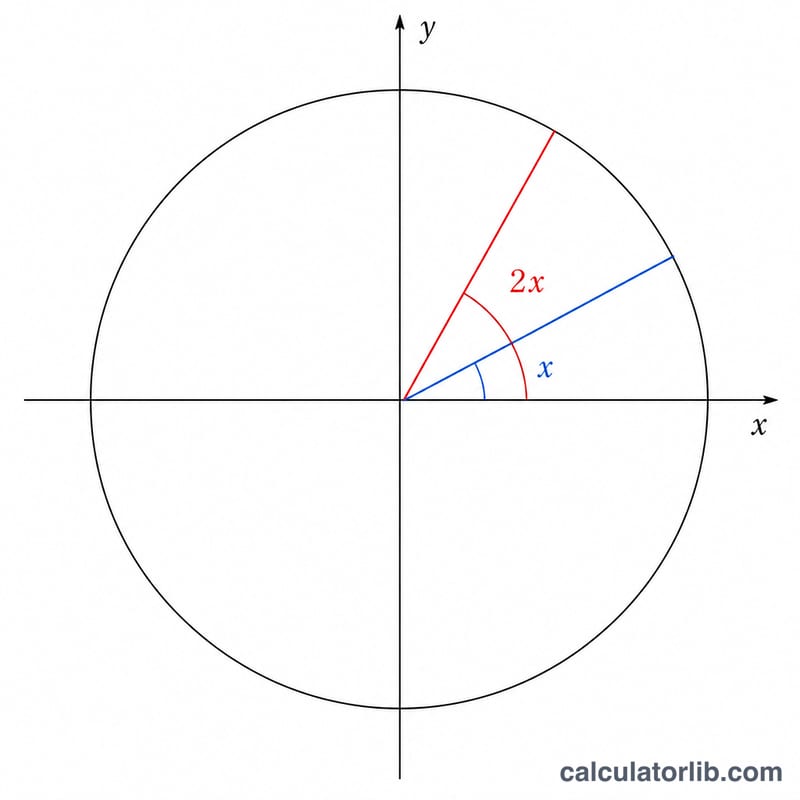
The double angle calculator evaluates the three core double-angle trigonometric identities — \(\sin(2x)\), \(\cos(2x)\) and \(\tan(2x)\) — for any angle you enter. These identities express the trig functions of a doubled angle (\(2x\)) in terms of the original angle (\(x\)), and they appear constantly in calculus, physics, signal processing and exam questions.
How to use it
Enter your angle x, then choose whether the value is in degrees or radians. The calculator converts internally to radians, doubles the angle, and returns the sine, cosine and tangent of \(2x\). If \(\cos(2x)\) equals zero (for example at \(x = 45°\)), \(\tan(2x)\) is undefined and is reported as such because the denominator vanishes.
The formulas explained
Starting from the angle-sum identities with both angles equal to \(x\):
• $$\sin(2x) = 2 \sin x \cos x$$ — derived from \(\sin(a+b) = \sin a \cos b + \cos a \sin b\).
• $$\cos(2x) = \cos^2 x - \sin^2 x$$ — derived from \(\cos(a+b) = \cos a \cos b - \sin a \sin b\). Equivalent forms are \(1 - 2\sin^2 x\) and \(2\cos^2 x - 1\).
• $$\tan(2x) = \frac{2 \tan x}{1 - \tan^2 x}$$ — derived from the tangent addition formula.
Worked example
Let \(x = 30°\). Then \(2x = 60°\). So \(\sin(60°) = \frac{\sqrt{3}}{2} \approx 0.866025\), \(\cos(60°) = 0.5\), and \(\tan(60°) = \sqrt{3} \approx 1.732051\). Using the identities: $$2 \sin 30° \cos 30° = 2(0.5)(0.866025) = 0.866025 \;\checkmark$$ and $$\cos^2 30° - \sin^2 30° = 0.75 - 0.25 = 0.5 \;\checkmark$$
FAQ
Why is \(\tan(2x)\) sometimes undefined? When \(\cos(2x) = 0\) (e.g. \(x = 45°\), \(2x = 90°\)), division by zero makes the tangent undefined.
Can I enter negative angles? Yes. Negative and large angles work fine; results follow standard trig periodicity.
Degrees or radians? Pick whichever your problem uses. The \(2x\) equivalent is also shown in degrees for reference.