
What Is a Divisor Calculator?
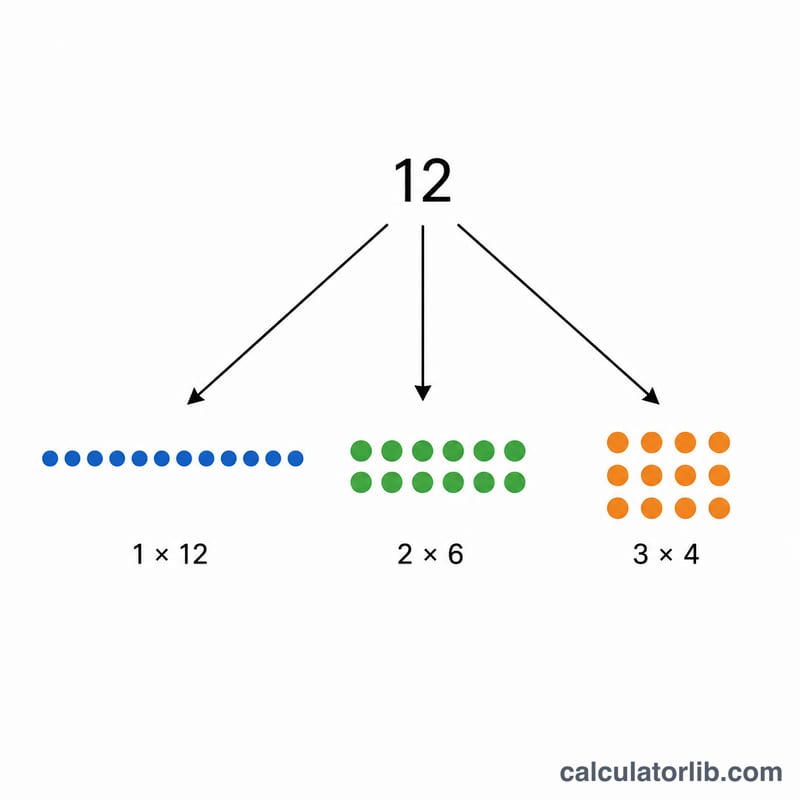
A divisor (or factor) of a number n is any positive integer that divides n evenly, leaving no remainder. This calculator finds every divisor of the number you enter, then reports the complete list, how many divisors there are, and their total sum. It works for any positive whole number and is useful for factoring, simplifying fractions, number theory homework, and checking whether a number is prime or perfect.
How to Use It
Type a positive whole number into the box and submit. The calculator tests each candidate from 1 up to n and keeps those that divide evenly. To stay fast even for large numbers, it only checks values up to the square root of n and adds each divisor's matching pair, so results are nearly instant.
The Formula Explained
The set of divisors is defined as $$D(n) = \left\{\, d \in \mathbb{Z}^{+} \;:\; 1 \le d \le n \;\text{and}\; n \bmod d = 0 \,\right\}$$ The "mod" operation returns the remainder of a division; when that remainder is 0, the divisor goes evenly into \(n\). The count is simply the size of this set, and the sum of divisors \(\sigma(n)\) adds every element together.
Worked Example
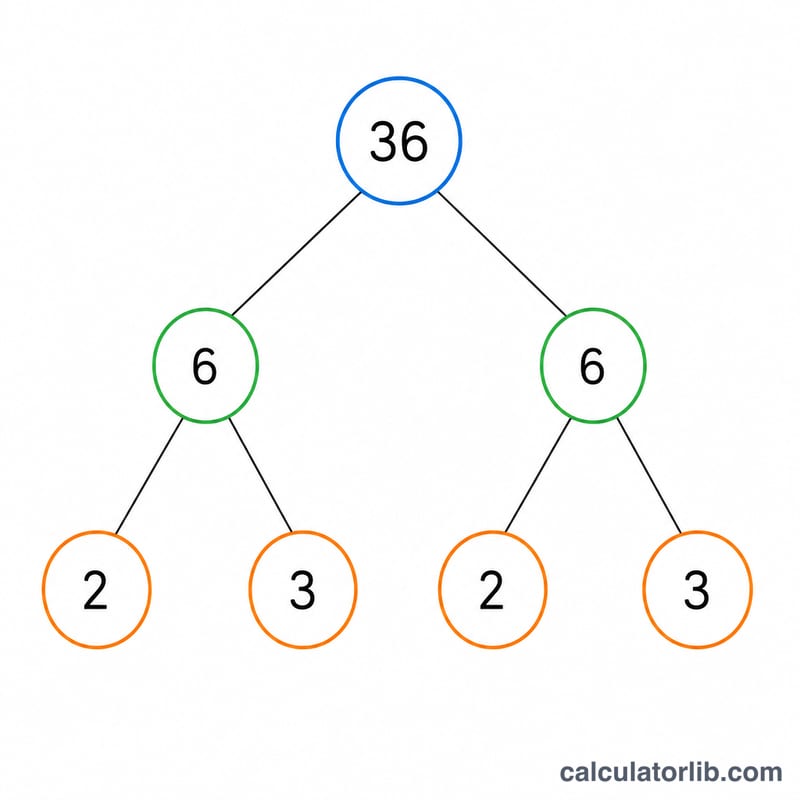
Take \(n = 36\). We test each number: 1, 2, 3, 4, 6 each divide 36, and so do their pairs 36, 18, 12, 9, 6. Collecting and sorting gives the divisors 1, 2, 3, 4, 6, 9, 12, 18, 36 — that is 9 divisors. Their sum is $$1 + 2 + 3 + 4 + 6 + 9 + 12 + 18 + 36 = 91$$
FAQ
Is 1 a divisor of every number? Yes. Both 1 and the number itself always divide it evenly, so every number \(\ge 1\) has at least these divisors.
How do I know if a number is prime? A prime number has exactly 2 divisors: 1 and itself. If the count equals 2, the number is prime.
What is a perfect number? A perfect number equals the sum of its divisors excluding itself — equivalently, its sum of divisors equals twice the number. For example, 6 has divisors 1, 2, 3, 6 summing to \(12 = 2 \times 6\).