
What is the Factors Calculator?
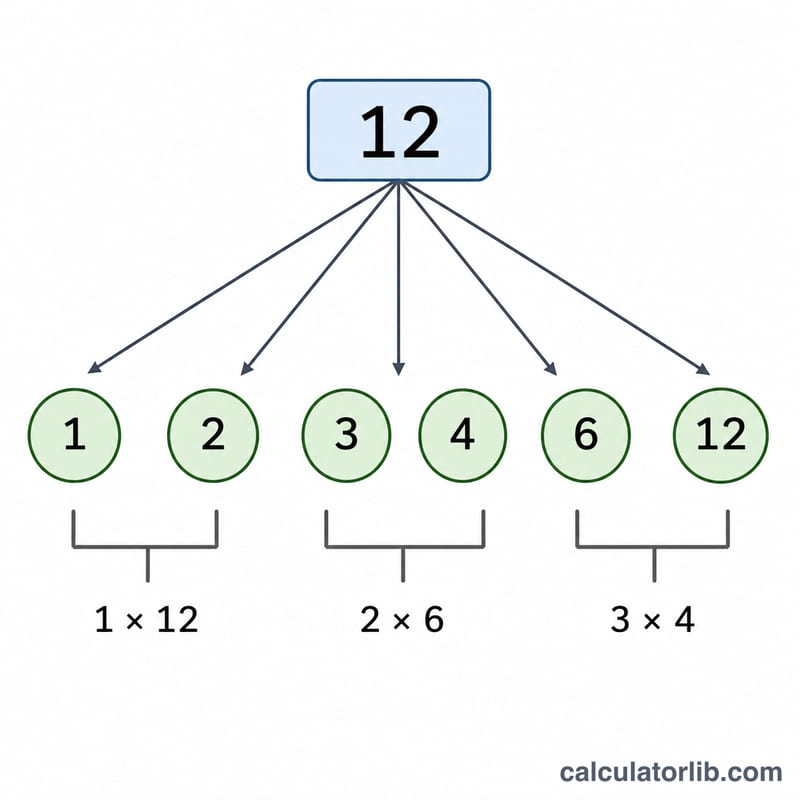
The Factors Calculator finds every factor (also called a divisor) of a whole number. A factor of n is any whole number that divides n evenly, leaving no remainder. For example, the factors of 12 are 1, 2, 3, 4, 6 and 12. This tool lists all of them, counts how many there are, adds them up, and tells you whether the number is prime.
How to use it
Enter any positive whole number and submit. The calculator returns the number of factors as the headline figure, then shows the complete ordered list of factors, their total sum, and a Yes/No prime check. It works for small numbers and large ones alike.
The formula explained
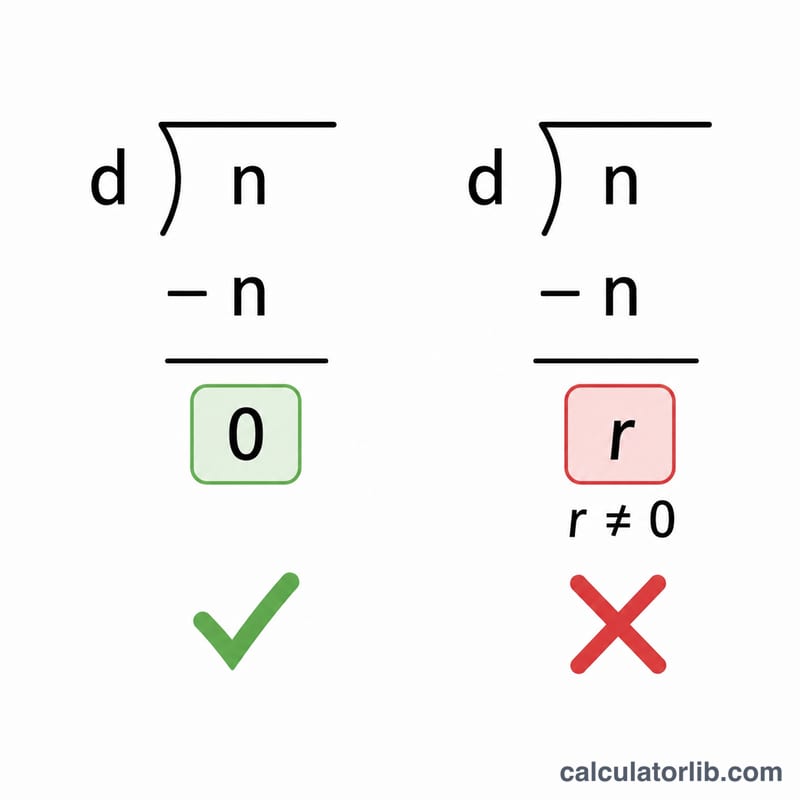
For each candidate divisor d, the calculator checks whether \( n \bmod d = 0 \). If the remainder is zero, d is a factor. The complete set of factors is given by:
$$\text{Factors}(\text{Number}) = \left\{\, d \in \mathbb{Z}^{+} : \text{Number} \bmod d = 0 \,\right\}$$To stay fast, it only tests values up to the square root of n; for every small factor d it also records the paired large factor \( n / d \). A number is flagged as prime only when it has exactly two factors (1 and itself).
Worked example
Take \( n = 36 \). Testing 1 through 6 (\( \sqrt{36} = 6 \)) gives the divisor pairs (1, 36), (2, 18), (3, 12), (4, 9) and (6, 6). Removing the duplicate 6, the factors are 1, 2, 3, 4, 6, 9, 12, 18, 36 — that is 9 factors, summing to:
$$1 + 2 + 3 + 4 + 6 + 9 + 12 + 18 + 36 = 91$$Since 36 has more than two factors, it is not prime.
FAQ
Is 1 a factor of every number? Yes. Every whole number is divisible by 1 and by itself.
Why isn't 1 prime? A prime must have exactly two distinct factors. The number 1 has only one factor (itself), so it is neither prime nor composite.
What is the sum of factors used for? It helps identify perfect numbers (where the proper factors sum to the number) and is common in number theory exercises.