
What this calculator does
This tool takes any positive whole number and instantly returns its complete list of factors (divisors), all of its factor pairs, the total count of factors, its prime factorization, and whether the number is prime. It is a general-purpose version of single-number pages like "Factors of 24" or "Factors of 100" — just type any value and get the full breakdown.
How to use it
Enter a positive integer (1 or greater) in the Number box and submit. Decimals are rounded down and negative signs are ignored, so the calculator always works on a positive whole number. The result shows the divisors in ascending order, the matched factor pairs, and the prime factorization in exponent form.
The formula explained
A number d is a factor of N when N mod d equals zero. To find every factor efficiently we only test divisors up to the square root of N: whenever d divides N, both \(d\) and \(N/d\) are factors. The relationship is $$d \mid N \iff N \bmod d = 0$$ The prime factorization uses trial division — repeatedly dividing out 2, then each odd number, until what remains is 1 or a prime. It can be written as $$N = p_1^{e_1} \times p_2^{e_2} \times \cdots \times p_k^{e_k}$$ The number is prime exactly when it has only two factors: 1 and itself.
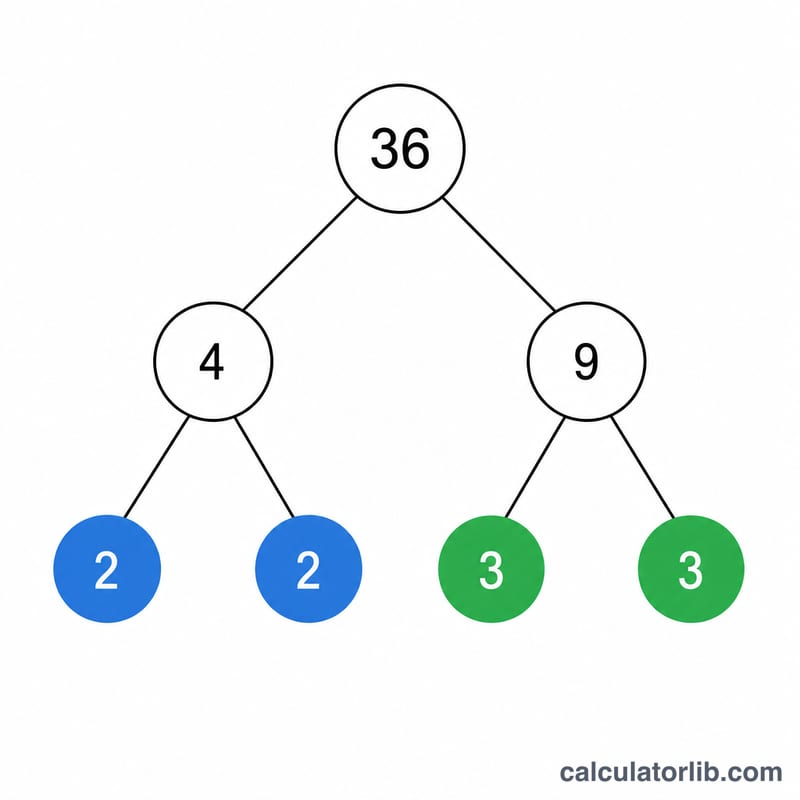
Worked example: N = 36
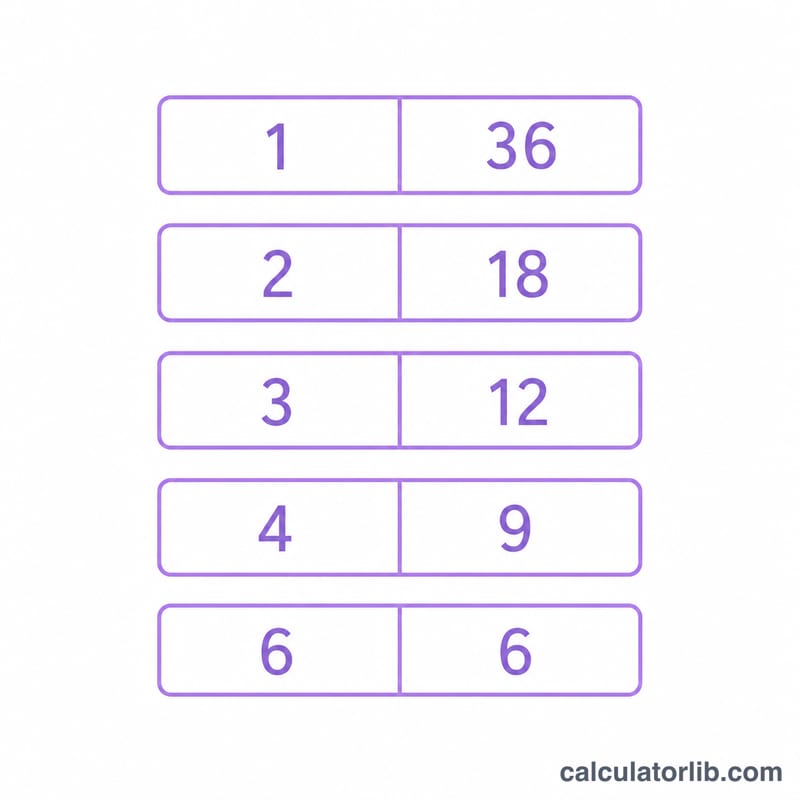
Testing \(d\) from 1 to 6 (the square root of 36) gives the divisor pairs (1, 36), (2, 18), (3, 12), (4, 9) and (6, 6). The full factor list is 1, 2, 3, 4, 6, 9, 12, 18, 36 — that is 9 factors. The prime factorization is $$36 = 2 \times 2 \times 3 \times 3 = 2^2 \times 3^2$$ Because 36 has 9 factors, it is not prime.
FAQ
Is 1 a prime number? No. The number 1 has only a single factor (itself), so it is neither prime nor composite, and it has no prime factors.
What is a factor pair? A factor pair is two numbers that multiply together to give the original number, such as (4, 9) for 36. Each pair lists the smaller value first.
Why does the prime factorization use exponents? Exponent notation like \(2^2 \times 3^2\) is shorthand for \(2 \times 2 \times 3 \times 3\). It is the standard, compact way to express repeated prime factors.