
What this calculator does
This Fractions Calculator performs one arithmetic operation - addition, subtraction, multiplication, or division - on two fractions and returns the answer three ways: as a fraction reduced to lowest terms, as a mixed number, and as a decimal. It works with proper fractions, improper fractions, and negative values. Because it is pure mathematics, it applies identically everywhere.
How to use it
Enter the numerator and denominator of the first fraction, choose the operation from the dropdown, then enter the second fraction. Denominators must be non-zero. Press calculate to see the simplified result. If you divide by a fraction whose numerator is zero, the tool reports that you cannot divide by zero.
The formula explained
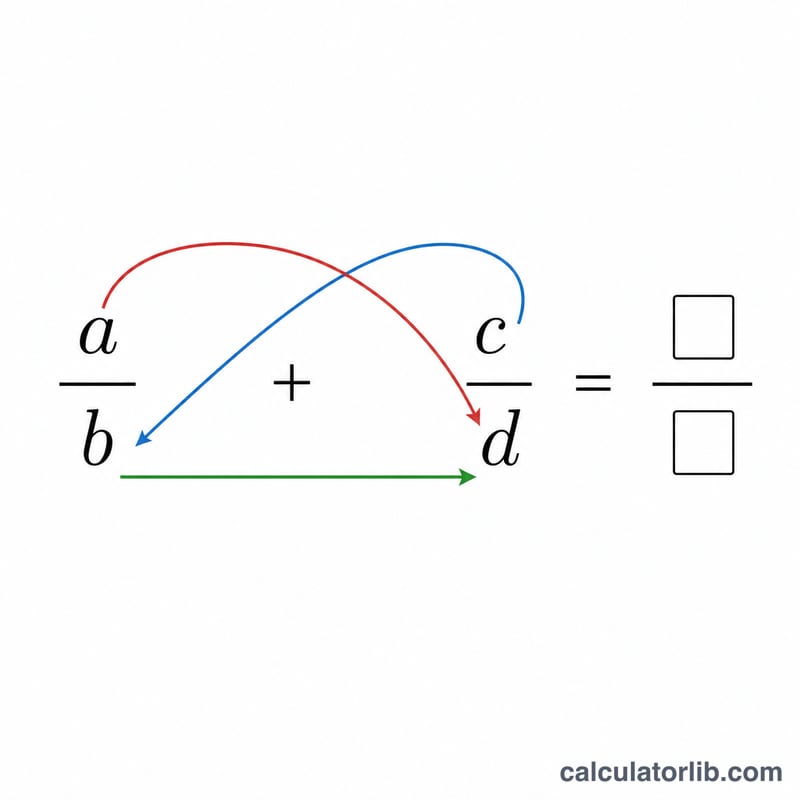
For fractions \(\frac{a}{b}\) and \(\frac{c}{d}\), addition and subtraction use a common denominator:
$$\frac{a}{b} \pm \frac{c}{d} = \frac{a \cdot d \pm c \cdot b}{b \cdot d}$$Multiplication is \(\frac{a \cdot c}{b \cdot d}\), and division multiplies by the reciprocal: \(\frac{a \cdot d}{b \cdot c}\).
$$\frac{a}{b} \times \frac{c}{d} = \frac{a\,c}{b\,d}, \quad \frac{a}{b} \div \frac{c}{d} = \frac{a\,d}{b\,c}$$The raw result is then reduced by dividing the numerator and denominator by their greatest common divisor (GCD), found with the Euclidean algorithm. The sign is normalized so the denominator stays positive.
Worked example
Take \(\frac{7}{4} + \frac{3}{4}\). Using a common denominator:
$$\frac{7 \cdot 4 + 3 \cdot 4}{4 \cdot 4} = \frac{28 + 12}{16} = \frac{40}{16}$$The GCD of 40 and 16 is 8, so \(\frac{40}{16}\) reduces to \(\frac{5}{2}\). As a mixed number that is \(2\frac{1}{2}\), and as a decimal it is \(2.5\).
FAQ
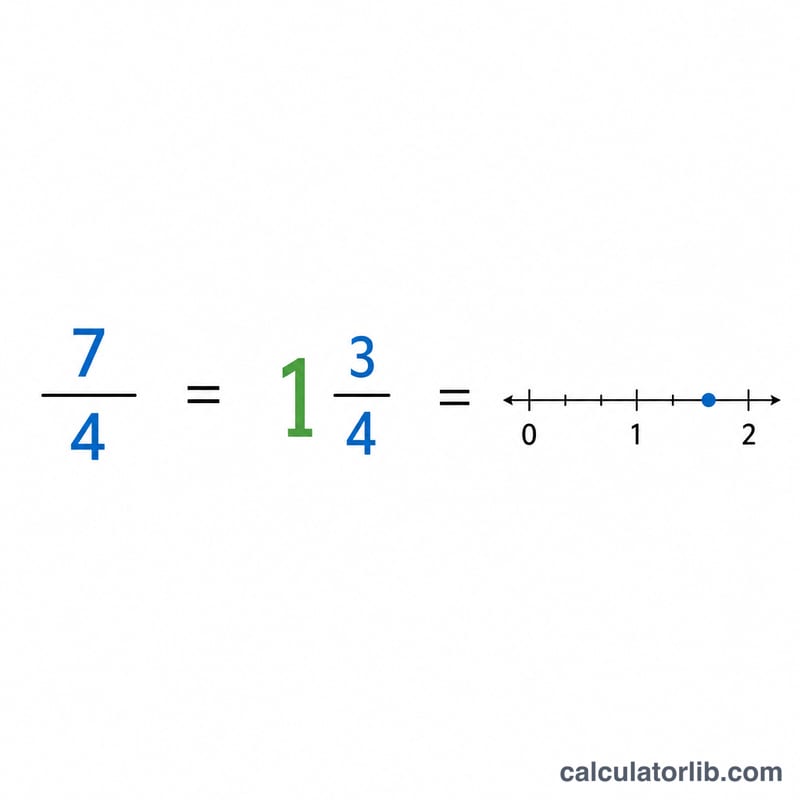
What is a mixed number? A whole number combined with a proper fraction, such as \(2\frac{1}{2}\). When the result has no remainder it shows as a whole number; when its absolute value is below 1 it shows as a plain fraction.
Can I use negative fractions? Yes. Enter a negative numerator or denominator; the calculator resolves the sign onto the numerator and keeps the denominator positive.
Why does my answer differ from mine on paper? The calculator always reduces to lowest terms, so \(\frac{6}{12}\) is shown as \(\frac{1}{2}\). Check whether your version is already simplified.