
What the Fractions to Decimal & Percent Table Calculator Does
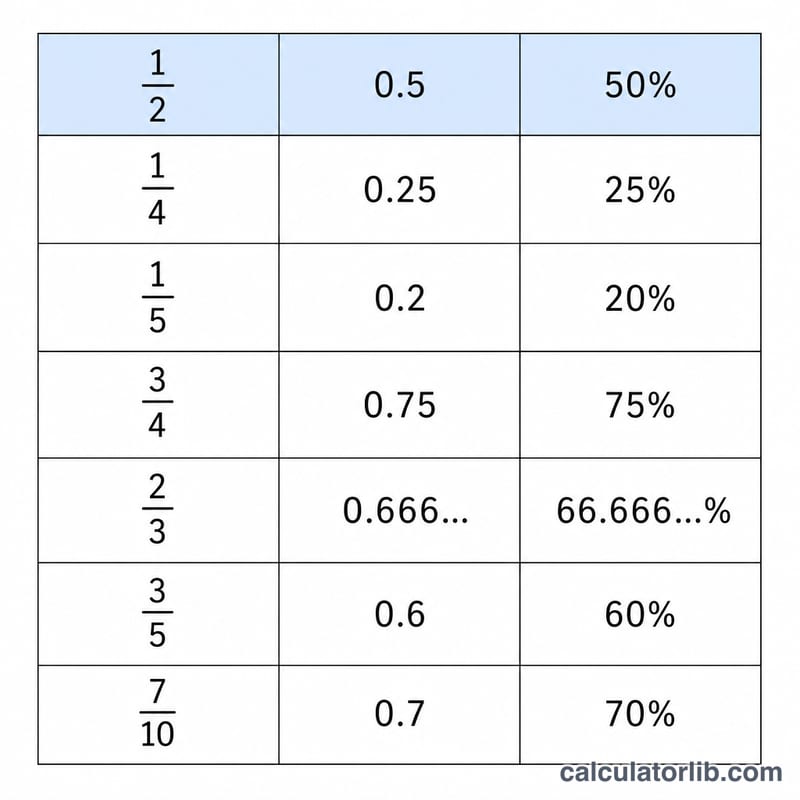
This tool builds a clean reference table that converts simple fractions into their decimal and percentage equivalents. Instead of converting one fraction at a time, it generates every distinct fraction up to a denominator you choose, then shows each value as a rounded decimal and a rounded percent. It is ideal for students learning fraction-decimal-percent relationships, teachers making worksheets, and anyone needing a quick lookup chart.
The Input Fields Explained
- Max denominator – the largest bottom number to include (allowed 2–16, default 16). The table covers fractions \(n/d\) for every denominator from 1 up to this value.
- Decimal places – how many digits to round the decimal column to (0–10, default 5).
- Percent places – decimal precision for the percent column (0–6, default 2).
- Min value and Max value – the range of values to display (default 0 to 1). If max is smaller than min, the calculator swaps them automatically.
The Formula and Behaviour
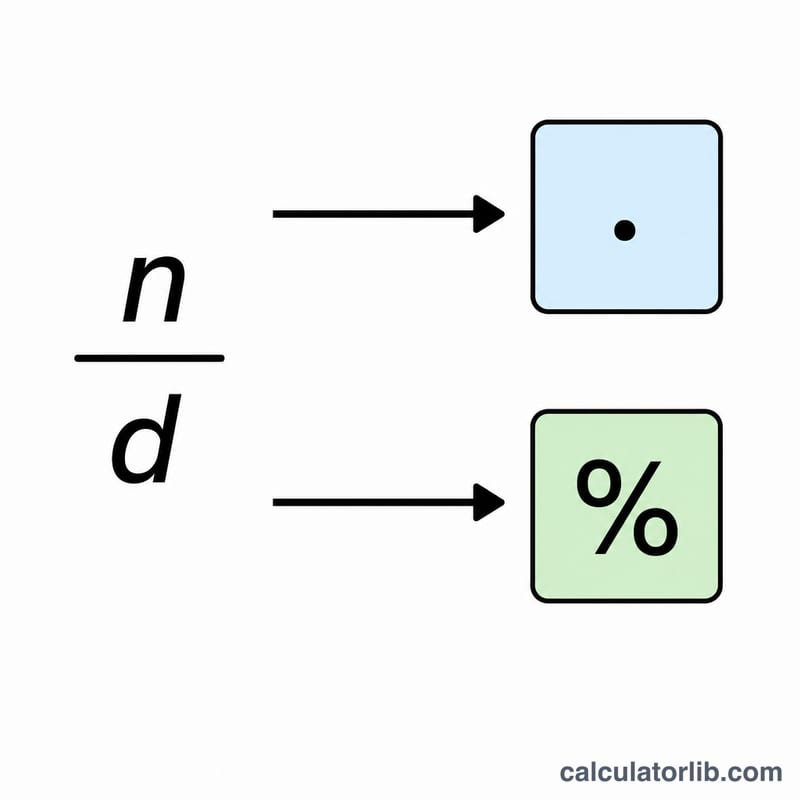
For every denominator \(d\) (1 to your max) and every numerator \(n\) (0 to \(d\)), the calculator computes the value \(v = n \div d\). It keeps only values inside your min–max range. Equal values produced by different fractions (for example 1/2, 2/4 and 8/16) are grouped together, so the table lists each unique value once while remembering all the fractions that produce it.
Each row is then displayed as:
- Decimal \(= \operatorname{round}(v \times 10^{dp}) \div 10^{dp}\)
- Percent \(= \operatorname{round}(v \times 100 \times 10^{pp}) \div 10^{pp}\)
Worked Example
Suppose you set Max denominator = 4, Decimal places = 4, Percent places = 2, Min = 0 and Max = 1. The unique values found are 0, 1/4, 1/3, 1/2, 2/3, 3/4 and 1. Taking 3/4: the decimal is $$3 \div 4 = 0.7500,$$ and the percent is $$0.75 \times 100 = 75.00\%.$$ For 1/3, the decimal rounds to \(0.3333\) and the percent to \(33.33\%\). The value 1/2 is also matched by 2/4, so both forms are grouped into a single row.
Frequently Asked Questions
Why are some fractions missing from the table? Equivalent fractions are merged. 2/4 does not get its own row because it equals 1/2; the calculator shows the value once.
Can I show values above 1? Yes. Raise the Max value field — for example set it to 2 to include whole numbers and improper-fraction values.
Why is the maximum denominator capped at 16? Limiting denominators keeps the table to common, readable fractions and prevents an unwieldy list of hundreds of near-duplicate values.