
What this calculator does
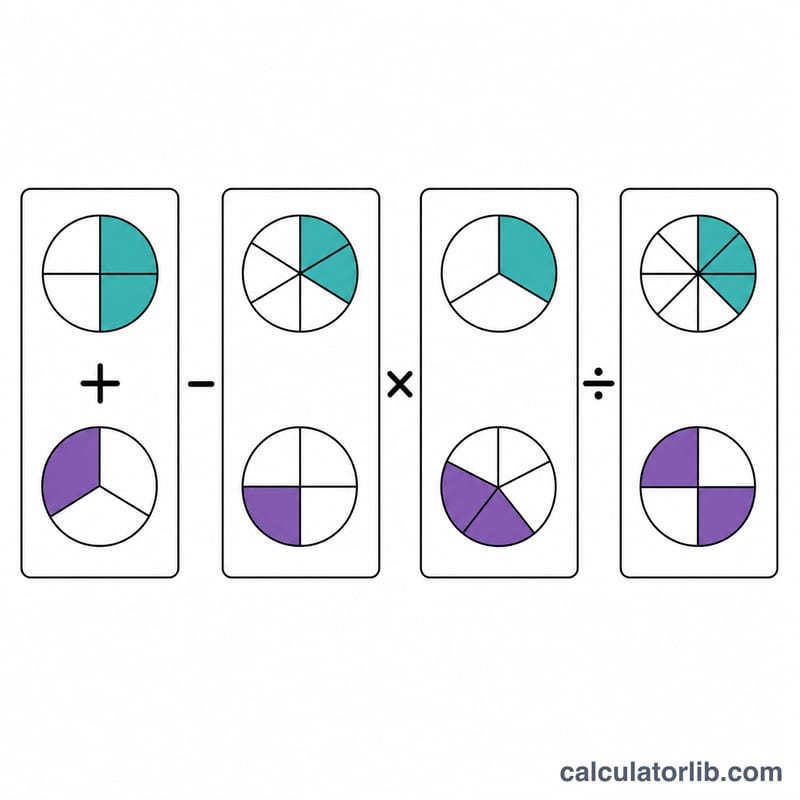
This Fractions Calculator adds, subtracts, multiplies and divides two fractions, and can also compute a fraction "of" another (the same as multiplying). After the arithmetic it automatically reduces the answer to lowest terms, rewrites it as a mixed number where appropriate, and gives the decimal value plus a full step-by-step solution so you can follow exactly how the result was obtained.
How to use it
Enter the numerator and denominator of the first fraction, choose the operation (add, subtract, multiply, divide, or "of"), then enter the second fraction. Negative numerators are allowed; the sign is carried on the numerator and the denominator is always normalized to a positive value. Denominators must not be zero, and you cannot divide by a fraction equal to zero.
The formulas
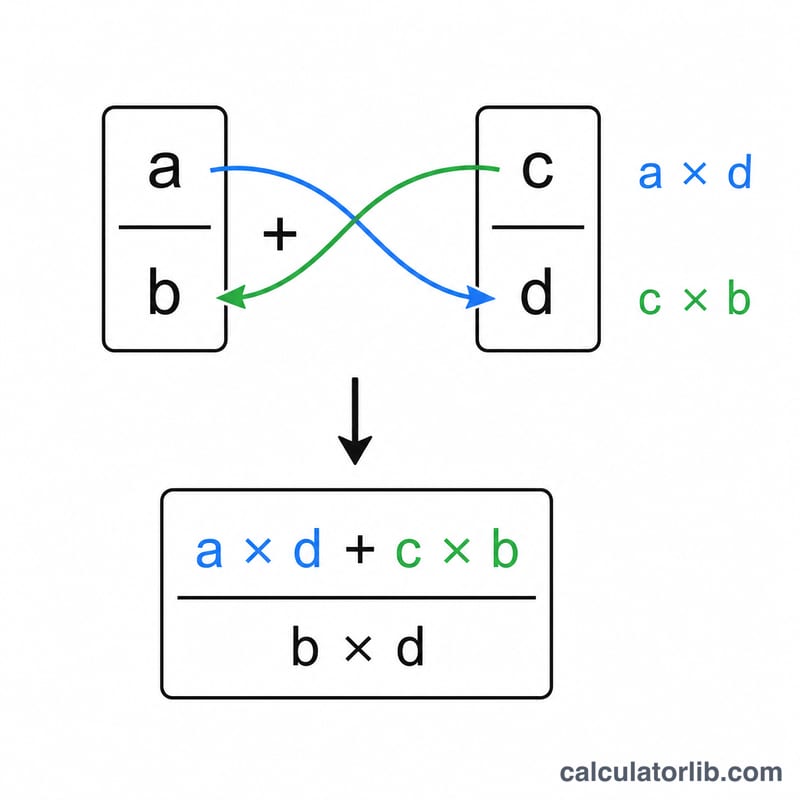
For fractions \(a/b\) and \(c/d\): addition and subtraction use a common denominator,
$$\frac{a}{b} \pm \frac{c}{d} = \frac{a\,d \pm c\,b}{b\,d}$$Multiplication and division give:
$$\frac{a}{b}\times\frac{c}{d}=\frac{a\,c}{b\,d}, \quad \frac{a}{b}\div\frac{c}{d}=\frac{a\,d}{b\,c}$$Division multiplies the first fraction by the reciprocal of the second. The raw result is then reduced by dividing the numerator and denominator by their greatest common divisor (GCD), found with Euclid's algorithm.
Worked example
Compute \(-3/4 + -5/8\). The common denominator is \(4\times 8 = 32\), so the numerator is
$$(-3)(8) + (-5)(4) = -24 - 20 = -44$$giving \(-44/32\). The GCD of 44 and 32 is 4, so the reduced fraction is \(-11/8\). As a mixed number that is \(-1\tfrac{3}{8}\), and as a decimal \(-1.375\).
FAQ
What does "of" mean? "A of B" means a fraction of another quantity, such as "1/2 of 3/4", which is mathematically identical to multiplication.
Why is the answer reduced automatically? Lowest-terms form is the standard way to express a fraction, so 4/6 is shown as 2/3.
Can I use negative fractions? Yes. Enter a negative numerator; the calculator carries the sign and always keeps the denominator positive.