
What this calculator does
This tool finds the average (arithmetic mean) of a list of values that may include simple fractions, improper fractions, mixed numbers and plain integers. Instead of giving you a rounded decimal, it returns an exact, fully reduced fraction and shows every step of the work, so it doubles as a learning aid for fraction arithmetic.
How to use it
Type your values into the box, separated by commas. Each value can be an integer like 3 or -5, a fraction like 1/2 or 9/12, or a mixed number like 3 5/8 (put a space between the whole part and the fraction). A leading minus sign negates the entire value. Press calculate to see the average and its decimal approximation.
The formula explained
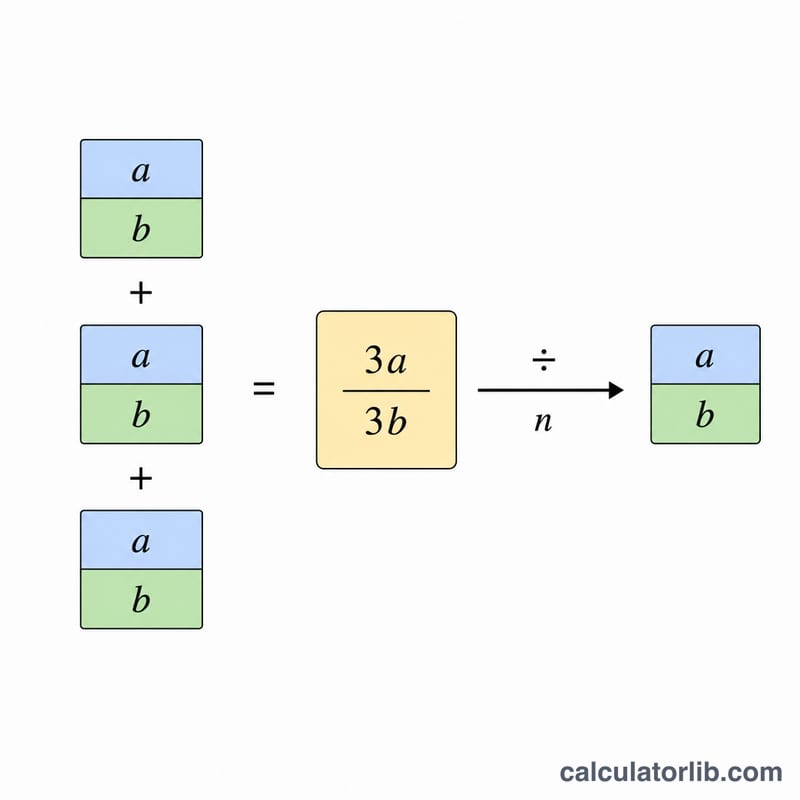
First, every value is converted to an improper fraction. The calculator finds the least common denominator (LCD), which is the LCM of all the denominators, then rewrites each fraction over that LCD. The rewritten numerators are summed to give S, so the total of the inputs is S / LCD. Dividing by the number of values n gives the mean: $$\bar{x} = \frac{S}{\text{LCD}\cdot n}$$ Finally the fraction is reduced by its greatest common divisor (GCD).
Worked example
For 1, 1/2, 3/4, 9/12, 3 5/8, -12/16 the improper fractions are \(\frac{1}{1}, \frac{1}{2}, \frac{3}{4}, \frac{9}{12}, \frac{29}{8}, -\frac{12}{16}\), so \(n = 6\). The LCD is 48. Over 48 these become 48, 24, 36, 36, 174, -36, which sum to 282, giving $$\frac{282}{48} = \frac{47}{8}.$$ Dividing by 6 gives \(\frac{47}{48} \approx 0.97917\).
More Worked Examples
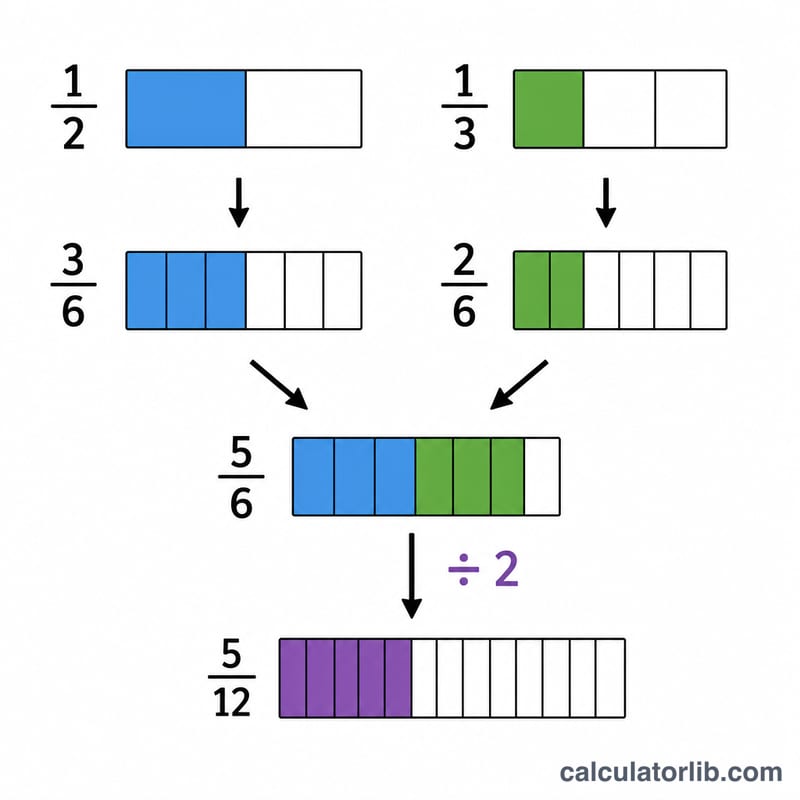
Each example follows the same four steps: find the least common denominator (LCD), rewrite every fraction over the LCD and add the numerators, divide that sum by the count \(n\), then reduce the result to simplest form.
Example 1 — Three simple fractions: \(\tfrac13,\ \tfrac16,\ \tfrac14\)
- LCD. The denominators are 3, 6 and 4. The least common multiple of 3, 6 and 4 is 12.
- Rewrite and sum. \(\tfrac13=\tfrac{4}{12}\), \(\tfrac16=\tfrac{2}{12}\), \(\tfrac14=\tfrac{3}{12}\). The sum is \(\tfrac{4+2+3}{12}=\tfrac{9}{12}\).
- Divide by \(n=3\). \(\dfrac{9/12}{3}=\dfrac{9}{36}\).
- Reduce. \(\gcd(9,36)=9\), so \(\tfrac{9}{36}=\tfrac{1}{4}\).
Average \(=\tfrac14=0.25\).
Example 2 — Negative mixed numbers: \(-1\tfrac12,\ -2\tfrac34\)
- Convert to improper fractions. \(-1\tfrac12=-\tfrac32\) and \(-2\tfrac34=-\tfrac{11}{4}\).
- LCD. Denominators 2 and 4 give LCD \(=4\). Rewrite: \(-\tfrac32=-\tfrac{6}{4}\), \(-\tfrac{11}{4}\) stays. Sum \(=\tfrac{-6-11}{4}=-\tfrac{17}{4}\).
- Divide by \(n=2\). \(\dfrac{-17/4}{2}=-\dfrac{17}{8}\).
- Reduce / convert. \(\gcd(17,8)=1\), already reduced. As a mixed number \(-\tfrac{17}{8}=-2\tfrac18\).
Average \(=-\tfrac{17}{8}=-2.125\).
Example 3 — Integers mixed with an improper fraction: \(2,\ 5,\ \tfrac72\)
- Write everything as fractions. \(2=\tfrac21\), \(5=\tfrac51\), and \(\tfrac72\).
- LCD. Denominators 1, 1 and 2 give LCD \(=2\). Rewrite: \(\tfrac21=\tfrac42\), \(\tfrac51=\tfrac{10}{2}\), \(\tfrac72\). Sum \(=\tfrac{4+10+7}{2}=\tfrac{21}{2}\).
- Divide by \(n=3\). \(\dfrac{21/2}{3}=\dfrac{21}{6}\).
- Reduce. \(\gcd(21,6)=3\), so \(\tfrac{21}{6}=\tfrac72=3\tfrac12\).
Average \(=\tfrac72=3.5\).
Key Terms Explained
- Arithmetic mean (average)
- The sum of all the values divided by how many values there are: \(\bar{x}=\frac1n\sum_{i=1}^{n}x_i\). For fractions this means adding them all together and dividing the total by the count \(n\).
- Numerator
- The top number of a fraction \(\tfrac{a}{b}\); it counts how many equal parts are taken.
- Denominator
- The bottom number \(b\) of a fraction \(\tfrac{a}{b}\); it states how many equal parts the whole is divided into. It cannot be zero.
- Improper fraction
- A fraction whose numerator is greater than or equal to its denominator, such as \(\tfrac72\). Its value is at least 1, and it can be rewritten as a mixed number.
- Mixed number
- A whole number combined with a proper fraction, such as \(2\tfrac34\). It equals \(\tfrac{2\cdot4+3}{4}=\tfrac{11}{4}\) when converted to an improper fraction.
- Least common denominator (LCD)
- The smallest positive number that every denominator divides into evenly — i.e. the least common multiple of the denominators. It lets you rewrite all fractions over one shared denominator so they can be added.
- Least common multiple (LCM)
- The smallest positive integer that is a multiple of each of two or more numbers. The LCD of a set of fractions is exactly the LCM of their denominators.
- Greatest common divisor (GCD)
- The largest positive integer that divides two numbers without a remainder (also called GCF or HCF). Dividing a fraction's numerator and denominator by their GCD reduces it.
- Reduced (simplest) form
- A fraction is in simplest form when its numerator and denominator share no common factor other than 1 — that is, \(\gcd(a,b)=1\). For example \(\tfrac{9}{36}\) reduces to \(\tfrac14\).
FAQ
Can I mix fractions and whole numbers? Yes — integers, fractions and mixed numbers can all appear in the same list.
How do I enter a negative mixed number? Write -2 1/4; the minus negates the whole value, giving \(-\frac{9}{4}\).
Why a fraction instead of a decimal? Fractions are exact and avoid rounding error; the decimal shown is only an approximation.