
What this calculator does
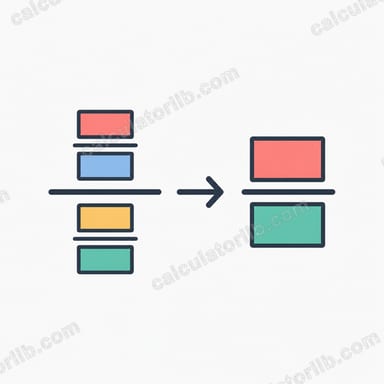
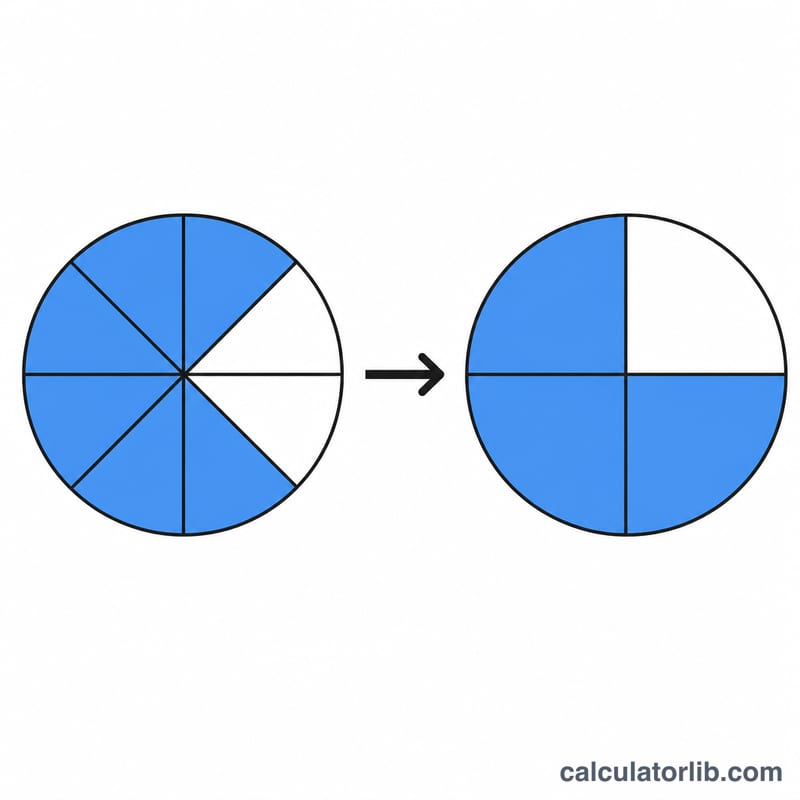
The Simplifying Fractions Calculator reduces any fraction to its lowest terms and, when the fraction is improper, also rewrites it as a mixed number. It works with positive and negative integers and shows the full working: the greatest common factor (GCF) used to reduce, the long-division step, and the final result. This is a universal mathematics tool with no country-specific rules.
How to use it
Enter a whole-number numerator (top) and a non-zero whole-number denominator (bottom), then read the result. Negative values are allowed in either box; the calculator extracts the overall sign, works with the magnitudes, and re-applies the sign to the answer. If you enter 0 as the denominator the fraction is undefined.
The formula explained
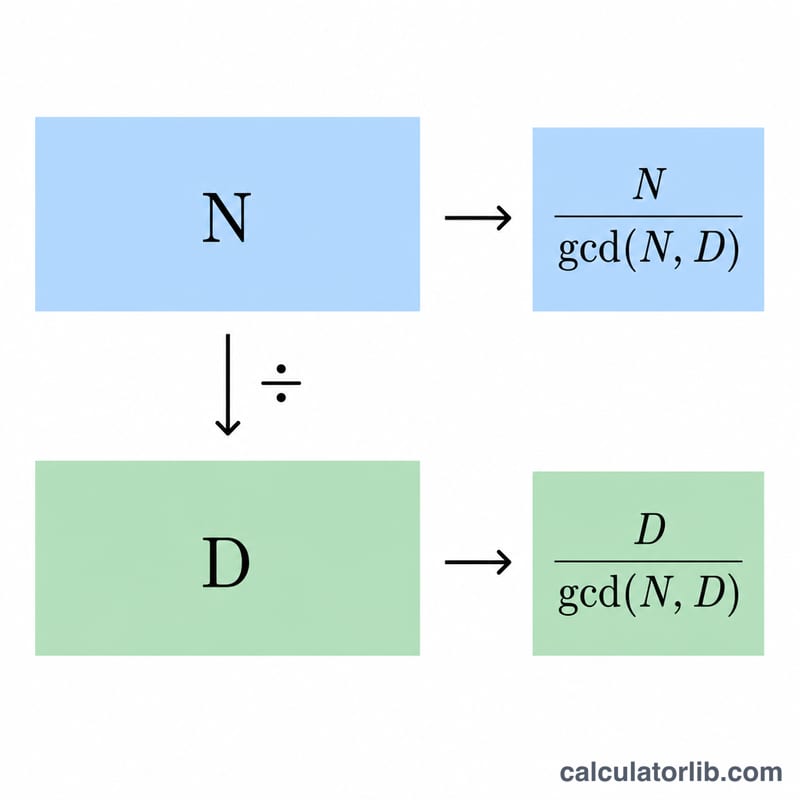
To reduce a fraction, divide both the numerator N and denominator D by their greatest common factor, found with the Euclidean algorithm: repeatedly replace \((a, b)\) with \((b, a \bmod b)\) until \(b\) is 0; the remaining \(a\) is the GCF. Dividing both parts by the GCF gives the lowest-terms fraction:
$$\frac{\text{Numerator}}{\text{Denominator}} = \frac{\text{Numerator} \div g}{\text{Denominator} \div g}, \quad g = \gcd\!\left(\text{Numerator},\, \text{Denominator}\right)$$
If that reduced fraction is improper (numerator at least as large as the denominator), it converts to a mixed number: the whole part is the integer quotient \(q = \lfloor a / b \rfloor\) and the remainder \(r = a - q \cdot b\) becomes the numerator of the leftover proper fraction.
Worked example
Take \(45/10\). The GCF of 45 and 10 is 5, so \(45/10\) reduces to \(9/2\):
$$\frac{45}{10} = \frac{45 \div 5}{10 \div 5} = \frac{9}{2}$$
Since 9 is greater than 2, this is improper: 9 divided by 2 is 4 with a remainder of 1, giving the mixed number \(4\tfrac{1}{2}\). The calculator displays the reduced fraction \(9/2\) and the mixed number \(4\tfrac{1}{2}\) along with these steps.
FAQ
What if the fraction is already in lowest terms? The GCF is 1 and the fraction is returned unchanged (an improper one is still converted to a mixed number).
How are negatives handled? The sign is carried on the numerator (or the whole number of a mixed result), e.g. \(-14/3\) becomes \(-4\tfrac{2}{3}\).
What happens with whole-number results? If the remainder is 0, such as \(10/5 = 2\), the answer is shown as a single integer with no fractional part.